
In most commercial buildings, hot water is treated as a background utility—necessary but rarely analyzed. Facility managers will negotiate electricity prices, upgrade HVAC, or optimize lighting, but they almost never evaluate domestic hot water (DHW) as a major cost center.
When we convert DHW consumption into actual energy demand, a different picture appears: hot water can be the second-largest or even the primary source of energy expense, especially in hotels, hospitals, laundries, factories, and worker camps.
Commercial solar hot water systems do not create comfort; they create financial outcomes. They turn repeated energy purchases into a fixed, predictable asset that produces heat every day the sun rises.
If you manage a hotel, hospital, laundry, or student residence, your DHW cost is not theoretical. Tell us your daily hot water volume and current energy source—we will calculate your real annual savings and payback.
1.1 Hot Water Is the Invisible Cost Center
Users see electricity and gas bills every month. Hot water hides behind fuel consumption, boiler runtime, and power demand.
Take a typical mid-size European hotel:
- 60–100 rooms
- Average 3,000–6,000 L/day DHW
- Incoming water temperature 10–15°C
- Setpoint 50–55°C
Heating 1,000 L of water by 35°C requires roughly 122 kWh of thermal energy. This means:
Daily Energy
366–732 kWh per day for 3–6 tons DHW
Annual Load
133,590–267,390 kWh per year
Before we add: Kitchen load, Laundry, Staff showers, SPA, Pool preheating.
Hospitals increase demand further—sterilization, laundry, equipment wash, patient bathing—with zero seasonality.
If you know how many rooms or beds your facility has, we can estimate your thermal load within 3–5% accuracy. Send us your room count, region, and energy source—we will size the system for you.
1.2 How Solar Thermal Works in Commercial Buildings
Solar thermal is not “a panel on the roof.” It is a controlled thermodynamic process:
- Solar radiation penetrates low-iron glass
- A selective absorber converts photons into heat
- Fluid circulates through copper or aluminum risers
- Heat transfers to DHW storage
- Users consume hot water
The challenge is not absorption—it is stability:
- Variable irradiation
- Scaling and cavitation
- Temperature cycling
- Stagnation
- Night backflow
- Control logic
A correctly engineered solar DHW system does not chase peak temperature. It functions like a silent base-load heater, delivering 50–80% of annual DHW energy reliably.
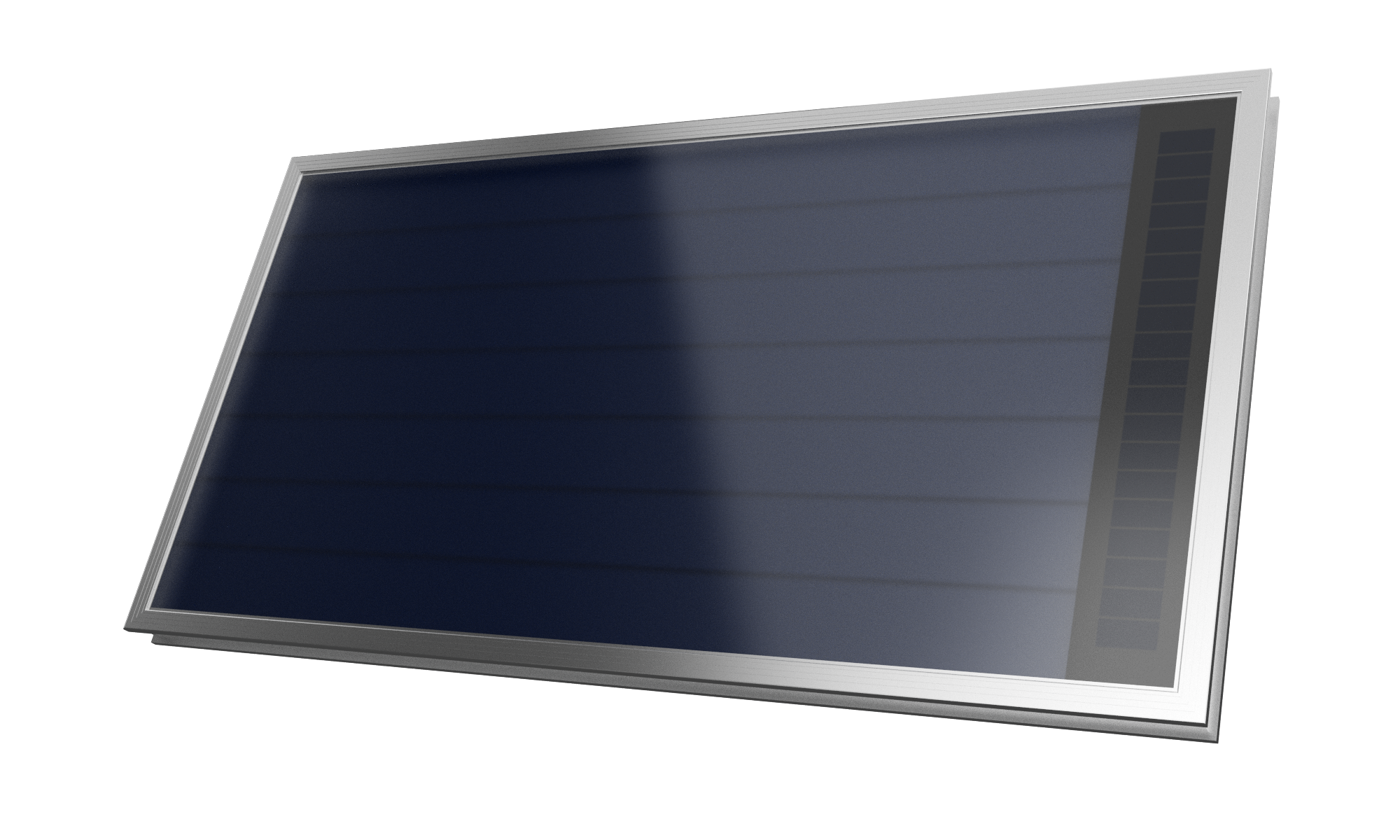
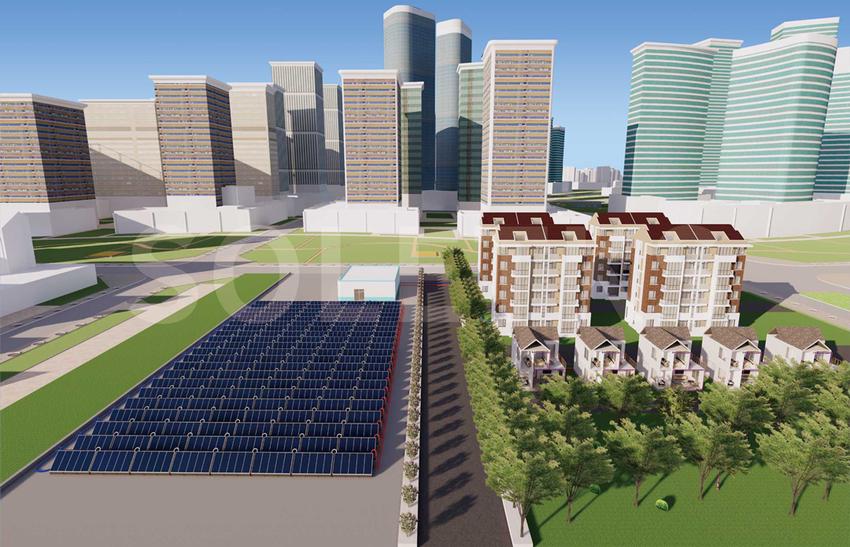
1.3 Flat Plate vs Vacuum Tube — What Works in Real Projects
Residential buyers often debate collector types emotionally. Engineers evaluate by lifetime performance and system stability.
| Aspect | Vacuum Tube | Flat Plate |
|---|---|---|
| Peak Output | High, rapid heat gain | Stable in practical ranges |
| Durability | Glass fragility, seal degradation | No single-point failure |
| Temperature | Uneven gradients, stagnation | Predictable hydraulics |
| Maintenance | High service costs | Easy maintenance |
| Efficiency/m² | Variable | High surface efficiency |
Commercial clients do not pay for sunlight spikes. They pay for repeatable 45–60°C delivery every single day.
1.4 System Architecture: Why Commercial Solar Thermal Is Not “Panels + Tank”
A real system is a hydraulic architecture, not a shopping list.
4.1 Direct Systems (Single Loop)
The collector fluid is potable water. Low complexity, low cost, high scaling risk, not suitable for heavy loads.
4.2 Indirect Systems (Closed Loop)
The collector fluid is antifreeze (glycol). Heat is exchanged into the DHW loop. Modern standard for hotels, hospitals, schools.
4.3 Dual-Tank Strategy
Buffer tank collects solar energy. Consumption tank stabilizes output. Decouples collection from delivery.
4.4 Return Circulation
Constant return line, temperature maintenance, anti-thermal shock, night bypass logic. Prevents cold tap delays.
If you know your peak demand (rooms, beds, washing cycles), we can determine your tank strategy and collector configuration. Send capacity and region—we will return a system draft.
1.5 Control Logic: Where 80% of Failures Happen
Solar thermal systems do not fail because glass breaks. They fail because the control layer is poor.
5.1 Energy Priority
Correct order: Solar → Heat pump → Boiler
- Solar handles baseline demand
- Heat pump finishes the lift to 60–70°C
- Boiler is emergency
Any other order = wasted money.
5.2 Anti-stagnation
Collectors exposed to >180–200°C without flow will:
- Burn glycol
- Crack gaskets
- Damage coatings
- Destroy pumps
5.3 Night backflow
Poor systems cool tanks at night. Better systems never let heat run upward to the roof.
The performance difference is dramatic: 20–35% across the lifecycle.
1.6 Material Integrity and Lifecycle Reality
Commercial systems don’t run for “three sunny months.” They run every day for 10–15 years.
Tanks
SUS304 / SUS316L or enamel, 50–70 mm insulation, magnesium rods, heat exchangers
Collectors
Low-iron tempered glass, selective absorber, copper/aluminum risers, EPDM outdoor sealing
Pumps
Glycol-rated, anti-cavitation, variable flow support
A system is not a photo—it is years of hydraulic stress, thermal cycling, and user complaints.
1.7 Why Commercial Loads Are the Sweet Spot
Residential use is intermittent. Commercial DHW is constant.
- Showers
- Laundry
- Kitchen
- Staff facilities
- Medical sterilization
Every kilowatt-hour of heat is consumed. No export. No curtailment. Just savings.
Solar thermal excels because hot water demand never “pauses.”
If your facility consumes DHW every day, you are already paying for fuel. Send us your DHW load and energy price—we will show you how much you could keep.
1.8 ROI: Real Numbers Instead of Marketing
Most industries still underestimate solar thermal because they only know PV.
PV has export issues. Solar heat does not.
Solar DHW → direct fuel replacement:
- No net-metering negotiations
- No grid dependency
- No battery cost
- No curtailment
- No energy loss at night
Typical Performance
60–80% annual hot water coverage
Payback Period
Europe: extremely stable payback due to high tariffs + DHW consistency.
1.9 Procurement Mindset
Buying “cheap solar hardware” is not a strategy. Buying an engineered system is.
Correct procurement includes:
- Collector sizing
- Tank strategy
- Hydraulic integration
- Circulation design
- Backup logic
- Commissioning
- O&M plan
Hotels and hospitals cannot afford stoppage. A failed system costs more than no system at all.
Let Us Model Your Building
Tell us 4 things: Building type, Daily hot water volume (L/day), Current energy source, City/Region
Get Your Custom AnalysisConclusion — Solar DHW Is a Financial Instrument
Commercial solar hot water is not a sustainability gesture. It is predictable cashflow: every kWh of heat produced is a kWh not purchased from the grid or a fuel vendor.
It protects boilers, reduces compressor load, stabilizes expenses, and increases asset value. Its performance depends on engineering—not slogans.
Action Hook — Let Us Model Your Building
Tell us 4 things:
- Building type (hotel/hospital/laundry/school)
- Daily hot water volume (L/day)
- Current energy source (electric/gas/diesel)
- City/Region
We will run your parameters and return:
- System configuration
- Annual savings
- Realistic payback
- Collector & tank sizing
Email Contact
We design commercial systems that work, not catalogs. Our engineering team will provide you with a detailed analysis within 48 hours, including system configuration, ROI calculation, and implementation roadmap.