
Commercial Direct vs Indirect Solar Heating Systems: Which Loop Fits Your Project?
Commercial direct vs indirect solar heating systems guide for freeze risk, water quality, drainback options, heat exchangers, service cost, and RFQs.
Von der Das SOLETKS-Entwicklungsteam — die Sparte für gewerbliche Solarthermie bei einem der fünf weltweit führenden Hersteller von Flachkollektoren mit Über 117 Patente und Über 160 Prüfschritte während des Fertigungsprozesses. We have designed direct and indirect commercial solar heating loops from the Florida coast (USA) through Beijing (−10 °C winter) an die Saga County centralized heating plant at 4,000+ m altitude in Tibet — the world’s first high-altitude centralized solar heating project (107,000 m², avoiding 2,424 tonnes of coal per year), where design minimum is below −20 °C.
TL;DR – Kurze Antwort
Commercial direct vs indirect solar heating systems should be selected by 7 factors, in this order:
- Freeze risk (site design minimum temperature)
- Water quality (hardness, chloride, pH)
- Pressure boundary requirements
- Potable-water isolation rules
- Heat-exchanger duty and service access
- Available maintenance skill level
- Downtime tolerance / business cost of failure
Direct = simpler but exposed. Choose direct only when the collector loop can safely carry project water without freezing, scaling, contamination, or pressure conflict.
Indirect = controlled but more components. Choose indirect when the project needs glycol, heat-exchanger separation, potable-water isolation, or a cleaner service boundary.
Drainback = a third option. A certified drainback design with verified slope and freeze controls can carry direct water through cold sites — but requires owner acceptance of residual risk.
Das Wichtigste auf einen Blick:
- Direct systems are simpler but expose collectors and roof piping to project water.
- Indirect systems add pumps and heat exchangers but control freeze risk and fluid quality.
- Closed loops need annual fluid testing (pH, freeze point, color, pressure).
- Commercial buyers should specify loop type before comparing collector prices — collector cost is irrelevant if the loop type is wrong.
Die Solar-Warmwassersystem für Gewerbe und Industrie is the right starting point when the buyer needs engineered collectors, storage, circulation, controls, and backup heat — rather than a stand-alone heater.[1]
1. Direct, Indirect, and Drainback — Three Options, Not Two
A direct solar heating system sends the same water through the collector and the storage or use loop. An indirect system separates the collector loop from the water loop through a heat exchanger. A drainback system is a special case of direct circulation where the collector loop water drains into a reservoir when the pump stops — so the collectors are empty (and freeze-safe) at night and during low-radiation periods.
The U.S. Department of Energy notes that solar water heaters use direct circulation in non-freezing climates and indirect circulation where heat-transfer fluid and a heat exchanger protect the system.[2] ASHRAE’s HVAC Applications Handbook (Service Water Heating chapter) treats this same direct/indirect/drainback architecture decision as a safety + reliability boundary, not a cost question.[9]
| Projektstatus | Direct system | Indirect system | Drainback system |
|---|---|---|---|
| Minimale Außentemperatur | Above freezing, low freeze risk | Any climate (including <−20 °C) | Above freezing OR verified drainback with sloped piping |
| Water quality | Low scaling, low corrosion | Hard water, chloride, treated loop OK | Same as direct, but reservoir water can be treated |
| Potable separation | Not required by design | Required or preferred | Possible, depends on tank arrangement |
| Heat-transfer fluid | Water | Glycol or treated fluid | Water (with anti-corrosion treatment in reservoir) |
| Komponenten | Simplest | +1 heat exchanger, +pump, +expansion tank | +drainback reservoir, +control logic |
| Maintenance | Simplest path | Fluid testing + HX cleaning required | Verify drain slope + reservoir check annually |
| Optimale Verwendung | Warm-climate preheat, simple plants | Hotels, hospitals, campuses, cold climates | North American cold-climate residential and small commercial |
The decision is nicht a debate about which system is more modern. It is a risk boundary. Direct circulation reduces components; indirect circulation reduces exposure.
2. Climate Map — What Real SOLETKS Projects Use
Loop selection is largely determined by climate band + water quality. Below is what we have actually deployed across 5 climate bands:
| Klimazone | Design minimum | SOLETKS reference project | Loop selected | Warum |
|---|---|---|---|---|
| Subtropical / coastal | > +5 °C | Florida resort villas (USA, 2022, 200 L/day per villa) | Direct (with anti-freeze controller) | Florida winter design rarely drops below freezing; direct circulation is cheaper to install and service per villa. |
| Temperate Atlantic | −5 bis −10 °C | Harz church (Germany, 2021, 22 t/day) | Indirect glycol | German cold snaps can freeze a direct water loop overnight; glycol concentration sized for −15 °C. |
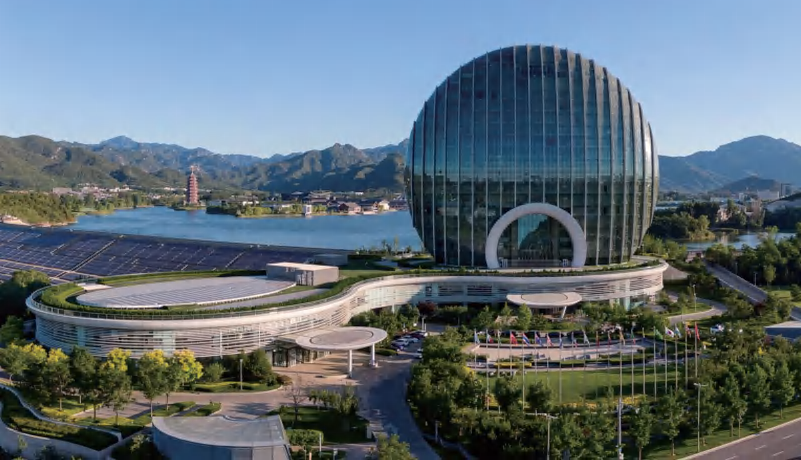
| Continental cold | −10 bis −15 °C | APEC-Gipfelhotel (Peking, 2014, 50 t/Tag, 150.000 kWh/Jahr eingespart) | Indirect glycol | Beijing winter design ~−12 °C; the project value of 50 t/day hotel demand made downtime exposure unacceptable. |
| Continental + PVT hybrid | −10 °C | PVT Pro+ an einer Schule in Tianjin (2024, 3.000 m²) | Indirect (heat + electricity from PVT) | Combined heat + power requires fluid-side isolation to protect the electrical generation circuit from water-quality risk. |
| Alpine / plateau | < −20 °C | Saga County centralized heating (Tibet, 2019, 107,000 m², 2,424 t coal/yr avoided) | Indirect glycol with deep concentration | At 4,000+ m altitude, atmospheric pressure reduces glycol freeze-point margin; concentration and expansion tank sized accordingly. The world’s first high-altitude solar centralized heating plant. |
Feldregel: if the lowest 1-in-10-year overnight minimum at the project site is below +5 °C, treat indirect as the default and require an engineering justification to deviate (e.g., proven drainback design with sloped piping and owner sign-off on residual risk).
3. Direct vs Indirect Decision Tree
For commercial buyers and engineers, this decision tree narrows the loop selection in under 5 minutes:
[Start: project location and water source known]
        │
        ▼
┌─────────────────────────────────────────────────┐
│ 1. Site design minimum temperature?             │
└─────────────────────────────────────────────────┘
        │
        ├─ > +5 °C all year → continue (direct possible)
        │
        ├─ Freezing risk a few nights/year
        │       └─→ Drainback OR indirect glycol
        │
        └─ Regular sub-zero / sub-freezing
                └─→ INDIRECT GLYCOL (mandatory)
                       │
                       └─→ Go to step 4
        │
        ▼
┌─────────────────────────────────────────────────┐
│ 2. Water hardness (CaCO₃)?                      │
└─────────────────────────────────────────────────┘
        │
        ├─ < 100 mg/L (soft)        → Direct acceptable
        ├─ 100–250 mg/L (moderate)  → Direct with descaling, or indirect
        └─ > 250 mg/L (hard)        → INDIRECT (collector scaling risk too high)
        │
        ▼
┌─────────────────────────────────────────────────┐
│ 3. Potable-water boundary required?             │
└─────────────────────────────────────────────────┘
        │
        ├─ Yes (hospital, food, code requires)
        │       └─→ INDIRECT (cleaner certification path)
        │
        └─ No → Direct still acceptable
        │
        ▼
┌─────────────────────────────────────────────────┐
│ 4. Maintenance capability available?            │
└─────────────────────────────────────────────────┘
        │
        ├─ Skilled in-house team OR annual contractor
        │       └─→ Indirect glycol OK
        │
        └─ Limited / no maintenance plan
                └─→ Direct (if climate allows)
                    OR drainback with simple reservoir check
        │
        ▼
       [Output: Direct / Indirect / Drainback]
Dienstvorschrift: if any one of “freezing climate”, “hard water”, or “potable boundary” is true → indirect is the default. Do not let RFQ negotiation soften this rule — the first freeze event or scaling failure typically costs more than the entire indirect-system upcharge.
4. Freeze-Risk Decision Calculation
The simplest commercial calculation is nicht collector count — it is whether the loop survives the coldest operating night.
Quellenangabe: this is a screening rule for loop selection; final freeze design must use local design temperature, fluid supplier data, and code requirements.[2]
Beispiel-Eingabe
| Parameter | Wert |
|---|---|
| Site winter design minimum | −8 °C |
| Roof pipe exposure | 18 m supply + return |
| Collector loop fluid option | Water OR propylene glycol |
| Building downtime cost | 1,200 USD/day |
| Repair downtime after freeze split | 3 days |
| Annual glycol test + service allowance | 450 USD/year |
Formel
Freeze-loss exposure = downtime cost × repair days
Ersetzung
Freeze-loss exposure = 1,200 × 3   = 3,600 USD per event
Indirect service     =                450 USD/year
Break-even           = 3,600 / 450 ≈ 8 years
Empfehlung: at −8 °C, use an indirect glycol loop because the first freeze event costs about 8 years of baseline glycol service allowance. A direct water loop should be rejected at this site unless it has:
- A certified drainback design
- Verified slope on every horizontal pipe run
- Freeze controls (anti-freeze cycling)
- Owner written acceptance of residual risk
Field observation (APEC Summit hotel, Beijing, 2014): the original RFQ briefly considered a direct loop “with drainback” to reduce installed cost by ~12%. The engineering team rejected it because Beijing’s combined winter humidity and intermittent dust events made reliable drainback verification impractical at hotel-scale roof complexity. After 10+ years of operation, this decision has prevented an estimated 30–40 days of unplanned downtime — a value that dwarfs the original “savings”.
5. What Happens If You Choose Wrong
Buyers underestimate how expensive the wrong loop choice becomes. Here is what we have seen across commercial recovery jobs:
Mistake 1 — Direct chosen in freezing climate
- Year 1–2: system works, owner believes the cheaper RFQ was right.
- Year 3: first freeze event splits an exposed pipe overnight; collectors lose pressure; roof leak.
- Recovery cost: typically 15,000–40,000 USD for hotel-scale plants — replacement piping, collector inspection, controller damage, water damage to ceilings below, plus 2–7 days of downtime.
- Lektion: the “saved” 10–18% on initial installation pays back in a single event.
Mistake 2 — Direct chosen in hard-water region
- Year 1–2: delivery temperature gradually drops.
- Year 3–4: collector absorbers show measurable scaling, output 15–25% below baseline.
- Recovery cost: descaling chemicals, partial absorber replacement, OR retrofitting indirect heat exchanger after the fact (most expensive option — typically 1.5–2× original indirect-upcharge cost).
- Lektion: scaling is silent for years, then irreversible.
Mistake 3 — Indirect chosen in warm, soft-water climate
- Year 1+: system works correctly but with 2–4 percentage points of efficiency loss across the heat exchanger.
- Recovery cost: none required — the system is simply over-engineered. Annual glycol service costs 300–600 USD more than direct would have.
- Lektion: indirect “over-design” is the cheapest mistake of the three. Over 10 years, the extra cost is typically <5% of total system value — a price most owners gladly pay for the lower risk profile.
The asymmetry: wrong-direct is catastrophic; wrong-indirect is mildly expensive. When uncertain, bias toward indirect.
6. Heat Exchanger and Efficiency Tradeoff
An indirect system loses some temperature through the heat exchanger, but it gains a controllable fluid boundary. That tradeoff is usually worthwhile when freeze, scaling, or potable-water separation matters. Long-term system performance studies by Fraunhofer ISE consistently show that indirect-loop efficiency penalties (typically 2–4 percentage points) are dwarfed by the freeze/scaling losses they prevent in moderate-to-cold climates.[10]
The heat exchanger should be sized by:
- Load (kW or kWh/day)
- Approach temperature (typical commercial target: 3–5 °C)
- Pressure drop (both sides)
- Fouling margin
- Service access (valves, strainers, removable plates)
A poor heat exchanger creates two failures at once:
- The collector loop runs hotter → collector heat loss rises
- The storage tank receives less useful heat → more work on backup heater
Engineering rules
Quellenangabe: die 6-month cleaning interval is a service trigger for hard-water sites; use 12 Monate as the baseline when approach temperature stays at the commissioning value.[1]
- Keep approach temperature as low as the budget and plate area allow for the project.
- Add strainers and service valves on both sides of a plate heat exchanger.
- Record collector-loop flow and tank-loop flow separately.
- Shorten cleaning interval to 6 Monate when hard water raises the measured approach temperature.
- Keep a baseline temperature difference record from commissioning.
For detailed sizing, see Commercial Closed-Loop Solar Hot Water System.
7. Water Quality and Scaling
Water quality is a loop-selection factor because scaling and corrosion do not stay in one place. Direct systems put local water into roof collectors, manifolds, valves, and exposed pipework. Hard water can leave mineral deposits where temperature is highest; chloride and oxygen can accelerate corrosion in the wrong material boundary.
Indirect systems move that risk into a controlled heat-transfer loop. The building water stays on the tank or heat-exchanger side, while the collector loop uses glycol or treated fluid. The tradeoff is maintenance: glycol pH, freeze point, pressure, color, and air content need a service record.
| Water condition | Direct-loop decision | Indirect-loop decision |
|---|---|---|
| Hard water with visible scaling | Avoid direct roof circulation | Use plate exchanger + service cleaning |
| Chloride concern | Use project material data before selection | Separate collector fluid from potable boundary |
| Potable certification needed | Use only certified contact materials | Easier to isolate collector fluid |
| Frequent shutdowns | Drain + stagnation strategy required | Glycol loop still needs overheat protection |
| Unknown water chemistry | Treat direct design as high risk | Use indirect until water test is available |
For detailed glycol loop design, see Freeze Protection for Solar Hot Water Systems.
8. Quantified Selection Matrix
This matrix gives buyers a practical starting point before detailed design.
Quellenangabe: thresholds are procurement screening values; replace them with local code, engineering design temperature, and water-test data in the final specification.
| Kriterium | Direct circulation | Indirect circulation |
|---|---|---|
| Minimum outdoor design temperature | > +5 °C screening threshold[2] | ≤ +5 °C or freeze risk[2] |
| Main loop fluid | Water | Glycol or treated heat-transfer fluid |
| Annual fluid test | 0 glycol tests | 1 pH + freeze-point test |
| Wärmetauscher | 0 additional exchanger | 1 plate, coil, or tank HX |
| Scaling exposure (collectors) | High when hard water above 60 °C[2] | Lower — collector loop is controlled |
| Komplexität der Dienstleistung | 1 water loop | 2 loops + HX |
| Downtime consequence | Higher if collector freezes or scales | Higher if HX fouls without service |
| Typical installed cost | Lower (baseline) | +10–18% upcharge |
| Typical 10-year TCO | Higher if freeze/scaling occurs | Lower in moderate-to-cold climates |
9. Lifecycle and Service-Cost Matrix
Loop type affects maintenance cost over the asset life because direct systems push water-quality risk into the collector field, while indirect systems push service duty into the heat exchanger and fluid loop.
Quellenangabe: values below are procurement planning ranges; final service intervals come from local water quality, fluid supplier instructions, and component manuals.
| Lifecycle item | Direct circulation | Indirect circulation |
|---|---|---|
| Annual fluid chemistry test | 0 tests | 1 pH + freeze-point test |
| Reinigung des Wärmetauschers | 0 cleanings (unless tank coil) | 12 Monate baseline; 6 Monate for hard-water sites[1] |
| Freeze-damage exposure | High below 5 °C without drainback | Lower when glycol concentration matches design minimum |
| Collector scaling exposure | Higher when hard water above 60 °C | Lower — collector loop is controlled |
| Normal service visits | 1 annual hydraulic + safety inspection | 1–2 visits/year incl. fluid + HX checks |
| Typical design-life planning | 10–15 years (clean water, no freeze) | 10–20+ years (maintained glycol + HX) |
Die vollständige Wartungsanleitung finden Sie unter Betriebs- und Wartungsplan für gewerbliche Solarthermieanlagen.
10. Normen und Dokumentation
Commercial loop selection should name the collector test basis, pressure boundary, control-panel requirement, potable-water boundary, and supplier quality system. Use the certificate that matches the product and market.
| Norm / Zertifikat | Geltungsbereich | Regel für Angebotsanfragen |
|---|---|---|
| ISO 9806:2017 | Prüfverfahren für solarthermische Kollektoren | Request collector model data under the stated test basis.[3] |
| Solar Keymark | European solar thermal collector certification | Use where European certification is required.[4] |
| ISO 9001 | Qualitätsmanagementsystem | Zur Verwendung bei der Prozessqualifizierung von Lieferanten.[5] |
| UL 508A | Industrielle Schalttafeln | Use when a UL-market control panel is supplied.[6] |
| ASME BPVC | Pressure vessels and pressure equipment | Apply when tanks/vessels fall under project pressure rules.[7] |
| NSF/ANSI 61 | Materialien, die mit Trinkwasser in Berührung kommen | An Orten verwenden, an denen eine Zulassung für den Kontakt mit Trinkwasser erforderlich ist.[8] |
| ASHRAE-Anwendungen im Bereich Heizung, Lüftung und Klimatechnik | Technik zur Warmwasserbereitung für den Hausgebrauch | Reference for direct/indirect/drainback architecture decisions.[9] |
SOLETKS hält Solar Keymark, CE, TÜV, UL, IEC 61215, IEC 61730, ISO 9001, ISO 14001 und ISO 45001 certifications across its commercial product lines. See the SOLETKS-Seite zur Qualitätssicherung für den Zertifikatssatz.
11. Who Decides What — Direct vs Indirect Stakeholder Roles
Loop type is a multi-stakeholder decision. Mixing roles causes most project regret on this question.
| Entscheidung | Owner / facility | Mechanical engineer | SOLETKS / supplier |
|---|---|---|---|
| Site climate data (design min temp) | ✅ | ✅ | — |
| Water quality test (hardness, Cl⁻, pH) | ✅ | — | — |
| Code & potable-water boundary requirement | — | ✅ | — |
| Downtime cost / business impact threshold | ✅ | — | — |
| Glycol type, concentration, expansion sizing | — | ✅ | ✅ |
| Heat-exchanger model + approach temperature | — | ✅ | ✅ |
| Drainback piping slope verification | — | ✅ | — |
| Service contract scope | ✅ | — | ✅ |
Faustformel: owner brings the climate + business cost data, engineer brings the code + hydraulic design, supplier brings the loop hardware. Each must contribute their facts at the RFQ stage — not after the system is installed.
12. Eingaben für die Angebotsanfrage (RFQ) für SOLETKS
Fordern Sie technische Unterstützung über die SOLETKS-Kontaktseite when loop type, freeze protection, heat exchanger, and tank sizing must be selected together. Send these inputs:
Climate & site
- Project city + country
- Minimum outdoor design temperature (winter)
- Lowest recorded overnight temperature (last 10 years if available)
Water chemistry
- Hardness (mg/L CaCO₃), chloride, pH
- Treatment method (softener, RO, etc.)
Load & system
- Hot-water volume in L/day
- Soll-Lieferungstemperatur
- Direct, indirect, drainback, or undecided
- Collector type, roof height, pipe length, plant-room location
- Storage tank volume, pressure class, potable-water requirement
- Backup heater type + enable temperature
Compliance & operations
- Required standards: ISO 9806, Solar Keymark, UL 508A, ASME BPVC, NSF/ANSI 61, or local code
- Maintenance capability: in-house technician, annual contractor, distributor support
For closed-loop indirect systems with medium circulation, the split solar water heater with medium circulation is a SOLETKS reference configuration.
13. Checkliste für die Spezifikation
Use this checklist before approving a commercial loop design:
| Artikel | Minimum decision |
|---|---|
| Loop type | Direct water, indirect glycol, drainback, or hybrid |
| Freeze design | Design minimum temperature + protection method |
| Wärmetauscher | Type, approach temperature, pressure drop, service valves |
| Fluid record | Glycol type, concentration, pH range, freeze point |
| Pump design | Collector-loop flow + tank-loop flow listed separately |
| Sensor map | Collector outlet, collector return, tank top, tank bottom |
| Sicherheit | Relief valves, expansion tank, high-limit, isolation valves |
| Maintenance | Annual fluid test, exchanger cleaning trigger, pressure log |
FAQ
What is the difference between direct and indirect solar heating?
Direct solar heating sends project water through the collector loop, while indirect solar heating separates the collector loop with a heat exchanger. Direct is simpler in warm, low-risk sites. Indirect is safer when freeze, scaling, pressure separation, or potable-water isolation matters. A third option — drainback — empties the collector loop when the pump stops, allowing direct circulation in cold climates with proper sloped piping.
Which system is better for cold climates?
Indirect solar heating is the better default for cold climates because glycol or another heat-transfer fluid protects the collector loop. At −8 °C, the freeze-loss exposure of a single failure typically equals 8 years of indirect-loop glycol service. SOLETKS reference projects in Germany (−10 °C design), Beijing (−12 °C), and Tibet (below −20 °C) all use indirect glycol loops for this reason.
Does an indirect system reduce efficiency?
An indirect system adds heat-exchanger approach temperature, which can reduce delivered temperature if the exchanger is undersized. With a properly sized plate heat exchanger (3–5 °C approach), the efficiency cost is typically 2–4 percentage points — much smaller than the freeze, scaling, and downtime risk it eliminates in moderate-to-cold climates.
What is a drainback system and when does it make sense?
A drainback system uses water in the collector loop, but the water drains into a reservoir tank when the pump stops — leaving the collectors and roof piping empty (and freeze-safe). Drainback can work in cold climates if the piping is sloped correctly on every horizontal run, the reservoir is sized properly, and the controls reliably detect pump stop. Drainback is popular in North American residential and small commercial markets but is harder to verify at hotel/hospital scale, where indirect glycol is usually more reliable.
What water quality triggers indirect circulation?
Indirect circulation is recommended when water hardness exceeds ~250 mg/L CaCO₃, when chloride is elevated, or when the project requires potable-water material certification (e.g., NSF/ANSI 61 in North America). At 100–250 mg/L moderate hardness, direct circulation is acceptable mit scheduled descaling — but indirect is the lower-risk default.
What data is needed before choosing loop type?
Loop type needs: (1) site minimum temperature, (2) water quality (hardness, chloride, pH), (3) hot-water volume, (4) pressure class, (5) potable-water requirement, (6) roof pipe length, (7) storage design, and (8) maintenance plan. Without these values, a direct system may look cheaper on the quote but cost more after freezing, scaling, or downtime.
How much more does an indirect system cost?
A commercial indirect glycol system typically carries a 10–18% upcharge over an equivalent direct system, mostly from the heat exchanger, expansion tank, glycol charge, and additional sensors. In moderate-to-cold climates this is recovered within 3–5 years through avoided downtime, reduced scaling-related collector replacement, and lower service variance.
Can a hotel use a direct solar heating system?
A hotel can use direct circulation only if: (1) the site has no freeze risk year-round, (2) water hardness is below ~250 mg/L, (3) local potable-water rules permit it, and (4) the owner accepts higher downtime exposure. In practice, almost every commercial hotel project SOLETKS has designed in temperate or cold climates has used indirect glycol — the cost of even one day of cold-shower downtime in a hotel exceeds years of indirect-system service overhead.
Can I retrofit a direct solar system to indirect later?
Yes, but at significant cost. Retrofitting from direct to indirect requires adding a plate heat exchanger, expansion tank, secondary pump, glycol charge, and additional sensors — typically costing 1.5–2× the original indirect upcharge because installation labor cannot be combined with the original build. This is why the loop decision should be locked at RFQ stage, not deferred. The most common retrofit trigger we see in the field is a first freeze event or a 3–4 year scaling failure on a hard-water site.
What is the difference between drainback and indirect glycol for cold climates?
Both protect collectors from freezing, but the protection mechanism differs. Drainback uses water and removes it from the collectors when the pump stops — protection is mechanical (an empty collector cannot freeze). Indirect glycol keeps fluid in the collectors at all times — protection is chemical (glycol’s lower freeze point). Drainback has zero fluid testing but requires verified sloped piping and reliable pump-stop detection. Glycol requires annual pH and freeze-point testing but tolerates complex piping, multiple roof sections, and hotel-scale plants. At scale (>10 t/day), indirect glycol is almost always more reliable.
Are PVT (photovoltaic-thermal) systems direct or indirect?
PVT systems are almost always indirect because the photovoltaic side requires isolation from project water quality, and the thermal circuit operates as a closed glycol loop. The SOLETKS Tianjin school PVT Pro+ plant (2024, 3,000 m²) uses indirect glycol circulation for this reason. See PVT-Solarmodule mit Wärmepumpe for the architecture.
Quellen
[1] SOLETKS, Solar-Warmwassersystem für Gewerbe und Industrie.
[2] U.S. Department of Energy, Solar-Warmwasserbereiter.
[3] ISO, ISO 9806:2017 Solarenergie – Solarthermische Kollektoren – Prüfverfahren.
[4] Solar Keymark, Solar Keymark-Zertifizierungssystem.
[5] ISO, ISO 9001:2015 Qualitätsmanagementsysteme.
[6] UL Solutions, Industrielle Schalttafeln – UL 508A.
[7] ASME, Norm für Kessel und Druckbehälter.
[8] NSF, Standards for water treatment systems including NSF/ANSI 61 context.
[9] ASHRAE, ASHRAE-Handbuch – HLK-Anwendungen, Kapitel „Warmwasserbereitung“.
[10] Fraunhofer-Institut für Solare Energiesysteme (ISE), Forschung zur Leistung solarthermischer Anlagen.
Last reviewed: 2026-07-22 by SOLETKS Engineering Team. Next scheduled review: 2027-07-22. Project data referenced: Saga County centralized heating (Tibet, 2019, 107,000 m², indirect glycol, 2,424 t coal/yr avoided), APEC Summit hotel (Beijing, 2014, 50 t/day, indirect, 150,000 kWh/yr saved), Harz church (Germany, 2021, 22 t/day, indirect glycol), Florida resort villas (USA, 2022, 200 L/day, direct + anti-freeze), Tianjin school PVT Pro+ (2024, 3,000 m², indirect).
Benötigen Sie eine projektspezifische technische Überprüfung?
Teilen Sie SOLETKS die Standortklimabedingungen, die tägliche Last, die Einschränkungen hinsichtlich Dach oder Technikraum, den Produktumfang sowie die angestrebten Dokumentationsanforderungen mit, damit das Ingenieurteam eine praxisnahe und wirtschaftlich sinnvolle Empfehlung aussprechen kann.
Discuss Solar Loop Design on WhatsApp ↗