
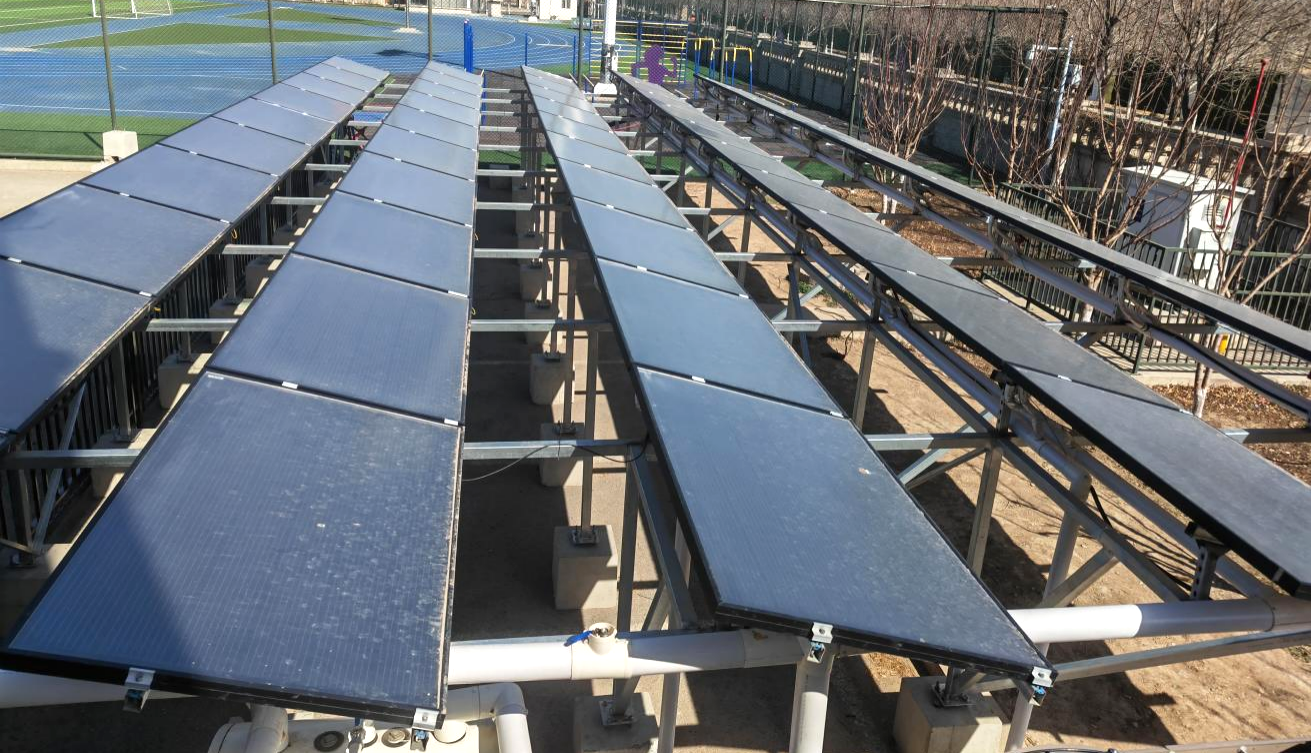
A PVT collector (photovoltaic-thermal, also called a solar PV-T collector) produces electricity and useful heat from the same roof area. That part is simple. What is less obvious is that "PVT" covers several quite different products, and choosing the wrong type is the most common reason a PVT project under-delivers.
This guide compares the main PVT collector types, explains the trade-off between electrical and thermal output that drives every design, and shows which type fits which application. If you are new to the technology, start with our overview: What is a PVT solar panel?
The one trade-off behind every PVT design
Every PVT collector balances two goals that pull in opposite directions:
- PV cells prefer to stay cool. Crystalline silicon cells lose roughly 0.3–0.5% of their power output for every 1 °C rise in cell temperature (the exact figure is the module's temperature coefficient on its datasheet).
- Thermal collectors want to run hot. The higher the outlet temperature, the more directly usable the heat is for domestic hot water or space heating.
A PVT collector cannot maximise both at once. Designs that keep losses low (glass cover, rear insulation) deliver hotter water but warmer cells. Designs that stay open to the air keep the cells cool but deliver low-temperature heat. Each PVT type is simply a different position on this scale.
The main PVT collector types
1. Unglazed liquid PVT
How it works: A standard PV laminate with a liquid heat exchanger (absorber) bonded to its back. There is no extra glass cover over the cells. Versions with and without rear insulation exist.
Typical operating range: Low temperature, from below ambient (when used as a heat pump source) up to about 30–40 °C fluid temperature.
Stärken
- Highest electrical yield among flat-plate PVT types, because the fluid actively cools the cells and there is no extra glass cover.
- Looks and installs much like a normal PV module.
- Versions without rear insulation can absorb heat from ambient air, including at night and on cloudy days. This makes them a good heat source for heat pumps.
Beschränkungen
- On its own, it cannot reliably reach domestic hot water temperatures (55–60 °C) in most climates.
- Thermal output drops quickly in wind and cold weather.
Am besten geeignet für: Heat pump source systems, ground-source borehole regeneration, pool heating, and low-temperature preheating. See our PVT solar panel range for liquid PVT modules.
2. Glazed (covered) liquid PVT
How it works: A liquid PVT laminate inside an insulated frame with a glass cover, similar in build to a flat plate solar thermal collector.
Typical operating range: Medium temperature, commonly 40–60 °C and higher.
Stärken
- Much higher thermal efficiency at useful temperatures.
- Can deliver domestic hot water directly, without a heat pump.
Beschränkungen
- Cells run hotter, so electrical output is lower than an unglazed PVT of the same cell area. The extra glass layer also reflects some light.
- Stagnation is the key risk. If circulation stops on a sunny day (pump failure, full tank, power cut), temperatures inside a glazed PVT can climb well above what PV encapsulants are designed for. Look for products tested for stagnation, and design the system with overheat protection such as heat dumping, drainback or controlled night cooling.
Am besten geeignet für: Domestic hot water where roof space is limited and both electricity and hot water are needed from the same area.
3. Air PVT (PVT-air)
How it works: Air flows through a channel behind the PV laminate, picking up heat that would otherwise raise the cell temperature. Fans move the air into the building or into a process.
Typical operating range: Warm air, typically used for space heating, ventilation preheat or drying.
Stärken
- No liquid, so no freezing, leakage or pressure concerns.
- Simple hydraulics and low maintenance.
- Works well integrated into building facades or roofs.
Beschränkungen
- Air carries far less heat per volume than water, so ducts and fans must be sized carefully and fan power counts against the energy balance.
- Storing heat from air is harder than storing hot water.
Am besten geeignet für: Ventilation air preheating, space heating in commercial and agricultural buildings, and drying applications. See our air PVT solar panel for this configuration.
4. Concentrating PVT (niche)
Concentrating PVT uses mirrors or lenses to focus sunlight onto a small cell area, reaching higher temperatures. Most designs need sun tracking, all depend on direct (not diffuse) sunlight, and the technology is mainly used in research or specialised industrial projects. It is rarely the right choice for buildings.
Side-by-side comparison
| Merkmal | Unglazed liquid PVT | Glazed liquid PVT | Air PVT |
|---|---|---|---|
| Typical useful temperature | Low (≈ ambient to 30–40 °C) | Medium (40–60 °C+) | Warm air |
| Elektrischen Ertrag | Höchste | Niedriger | Medium–high |
| Thermal yield at DHW temperature | Niedrig | Hoch | Not applicable (air) |
| Works as heat pump source | Ausgezeichnet | Possible | Possible with air-source units |
| Frostrisiko | Yes (needs glycol or drainback) | Yes | Keine |
| Stagnation / overheat risk | Niedrig | High – must be designed for | Niedrig |
| Typical applications | Heat pumps, pools, preheat | Warmwasser für den Haushalt | Ventilation, space heating, drying |
Absorber design: why two "similar" PVT panels perform differently
Inside liquid PVT collectors, the way heat moves from the cells into the fluid matters as much as the collector type. Common absorber designs include:
- Sheet-and-tube: Metal sheet with tubes attached. Proven and low cost, but heat must travel sideways to the tubes, so contact quality is critical.
- Roll-bond: Two metal sheets bonded with channels expanded between them. Larger wetted area and more even cooling.
- Flat-box / channel absorbers: Fluid flows across most of the back surface. Very even cell cooling, usually with higher fluid volume.
The key question for any design is thermal contact: if the absorber is poorly bonded to the laminate, the cells stay hot and both electrical and thermal output suffer. Ask suppliers how the absorber is bonded and whether this has been tested over thermal cycling.
How to choose the right PVT type
Start from the heat you actually need, not from the collector:
- What temperature does the heat need to be?
- Heat pump source or pool → unglazed liquid PVT.
- Domestic hot water without a heat pump → glazed liquid PVT.
- Warm air for ventilation or drying → air PVT.
- Which output matters more, electricity or heat? If most of the value comes from electricity, lean toward unglazed. If hot water is the priority and roof space is tight, glazed PVT makes sense.
- What happens when there is no heat demand? Summer holidays at a school or a full storage tank create stagnation. Unglazed and air PVT handle this easily; glazed PVT needs a protection strategy.
- What is the climate? In cold, windy climates unglazed collectors lose heat quickly unless used as a heat pump source. Freeze protection is needed for all liquid PVT.
For complete system layouts, see PVT hybrid solar systems und PVT solar panels with heat pumps.
What to check on a PVT datasheet
When comparing quotations, ask for these items rather than relying on a single "total efficiency" figure:
- Electrical rating at STC (Wp), temperature coefficient of power, and module certification (for example IEC 61215 and IEC 61730).
- Thermal performance tested to ISO 9806, including zero-loss efficiency (η0) and heat loss coefficients (a1, a2). For unglazed PVT, also ask for the wind-speed and long-wave radiation coefficients, because unglazed output depends strongly on wind and sky conditions. Solar Keymark certification is a useful sign in European markets.
- Stagnationstemperatur and confirmation that the laminate is rated for it (especially for glazed PVT).
- Maximum operating pressure, recommended flow rate and Druckabfall at that flow.
- Absorber material and connection type, to check compatibility with your piping and heat transfer fluid.
- Garantiebedingungen for both the electrical and the thermal parts.
Frequently asked questions
Is PVT better than separate PV and solar thermal panels?
PVT gives more total energy per square metre, which matters when roof space is limited. Where space is plentiful, separate PV and thermal collectors can each be optimised and may cost less. The answer depends on roof area, heat demand and local energy prices.
Can unglazed PVT heat domestic hot water?
Not reliably on its own in most climates. Paired with a heat pump, it becomes an efficient source of low-temperature heat that the heat pump lifts to hot water temperature.
Do PVT collectors need freeze protection?
Liquid PVT collectors do, usually with a glycol mixture or a drainback design. Air PVT does not.
Which PVT type has the highest electrical output?
Among common flat-plate designs, unglazed liquid PVT, because the fluid keeps the cells coolest and there is no extra glass cover.