
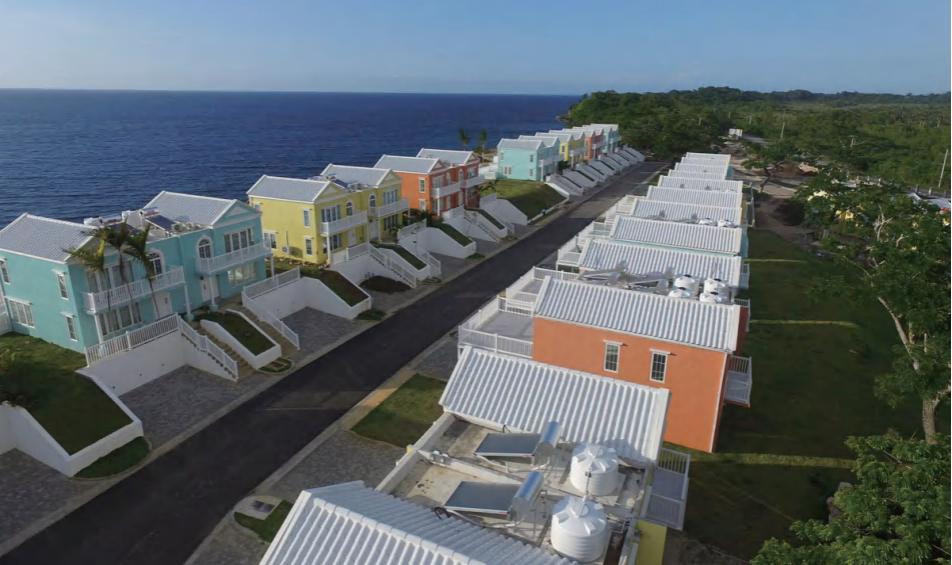
Choose 200 لیتر only when measured daily use and the busiest one-hour draw both fit comfortably inside its usable capacity. Choose 300 لیتر when the villa has three bedrooms, three to four regular occupants, back-to-back showers, a bathtub, frequent guests or a longer gap between solar reheating periods.
That is a screening answer, not a universal product rule. A tank label does not tell you how much 40°C water will reach the taps, how quickly the solar loop can recharge the tank, or whether the backup heater can cover a cloudy morning. Those questions depend on inlet temperature, storage temperature, stratification, collector output, controls and user behaviour.
Important product distinction: the current online SOLETKS split-system specification lists 300L, 500L, 800L and 1,000L tanks. Its Florida resort-villa reference states 200L of hot water per villa per day — that is a demand figure, not proof of a 200L split-tank model. A buyer evaluating a 200L option should request a confirmed model and bill of materials rather than assume that “200L/day” and “200L tank” mean the same thing.
Quick Decision: When 200L or 300L Is the Better Starting Point
Before running any calculation, use this screening framework to shortlist a starting capacity. Each row assumes the buyer will still verify peak-hour draw, inlet temperature and collector pairing before final purchase.
One–Two Bedrooms, Low Simultaneous Use
A smaller tank can reduce capital cost and unnecessary storage when the load is genuinely modest — efficient showers, little guest demand.
Three Bedrooms, 3–4 Occupants
More storage margin reduces the risk of running out during clustered morning or evening use — consecutive showers, occasional baths.
Four+ Bedrooms, Multiple Suites
A 300L tank can still be undersized when several fixtures — spa baths, multiple showers — operate in the same hour.
This framework is consistent with the Victorian Government’s current buyer guidance: 150–225L for one to two bedrooms, 225–300L for three bedrooms, and more than 300L for four or more bedrooms. The same guidance warns that sizing must account for more than bedroom count and recommends a larger system for simultaneous showers, long showers, baths, spa baths or hot-water-fed appliances.
Step 1: Size the Villa’s Daily Demand Before Comparing Tanks
If the villa already operates, install or read a water meter and record hot-water use for at least one representative week. Include weekdays, weekends and guest periods. Measured use is more reliable than a generic “litres per person” rule.
For early-stage screening, Solar Victoria uses around 50L of hot water per person per day and suggests about 1.5 days of storage. Under that regional rule of thumb:
- Two occupants: 2 × 50 × 1.5 = 150 لیتر
- Three occupants: 3 × 50 × 1.5 = 225L
- Four occupants: 4 × 50 × 1.5 = 300 لیتر
This makes a 200L tank a plausible screening option for a low-demand two-person villa and, in some cases, a tightly managed three-person household. It makes 300L a more natural starting point for four occupants or a three-bedroom dwelling designed for future occupancy.
Do not export those figures blindly to every country. Hot-water habits, shower flow rates, incoming-water temperature, solar availability and local hygiene rules vary. Use them to create a shortlist, then validate the shortlist with project data.
Step 2: Test the Busiest Hour, Not Only the Daily Total
Two villas can each use 180L per day and still need different tanks. One may spread demand from morning to night; the other may run two showers and fill a bath between 7:00 and 8:00.
The U.S. Department of Energy’s water-heating fact sheet provides useful demand-side reference values. Converted from U.S. gallons, the figures are approximately:
| Hot-water event | Reference volume per event | Metric equivalent |
|---|---|---|
| Shower | 15 US gal | 56.8L |
| Bath | 20 US gal | 75.7L |
| Hair wash | 4 US gal | 15.1L |
| Hand dishwashing | 2 US gal | 7.6L |
| Automatic dishwasher | 14 US gal | 53.0L |
| Clothes washing | 32 US gal | 121.1L |
These are historical U.S. reference values, not a prescription for a modern villa. Their value is the method: list every event that can occur in the peak hour and add the hot-water volumes.
Worked example
Two reference showers plus one bath total about 189L before kitchen use, pipe losses or a third fixture. That peak would consume almost the entire nominal volume of a 200L tank. If the same villa routinely has that pattern, 300L creates a more practical margin.
For a real project, replace the reference values with measured fixture flow:
Record the number of simultaneous fixtures, their litres per minute, average duration and delivery temperature. A thermostatic mixing valve changes the hot-water fraction, while a recirculation loop adds a continuous heat loss that must be included separately.
Step 3: Convert Tank Volume into Usable Mixed Water
Nominal tank volume is not the same as the amount of shower-temperature water available at the outlets. Hot stored water is mixed with colder mains water before use. In an ideal energy balance:
With water stored at 60°C, mains water at 10°C and delivery at 40°C, the ideal multiplier is 1.67. A perfectly mixed, loss-free 200L volume would therefore correspond to about 333L at 40°C; 300L would correspond to about 500L.
Real systems deliver less than the ideal calculation because of incomplete drawdown, destratification, pipe loss, sensor position, mixing-valve behaviour and the temperature at which the backup heater starts. Use the formula to compare scenarios, not to promise outlet capacity.

A UK government-commissioned Kiwa study illustrates the temperature effect using an 88L bath at 40°C with 10°C incoming water:
| Tank storage temperature | Hot water drawn from cylinder | Cold water mixed in |
|---|---|---|
| ۶۵°C | 48.0L | 40.0L |
| 60°C | 52.8L | 35.2L |
| 55°C | 58.7L | 29.3L |
| ۵۰°C | 66.0L | 22.0L |
| 45°C | 75.4L | 12.6L |
The table explains why two tanks with the same nominal volume can provide different user experiences. It also does not justify raising storage temperature without controls: scald protection, material limits, energy loss and local Legionella requirements must be designed by qualified professionals.
Step 4: Match the Tank to the Collector Field
A bigger tank is not automatically a better solar system. If the collector field is too small, a 300L tank may warm too slowly and rely heavily on backup energy. If the collector field is too large for a 200L tank, it may reach its temperature limit early and leave excess solar input to be managed through stagnation protection.

The U.S. Department of Energy’s consumer guide gives a historical active-system rule of thumb of about 1.5 US gallons of storage per square foot of collector, equivalent to roughly 61L per square metre. The guide also makes clear that collector area changes with climate and household size. Treat that ratio as an initial reasonableness check, not a design value.
The currently published SOLETKS 300L flat-plate split configuration uses three BTE-2.0 collectors. Each published module has 2.0m² gross area and 1.87m² aperture area, giving 6.0m² gross and 5.61m² aperture area for the listed set. The same product table states a 7-bar tank working pressure, 60mm polyurethane insulation, a 12L expansion tank and an auxiliary electric-heating range of 1.5–3.0kW at 220V.
Those numbers describe the published 300L configuration, not a universal pairing. Final collector area must be based on:
- the villa’s daily energy demand, not only litres
- monthly solar irradiation at the site
- collector efficiency at the expected temperature difference
- orientation, tilt and shading
- pipe and recirculation losses
- target annual or monthly solar fraction
- summer stagnation strategy
- backup-heater recovery duty
✅ The 200L Decision
Choose it only with a verified margin — all conditions below should hold true.
- The villa normally has one or two bedrooms in use
- Metered or carefully estimated daily demand is comfortably below usable capacity
- Showers are efficient and are not usually simultaneous
- There is no large bathtub or spa load
- Guest peaks are rare and can be covered by backup heat
- Local winter inlet temperature and low-sun period have been checked
- Supplier confirms an actual 200L split-system model with full specs
⭐ The 300L Decision
Usually stronger when any of these conditions apply.
- Three bedrooms or three to four regular occupants
- Two showers may run at once
- Users shower consecutively during a short morning or evening window
- The villa has a bathtub
- There are frequent guests or seasonal occupancy peaks
- The backup heater operates only during limited tariff windows
- The site experiences cold inlet water or weak winter irradiation
A Practical RFQ Checklist for Villa Projects
Do not ask a supplier only for “a 200L or 300L solar heater.” Send a load-based request that includes:
- Project location, altitude and design winter inlet-water temperature.
- Number of bedrooms, normal occupants and maximum guest occupancy.
- Fixture schedule for the busiest hour, including simultaneous showers and baths.
- Required delivery temperature and any local storage-temperature rules.
- Measured daily hot-water use, if available.
- Required solar fraction and acceptable backup-energy use.
- Collector model, aperture area, certified performance data and proposed quantity.
- Tank model, actual usable volume, pressure rating, insulation and heat-exchanger details.
- Pump station, controller, expansion vessel, relief valves and freeze protection.
- Backup-heater power and calculated recovery time.
- Summer stagnation-control method.
- Written confirmation of whether a 200L option is a standard SOLETKS split model or a custom configuration.
This information allows two quotations to be compared on delivered hot-water performance rather than tank label alone.
Frequently Asked Questions
Is a 200L split solar water heater enough for a family of four?
Is a 300L tank always more efficient than a 200L tank?
How many people can a 300L solar water heater serve?
Does hotter storage make a small tank equivalent to a large tank?
Does SOLETKS currently publish a 200L split flat-plate model?
Request a Capacity-Checked Villa Proposal
Send SOLETKS the villa location, bedroom count, normal and peak occupancy, busiest-hour fixture schedule, target delivery temperature, available roof area and preferred backup source. The engineering team can then compare tank capacity, collector area, heat exchanger, controls and recovery duty as one system.
Request Villa System Quote on WhatsApp ↗Continue the Villa Sizing Topic Cluster

Flat Plate Split Solar Water Heater — Full Specifications
آبگرمکنهای خورشیدی تحت فشار در مقابل بدون فشار برای توزیعکنندگان
Commercial Solar Hot Water Storage Tank Sizing: Peak Draw & Access
For broader system selection, see the solar water heater system design guide.
منابع
- Victorian Government — Hot Water System Buyers Guide
- Solar Victoria — Deciding Your Hot Water System Size and Tank
- U.S. Department of Energy — A Consumer’s Guide: Heat Your Water with the Sun
- U.S. Department of Energy Building America — Water Heating Technology Fact Sheet
- UK DECC/Kiwa — Hot Water Cylinders, Buffer Tanks and Heat Pumps
- سولهتکس — آبگرمکن خورشیدی صفحهای مسطح دو لولهای
- SOLETKS — Solar Water Heater System Design Guide