
1. Three Realities Up Front
First, hospital hot water is 24/7 critical infrastructure. Wards, operating theaters, sterilization, kitchens, and laundries need continuous hot water at controlled temperatures. Unlike hotels or offices, hospitals cannot accept scheduled downtime or seasonal underperformance.
Second, hygiene and safe delivery temperature are non-negotiable. In healthcare, system design must address Legionella risk, storage temperature thresholds, and point-of-use control before energy efficiency is even discussed.
Third, in most projects solar thermal works best as a preheating source in a hybrid architecture — not as a stand-alone system with no backup. That is not a technology limitation; it reflects how hospitals consume water and the continuity the facility must guarantee.
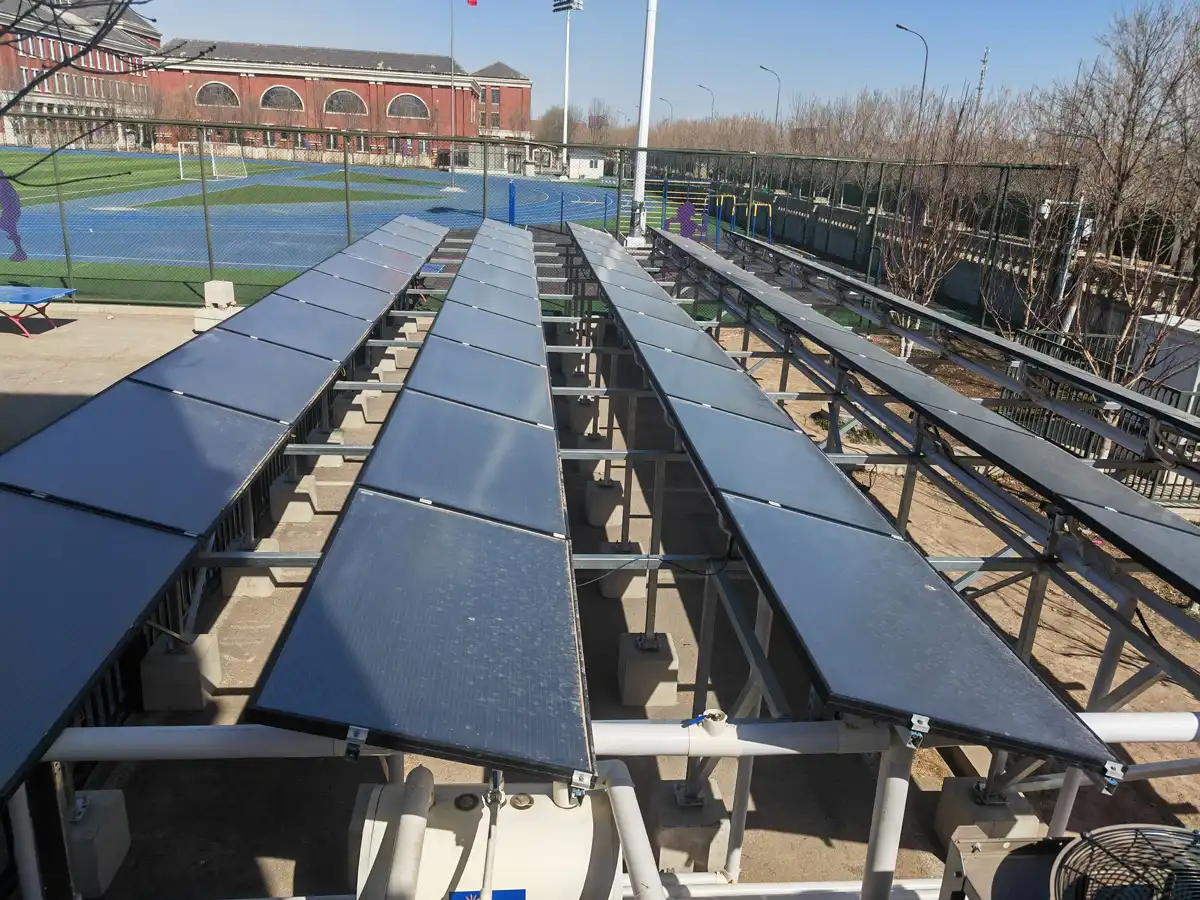
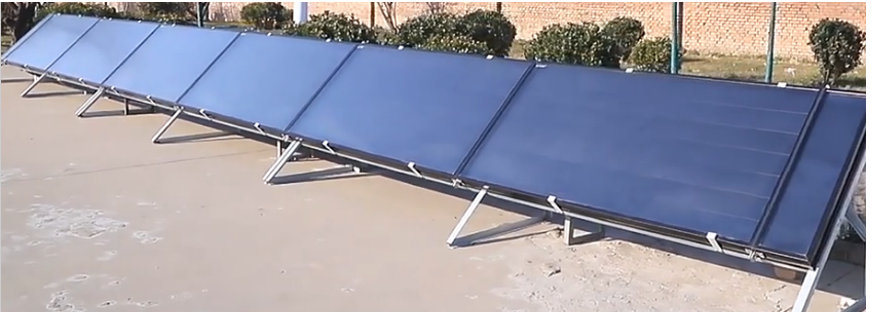
Central plants commonly use flat plate solar collector arrays for preheat; the art is in storage, recirculation, and auxiliary heat — covered in the sections below.
2. Why Hospital Hot Water Systems Are Different
Multi-department load shapes overlap: wards, kitchen, CSSD, laundry. Photo: Unsplash (license)
2.1 24/7 demand across departments
A hospital does not have a single DHW profile. Wards need hot water day and night. Kitchens peak at meal times. Laundry may need water above 65 °C for thousands of kilograms of linen per day. Sterilization / CSSD adds its own volume and temperature band. These loads overlap, shift by hour, and rarely fall to zero.
2.2 Stable temperature at the tap is safety-critical
In a typical commercial building, a short dip in DHW temperature is an inconvenience. In a hospital, it can compromise sterilization or, at the other extreme, create scalding risk for patients with reduced mobility. Point-of-use temperature must be controlled, not just averaged over a day.
2.3 Hygiene is embedded in the design, not a retrofit memo
Legionella management is written into standards across Europe, the Middle East, and many other markets. It shapes tank sizing, circulation, setpoints, valve placement, and monitoring from day one.
2.4 Downtime tolerance is near zero
Critical services often require N+1 or higher redundancy. A hot water failure in winter in a 400-bed site is a facility emergency. Any solar integration must let backup systems carry 100% of the load when required.
3. What Role Should Solar Play in a Hospital?
A frequent mistake is overselling solar fraction before the architectural role of solar is defined. In the majority of hospital projects, solar preheats cold water before the main storage or auxiliary heater — reducing boiler or heat-pump work without asking solar to hold final storage temperature unaided. That is a more honest, more robust philosophy.
For hybrid system thinking (thermal + heat pump, backup, and in some projects electricity co-generation), see PVT and heat pump hybrid system — a useful frame when the facility is targeting deeper decarbonisation while preserving clinical resilience.
Published evidence: A hospital case study designed for a 75% solar fraction delivered only about 27–28% in practice, mainly because distribution and recirculation losses were underestimated. Solar can still be highly valuable — the lesson is: do not size expectations before you size pipes and recirculation loss.
3.1 Solar as preheating, not a stand-alone promise
Collectors raise the temperature of incoming make-up water so the boiler or heat pump has less enthalpy to add. The auxiliary maintains storage setpoint and clinical compliance regardless of today’s weather.
3.2 Retrofit vs. new build
Retrofits must integrate with existing boilers, tanks, and controls; achievable solar share is often lower. New builds can optimise storage, routing, insulation, and controls, making higher solar contributions more realistic.
3.3 When a high solar fraction is — and is not — realistic
In regions with strong year-round irradiance, low-rise forms with generous roof, and moderate DHW temperature bands, above 50% can be achieved with care. In high-latitude, roof-constrained, or very high storage-temperature cases, a 20–35% preheat target may be the defensible line.
4. Hygiene and Temperature Control Logic
This is the line between a credible hospital solar DHW design and a generic commercial sheet. Your integrator should demonstrate command of the following.
4.1 Storage temperature
International guidance (e.g. UK HSE, US CDC) is broadly aligned: store hot water at no less than 60 °C to manage Legionella risk. In solar systems, the tank must be held or boosted to that threshold by auxiliary heat, regardless of daily solar gain.
4.2 TMVs and scald control
Storage at 60 °C+ is necessary for hygiene; delivering that temperature at patient outlets would create scalding risk. Thermostatic mixing valves (TMVs) at or near the point of use typically blend down to ~41–43 °C in many healthcare standards. TMV selection, placement, and maintenance are core design, not accessories.
Storage vs. delivery: two different temperature problems — both regulated. Photo: Unsplash (license)
4.3 Recirculation loop management
Long runs between plant and distant outlets require recirculation. HSE notes hot water in distribution should remain above 50 °C (and 55 °C in many UK healthcare premises); return temperature should be monitored. CDC recommends keeping circulating hot water above 49 °C and running recirculation continuously where possible. Always confirm against your local water safety / infection-control regime.
4.4 Dead legs, stagnation, sentinels
Dead legs and low-use outlets are high-risk. Water safety plans require identification, flushing, and temperature sentinels through the network — not “set and forget” at the tank alone.
5. Recommended System Architectures
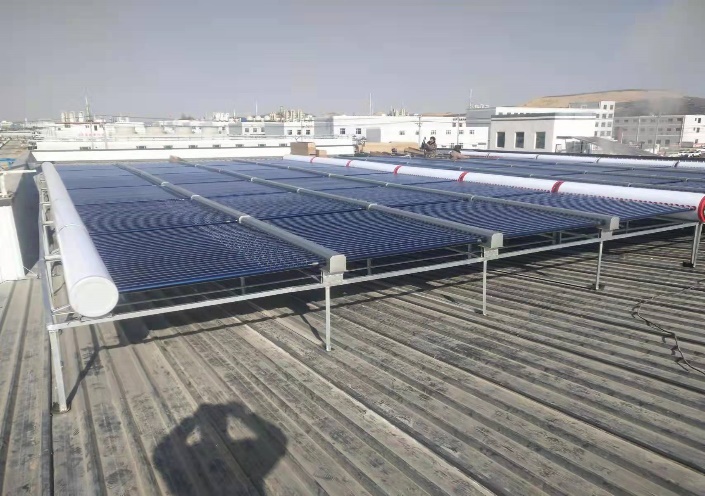
The right plant depends on site layout, legacy equipment, load profile, climate, and decarbonisation ambition. Here are three patterns used in real projects. For large flat plate field layout and hydraulic zoning, your EPC will usually pair these concepts with a detailed line diagram.

Roof or campus-scale collector fields feed preheat — auxiliary heat holds clinical setpoints. Photo: Unsplash (license)
5.1 Option A — Solar preheating + existing boiler
Collectors preheat make-up; the preheated flow enters an existing gas or oil boiler that lifts temperature to the storage setpoint. Common in retrofit: least disruption to the existing plant, fuel savings without abandoning a still-serviceable boiler.
5.2 Option B — Solar + heat pump + storage + emergency boiler
Solar feeds a preheat tank; a heat pump lifts water toward main storage; a boiler or electric package stands in for peaks and failure. Suited to new build or deep retrofit when cutting fossil use is a formal target. The logic aligns with the PVT and heat pump hybrid system discussion when electricity and thermal are co-optimised.
5.3 Option C — Central solar plant + sectional loops
A campus or multi-building site may use a central solar plant and thermal storage, with separate distribution loops, secondary storage, boosters, and TMV skids per building or zone — fewer rooftop plants, centralised O&M, phased construction support.
Key interfaces to specify in every variant
Heat exchanger type and kW; storage material, insulation, and nozzle layout; pump sets for solar primary, secondary, and DHW; bypass / isolation for service; and control logic for solar input vs. heat pump vs. boiler priority, including Legionella / pasteurisation cycles where required.
6. How to Size a Hospital Solar Hot Water System
Research agrees: the dominant failure mode is often not collector quality — it is wrong demand, ignored distribution and recirculation loss, and optimistic solar fraction. For step-by-step commercial methodology (hospitals and hotels), see how to size a commercial solar hot water system.
Step 1 — Demand by beds, departments, and ancillaries
Use region- and specialty-appropriate per-bed figures, then add kitchen, laundry, CSSD, and any process load. A site with on-site laundry can be 30–50% higher than an outsourced-linen site — do not use a single “average hospital” number.
Step 2 — Storage and recirculation losses
Size storage for peak hour + recovery margin. Include recirculation loss explicitly; on large campus mains it can approach draw-off energy in magnitude. After Step 2, re-read the Soletks guide on how to size a commercial solar hot water system to cross-check your load stack.
Step 3 — Target solar fraction and collector area
Set a conservative solar share from roof area, orientation, shading, irradiance, and the losses from Step 2. A number that survives winter and monsoon beats a CAD headline that only works in May.
Step 4 — Auxiliary capacity and redundancy
Auxiliary (boiler, heat pump, or both) must be sized to carry 100% of design load with zero solar. Solar reduces energy cost; it does not relax installed backup capacity in a clinical facility.
Step 5 — Recalibrate after commissioning
Measure draw, solar yield, recirculation loss, and control behaviour in the first season; adjust flows, setpoints, and pump schedules. That is normal engineering, not project failure.
7. Reliability, Redundancy, and Fail-Safe Design
Solar is an additional energy input — it does not count toward N+1 for critical heat. The design should spell out responses to common faults.
- N+1 for critical plant: If two boilers are required for continuity, a third on standby; same philosophy for large heat-pump or pump trains and — where applicable — control servers.
- Standby circulation pumps with auto changeover; parallel collector strings with isolation for sectional maintenance.
- Isolation and bypass around array, heat exchanger, storage, boiler, and heat pump so any segment can be removed without total outage.
- Documented control responses: pump fail → standby; sensor fail → safe mode; power blip → UPS for controls cURL Too many subrequests. boiler / electric priority as defined in the sequence table.
8. Commissioning and Maintenance for Healthcare Projects
Commissioning: every mode table tested — not a sign-off formality. Photo: Unsplash (license)
- Pressure test and leak check every circuit: solar primary, heat exchange, storage, distribution, recirculation.
- Balance flows across collector banks cURL Too many subrequests. risers.
- Test controls for: normal solar, low solar, boiler-only, heat-pump priority, night, pasteurisation if used, pump fail-over, manual override.
- Verify sentinel outlets for temperature: near plant, far field, ward, kitchen, laundry.
- Maintenance: glycol test/replace, TMV exercise, insulation inspection, documented logs for water safety compliance.
9. RFQ Checklist for Hospital Solar Hot Water Projects
Incomplete briefs cause weeks of delay. Assemble the following before you ask for firm pricing.
Pre-RFQ data pack
- Location & solar resource: city, country, lat/long; TMY or irradiance if available.
- Scale & departments: bed count, buildings, in-house vs. outsourced laundry, kitchen, CSSD, process heat.
- Temperatures: storage (typically ≥60 °C for control strategy), delivery at patient care, special high-T departments.
- Existing plant (retrofit): boiler / HP / tank make, model, kW, fuel, historic consumption where possible.
- Space: roof area, azimuth, tilt, structural headroom, plant room footprint, access for cranes.
- Rules: national / institutional water-safety and infection-control requirements; redundancy (N+1, 2N) expectation.
Soletks Solar supplies 평판형 태양광 집열기 cURL Too many subrequests. engineering-grade hot water flat collector modules for centralised commercial-scale systems, including hospital applications. For projects integrating storage, heat exchange, and backup heat, Soletks can support architecture options, collector layout, and quotation-ready technical packages from the parameters above. Factory-direct programs with 솔라 키마크 cURL Too many subrequests. flexible OEM configuration are available — include Soletks in the RFQ shortlist at discipline stage, not as an afterthought.
Hospital project next steps
Choose the path that matches your stage — we reply from the factory engineering team.
Hospital consultation
Share bed count, layout, target temperatures, existing boiler / tank data, and roof area. We return a preliminary architecture cURL Too many subrequests. RFQ-ready technical pack.
Request hospital project consultation →System recommendation
Send building type, estimated DHW, roof plan, minimum winter temperature, and backup preference. We advise preheat vs. solar+HP and a quotation-style proposal.
Get a system recommendation →Start your RFQ
Use the checklist in Section 9, send your parameters — collector layout, storage guidance, and indicative budget 내 3 business days.
Start your hospital project RFQ →이메일: export@soletksolar.com · service.soletksolar.com/contact
자주 묻는 질문
Can solar meet hospital DHW on its own?
In most projects, no — not at required volumes and temperatures with 24/7 assurance. Solar is usually a preheat stage; auxiliary is sized to carry 100% without solar, because output varies with season and weather.
Why is solar usually preheating in hospitals?
You need ≥~60 °C storage for hygiene, continuous recirculation, and no tolerance for “out until sunny.” Preheat + controllable backup matches that operating reality.
What temperature strategy reduces hygiene risk?
Store at no less than ~60 °C, keep distribution in the compliant band (regional rules vary: e.g. 50+ / 55+ °C in many UK / CDC discussions), and use TMVs to deliver ~41–43 °C at vulnerable outlets. Verify against your local water safety code.
Is recirculation mandatory?
For most large hospitals with long runs, yes — without it, far branches cool into risk bands; return temperature must be monitored.
When add a heat pump?
When the site wants to cut fossil use beyond preheat alone, or a new build is targeting low-carbon design. Preheat + heat pump + emergency boiler is a common modern stack. See also PVT and heat pump hybrid system.
What do you need to quote?
At minimum: location, beds / buildings, major DHW users, storage and delivery T, existing equipment (retrofit), roof / plant room, and standards + redundancy expectations — as in Section 9.