Introduction: Channel Strategy, Not Just Piping
In markets like Greece, thermosiphon systems have dominated residential hot water for decades — familiar, affordable, and effective under high irradiance. For hotels, hospitals, schools, dhe multi-story commercial buildings, forced circulation is the practical default. Distributors who want to serve both segments — and those evaluating new supply partnerships — need a clear map of fit, buyer language, and certification. Most will need both system types in stock; the question is which to recommend for each project profile, not which is “better” in the abstract.
1. Quick Answer: Which System Fits Which Project?
Everyday selection logic
- Rezidenciale villa, small home, or budget replacement → usually thermosiphon
- Hotel, hospital, school, or centralised commercial DHW → forced circulation
- Flat roof, local installers used to compact rooftop units → thermosiphon wins on speed and simplicity
- Indoor tank, long runs, multi-floor → forced circulation is often the only viable path
- Private label / differentiated specs → prioritise an OEM-capable partner with collector size options dhe documentation mbështetje
Most Southern European distributors will need both in the portfolio; stock and sales training should reflect that.
2. Why This Comparison Matters More in Southern Europe
2.1 Why thermosiphon stays strong in Greece (and similar markets)
Greece is one of the world’s most mature thermosiphon markets. Data from IEA SHC Solar Academy–type presentations cite thermosiphon meeting an estimated 80–90% of residential DHW annually for many Greek households. Drivers include: high year-round irradiance (2–4 m² collectors + 150–300 L storage often cover most family DHW), affordable first cost (sometimes cited on the order of one month’s income for a typical household — use as a cultural benchmark, not a price quote), fast install (often in a single day), and high homeownership (>75%) with investment in on-site autonomy. Greek flat plate domestic suppliers supply over 95% of the domestic market (industry channel estimates often cited in trade and policy discussions); imported brands face brand and service-network barriers — thermosiphon is entrenched; price alone rarely displaces incumbents.
2.2 Why forced circulation is still necessary for project business
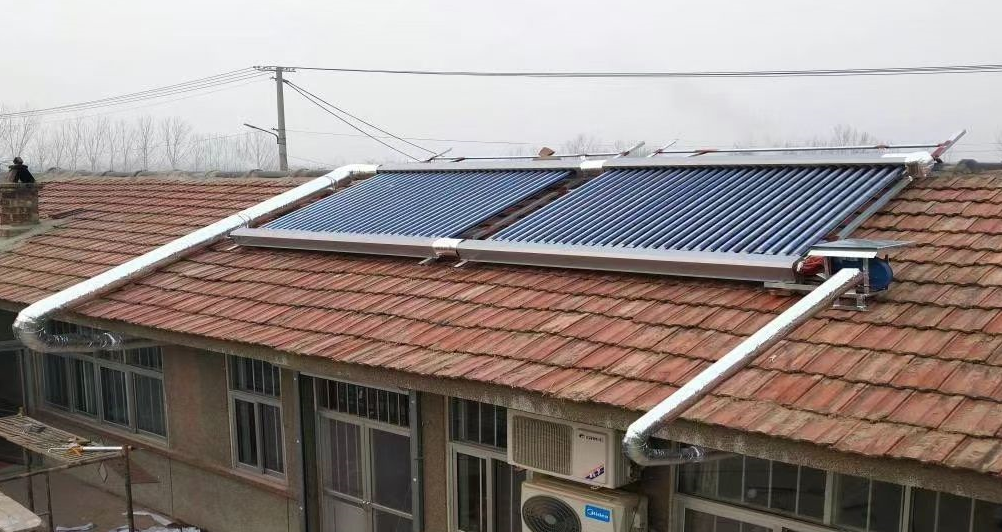
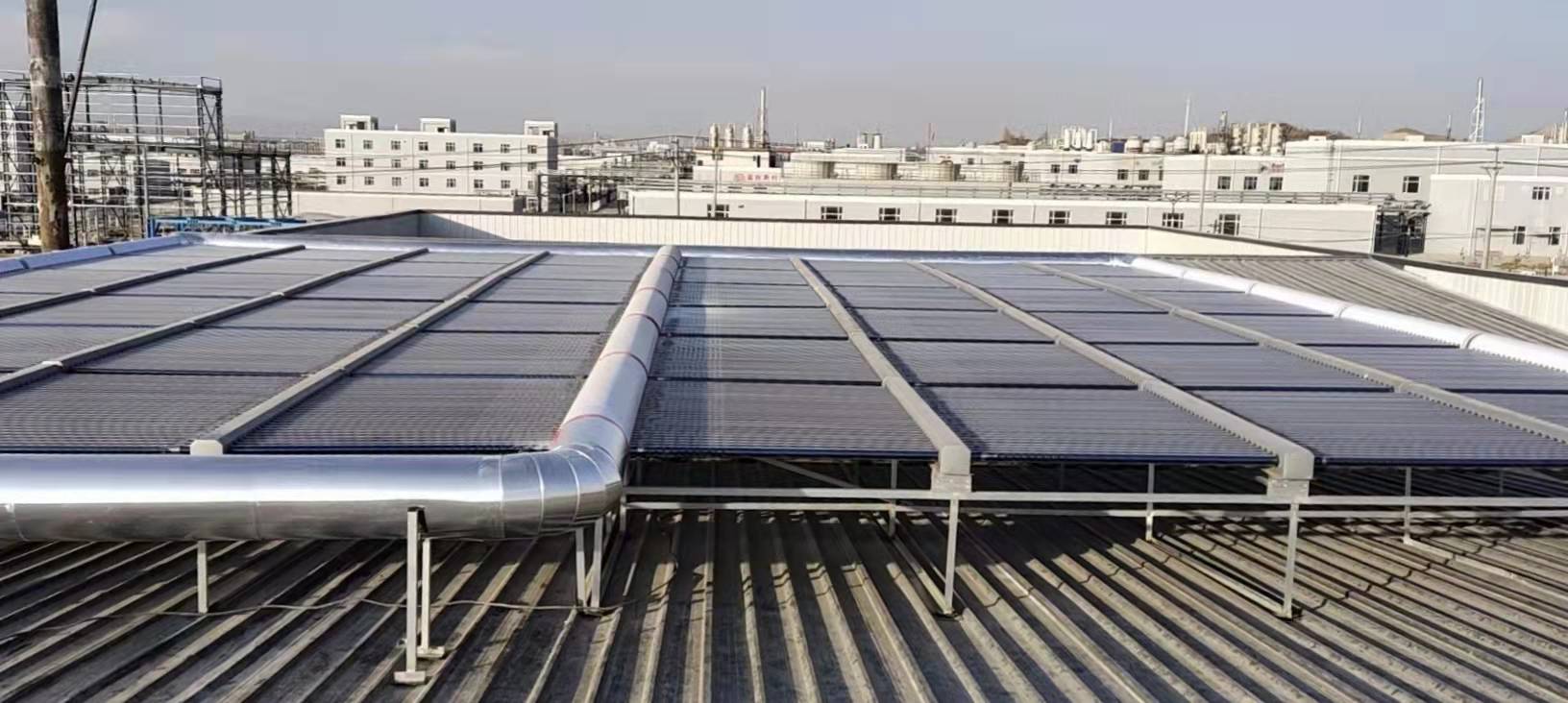
As soon as a job involves multi-story form, central DHW, peaks, or no roof tank, forced circulation is the workhorse: split layout (collectors on roof, tank in plant room), pumps, controllers, expansion vessels, series/parallel arrays, and precise temperature management. In Italy, Conto Termico and similar lines can support qualifying renewable heat investments — public materials have referenced up to ~65% of eligible costs in some cases; commercial lines typically need certified equipment dhe documentation that forced systems with Solar Keymark collectors are built to satisfy. Distributors in the project channel need reliable supply of certified collectors and compatible components + datasheets for incentive files.
3. What Is a Thermosiphon Solar Water Heater?
Typical story: collectors + storage on the roof — passive circulation, no pump. Photo: Unsplash (license)
A thermosiphon system is passive: heated fluid in the collector rises by natural convection into a tank mounted above the array. No pump, no controller, no external power for normal operation. The compact rooftop form is widely sold as an integrated solar water heater product line. Typical residential units: 1–2 flat plates, 150–300 L (pressurised or non-pressurised), often with an electric element for backup.
Best for: simple residential DHW where low first cost, fast install, dhe minimal maintenance top the list — matching demand in Greece, Cyprus, southern Italy, and similar high-irradiance markets.
4. What Is a Forced Circulation Solar Water Heater?
A forced circulation (active) system uses a pump to move heat-transfer fluid between the collector field and a separately sited tank, controlled by a differential controller using temperatures at the collector and store. The tank can sit indoors, basement, or plant room; collectors on roof, façade, or ground. The layout matches what many catalogues list as a split solar water heater system — the standard path for commercial solar thermal in Italy and Greece when scale and zoning matter.
Best for: engineered projects: layout flexibility, accurate temperature control, large volume delivery, and integration with backup heat and BMS.
5. Forced Circulation vs Thermosiphon: Side-by-Side
| Topic | Termosifon | Qarkullim i detyruar |
|---|---|---|
| Layout / roof | Tank above collector on same roof; ~200–400 kg when full; limits on pitch / load | Split: roof carries collectors only; tank anywhere below — key for multi-story and heritage |
| Peaks & control | Fine for modest, predictable home use in sunny climates | Better for concentrated peaks (hotel mornings, kitchen, shifts); buffering dhe charging logic |
| Standby loss | Rooftop tank: wind / night losses; non-trivial in winter | Indoor tank often cuts overnight standby loss; system-level studies tend to favour active systems when losses + variable demand count |
| Mirëmbajtja | Fewer moving parts; anode / occasional clean — good where service networks are thin | Pump, controller, glycol, pressure — fine where pro installers exist |
| First cost vs lifecycle | Më i ulët purchase + install — dominates residential economics | Higher upfront; lifecycle case stronger on commercial when loss + integration + incentives matter |
6. What Southern European Buyers Actually Care About
Value vs. local brands
In Greece / South Italy, incumbents have decades of trust. A new entrant must offer different value: both system types, multiple collector sizes, OEM / documentation, dhe independently verified performance — not “same, but cheaper” alone.
Solar Keymark & data
Solar Keymark (CEN/CENELEC framework) underpins comparable test data and is often a gate for support schemes. Ask for a full datasheet, not a certificate scan: η₀, a₁, a₂ dhe reference yield lines must be legible.
OEM & spec flexibility
Distributors under own brand need: labelling, packaging, local-language docs, dhe flex on tank / collector / accessories. Factory QC + consistent certificates beat one-off “custom” with no paper trail.
7. How to Position a Chinese Brand Credibly in Italy and Greece
- Lead with certification, not with discount %. Open with Solar Keymark dhe test traceability — price follows trust.
- Sell “certified value”: Keymark performance, factory-direct efficiency, OEM fit, and SKUs that match Southern European demand (compact thermos + split commercial).
- Three win segments: (1) price-sensitive residential with Keymark and margin headroom; (2) private-label range builds; (3) commercial / public jobs needing certified engineering hot water flat collector fields and documented system design.
8. What Certified Performance Looks Like: A Solar Keymark Example
To ground the discussion: Soletks Solar holds Solar Keymark (Licence 011-7S3254 F, issued 2024-12-31 by DIN CERTCO) for STK-FPC flat plate solar collector series in 2.00 / 2.50 / 3.00 m² gross area. Steady-state outdoor tests (ISO 9806) report, among others: η₀,b = 0.774, a₁ = 1.64 W/(m²·K), a₂ = 0.077 W/(m²·K²).
For Athens (a reference climate close to much of Southern Europe), gross annual thermal yield per m²: 1,222 kWh (mean fluid T ≈ 25 °C), 871 kWh (≈ 50 °C), 422 kWh (≈ 75 °C); implied annual efficiencies 69% / 49% / 24% in that tabulation. Values come from the official Scenocalc method — comparable with any other Keymark flat plate on the market. Three gross sizes (2.0 / 2.5 / 3.0 m²) help match array layout to roof constraints dhe project scale.
Distributor takeaway
If a supplier cannot show Keymark + complete datasheet + reference-location yields, you are not holding an apples-to-apples discussion with other certified brands.
9. 8 Questions Distributors Should Ask Before Recommending a System
Decision checklist
- Residential vs commercial?
- Is the roof right for a tank-on-roof (load, space, aesthetics)?
- Replacement — like-for-like thermosiphon for fastest sale?
- Strong peak loads (hotel, hospital,…)?
- Must the tank be indoors?
- How strong is the service network?
- Is Keymark (or other cert) a channel requirement / incentive gate?
- Need OEM / private label?
Work these in order — they drive system type, supplier shortlist, and quotation quality.
Work with the factory engineering team
Thermosiphon, forced, or hybrid — we support distributors and projects with Keymark-backed data and quotation-ready configuration.
System recommendation
Building type, daily DHW (L), roof plan, winter minimum, backup preference — we return thermos vs forced and a quotation-ready configuration.
Request a system recommendation →Distributor inquiry
Target country, project mix, tank sizes, collector preferences, OEM needs — shortlist + Keymark docs + pricing frame.
Start a distributor inquiry →Technical consultation
Project brief to engineering — ≤48h first response: sizing, layout, and certified performance context.
Get a technical consultation →Email: export@soletksolar.com · service.soletksolar.com/contact
Pyetje të Shpeshta
Is thermosiphon still the best-selling type in Southern Europe?
In residential, yes in many areas (Greece, Cyprus, parts of Italy and Spain). Commercial / project work is dominated by forced systems for layout, volume, and indoor tank needs.
When recommend forced over thermosiphon?
When you have multi-story buildings, central DHW, indoor tank, high peaks, backup integration, or roof / structural limits for a full tank.
Why is Solar Keymark important for distributors?
It provides accredited test-based evidence, comparable performance tables, and is often required for incentive eligibility (e.g. Italy schemes). Without it, good hardware can still be excluded from subsidised project channels.
Can a Chinese OEM compete in Italy or Greece?
Yes, on Keymark + data + OEM + range + support — not on price alone versus entrenched local brands.
What to send for a quotation?
Building type, estimated daily L, users/rooms, roof area & type, indoor vs outdoor tank, winter minimum, cert needs, and OEM intent.
Is low price enough vs local brands?
No — need certification, documentation, dhe partnership depth; otherwise discount raises suspicion, not share.