
1. Inledning - Varför plana solfångare dominerar i Europa
I hela EU står plana solfångare för mer än 80 % av den nyinstallerade solvärmekapaciteten. Anledningen är enkel: de levererar Förutsägbar, medelhög värme (40-80 °C) till en kostnad per kWh som är lägre än för gas, el och värmepumpsalternativ under en 20-årig livscykel - särskilt för tappvarmvatten, flerfamiljshus och fjärrvärme.
För B2B-köpare - distributörer som lagerhåller varor för sydeuropeiska marknader, EPC-entreprenörer som lämnar anbud på renoveringsprojekt för hotell, upphandlingsteam som dimensionerar solpaneler för sjukhus - är den plana solfångaren ofta den bästa lösningen. standardstartpunkt. Men "platt platta" är inte en enda produkt. Glaserad, oglaserad, standardformat och storformatskollektorer av teknisk kvalitet betjänar mycket olika marknader, och rätt val beror på klimat, byggnadstyp, certifieringskrav och total ägandekostnad.
Den här guiden innehåller allt som en europeisk upphandlare behöver: arbetsprincip, solfångartyper, prestandadata, EN 12975 / Solar Keymark-krav, dimensioneringsmetodik och en praktisk checklista för urval - med stöd av verkliga projektreferenser från SOLETKS-installationer i Europa, Mellanöstern och Asien.
Vem denna artikel är avsedd för
Europeiska distributörer och grossister som köper in OEM-produkter eller solvärmeprodukter under eget varumärke, EPC-entreprenörer som utformar system med forcerad cirkulation för hotell, sjukhus och flerfamiljshus samt upphandlare som utvärderar solfångarspecifikationer för anbud. Om du är en husägare som väljer en bostadsenhet kan du börja med vår komplett guide för val av solvärmd varmvattenberedare istället.
2. Vad är en platt solfångare?
En plan solfångare är en icke-koncentrerande solvärmeanordning som omvandlar solljus till värme. Till skillnad från solfångare med evakuerat rör eller koncentrerande solfångare använder den en platt, rektangulär absorbentyta inrymd i ett väderbeständigt hölje. Solljuset passerar genom ett transparent hölje (vanligtvis härdat glas med låg järnhalt), träffar absorbenten och den resulterande värmen överförs till en arbetsvätska - vatten eller en vatten-glykolblandning - som cirkulerar genom rör som är bundna till absorbenten.
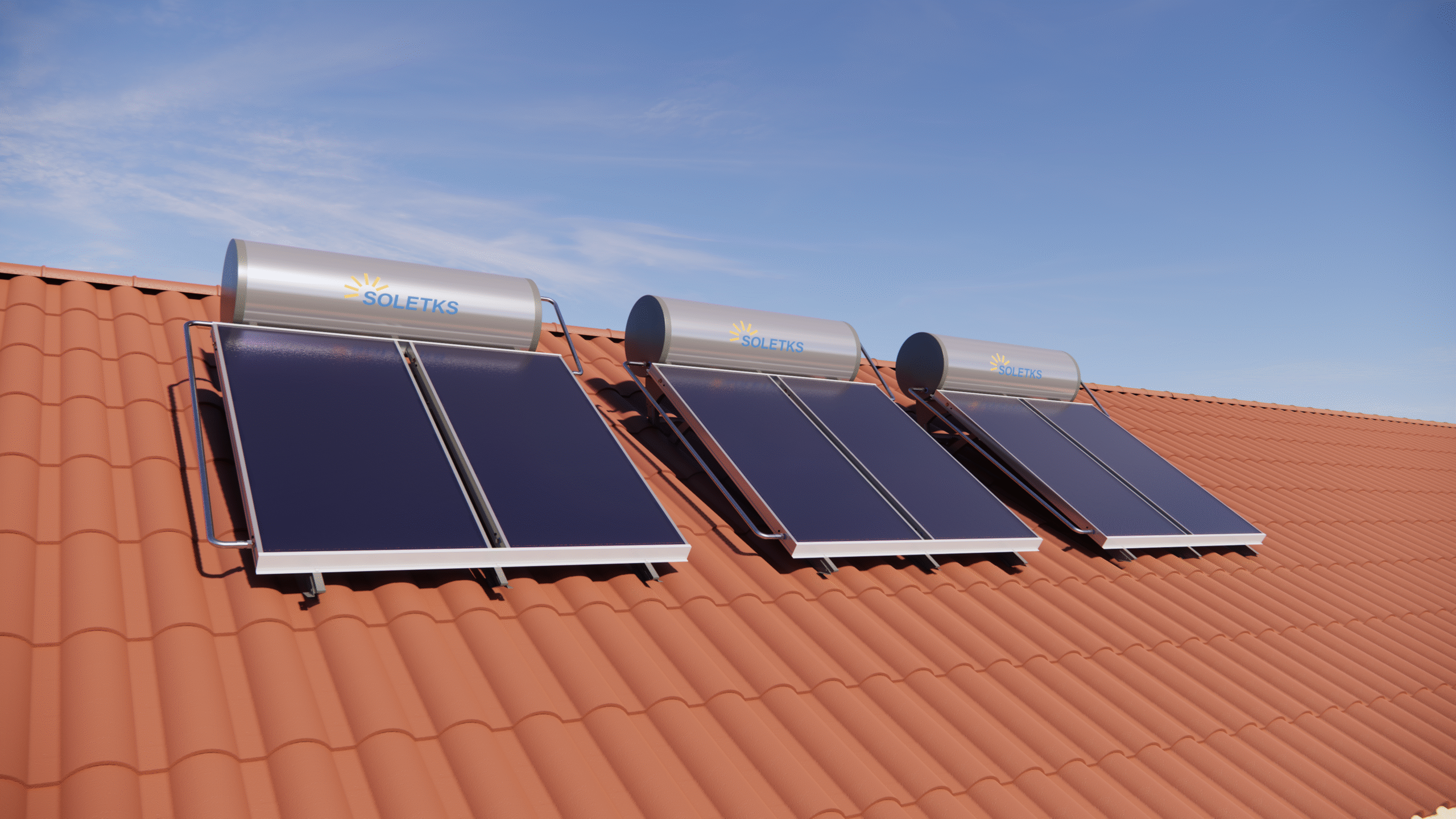
Plana solfångare på en europeisk byggnad - låg profil, arkitektoniskt integrerad
Designen är bedrägligt enkel, men modern teknik har gjort att den optiska effektiviteten har ökat till 0.81 och värmeförlustkoefficienter nedan 2,2 W/(m²-K). Med dessa siffror konkurrerar en plan solfångare med evakuerade rör i de flesta europeiska klimat, samtidigt som den erbjuder överlägsen hållbarhet, enklare underhåll och lägre kostnad per installerad m².
Samlaren är den termisk motor i alla solvärmesystem för varmvatten eller solvärme. Allt nedströms - lagringstankar, pumpar, regulatorer, rörledningar - beror på hur många kWh solfångaranläggningen levererar per kvadratmeter och år.
Viktig distinktion: En platt solfångare värmer en vätska, en fotovoltaisk (PV) panel genererar elektricitet. En PVT-hybridpanel gör båda delarna. Den här artikeln fokuserar uteslutande på termisk plattplatteteknik - kärnan i varje Platt solvärmare med delad solpanel system.
3. Arbetsprincip - från foton till varmvatten
Den termodynamiska kedjan i en plan solfångare består av fyra sekventiella energiöverföringssteg. Genom att förstå varje steg kan upphandlingsteamen utvärdera varför en solfångare presterar bättre än en annan vid identisk strålning.
Platt kollektor Energiöverföringskedja
Steg-för-steg-uppdelning
3.1 Transmission genom glasrutor
Täckglaset måste maximera den kortvågiga soltransmittansen och samtidigt blockera den långvågiga infraröda återstrålningen från absorbatorn. Premium solfångare använder Härdat glas med låg järnhalt och hög vithet med en transmittans på ≥ 91,5 %. Vissa avancerade enheter lägger till en dubbel antireflexbeläggning (AR) för att öka transmittansen till över 95 %, vilket minskar reflektionsförlusterna från ~8 % till ~2 %.
3.2 Absorption vid den selektiva beläggningen
Absorberbeläggningen är den enskilt mest kritiska komponenten för effektiviteten. A högselektiv beläggning har hög absorptionsförmåga (α ≥ 0,94) för kortvågig solstrålning och låg emissivitet (ε ≤ 0,06) för långvågig värmestrålning vid 80 °C. Denna "spektrala selektivitet" stänger inne värmen i solfångaren. SOLETKS tillverkar sina egna BLUE CORE™ PVD-beläggning (Physical Vapour Deposition)-en av få tillverkare i världen med egen kapacitet för selektiva beläggningar av både blåtitan och svartkrom, vilket garanterar strikt kvalitetskontroll från råmaterial till färdig kollektor.
3.3 Ledning till stigarrör
Värme som absorberas av beläggningen måste färdas i sidled genom absorbatorplåten till stigarrören. Den termiska vägen beror på röravstånd, plåtmaterial (koppar eller aluminium), plåttjocklek och bindningskvalitet. Lasersvetsning (används i SOLETKS EFPC-serie) skapar en kontinuerlig metallurgisk bindning överlägsen ultraljuds- eller clip-on-fogar, vilket säkerställer enhetlig värmeöverföring över hela absorbentbredden.
3.4 Konvektiv överföring till vätska
Inuti stigarrören absorberar arbetsvätskan värme genom forcerad konvektion (pumpdriven) eller naturlig konvektion (termosifon). Flödeshastigheten är viktig: för lågt flöde leder till att vätskan överhettas, vilket minskar temperaturdifferensen mellan absorbator och omgivning - vilket ökar strålningsförlusterna. Om flödet är för högt ökar tryckfallet, vilket kräver större pumpar. SOLETKS EFPC-kollektorer är optimerade för lågflödesdesign på 15-30 L/(h-m²), och balanserar effektivitet mot parasitisk pumpenergi.
3.5 Värmetillförsel till lagring
Den uppvärmda vätskan lämnar kollektorröret och leds till en lagringstank, där värmeväxling sker till hushållsvattnet - antingen direkt (öppen slinga) eller genom en värmeväxlare med slinga/platta (sluten slinga med glykol). För europeiska system med forcerad cirkulation är den indirekta konfigurationen med slutet kretslopp standard, vilket ger frysskydd och separering av dricksvatten.
Ekvation för verkningsgrad (EN 12975 / EN ISO 9806)
η = η₀ - a₁ × (Tm − Ta) / G - a₂ × (Tm − Ta)² / G
där η₀ är optisk (topp)verkningsgrad, a₁ är första ordningens värmeförlustkoefficient [W/(m²-K)], a₂ är andra ordningens värmeförlustkoefficient [W/(m²-K²)], Tm är vätskans medeltemperatur, Ta är omgivningstemperaturen och G är instrålningen [W/m²]. En lägre a₁ innebär mindre värmeförlust - avgörande under kalla europeiska vintrar.
4. Olika typer av plana solfångare
Alla plana solfångare är inte likadana. De tre huvudkategorierna betjänar fundamentalt olika marknader och temperaturområden.
4.1 Glasade plana solfångare (standard)
Arbetshästen på den europeiska solvärmemarknaden. En glasad solfångare har ett lock av härdat glas, en selektiv absorbator, stigarledningar av koppar eller aluminium, isolering av mineralull eller glasull och en väderbeständig ram av aluminium eller galvaniserat stål. Typiska öppningsytor varierar mellan 1,8 och 2,5 m² per panel.
| Parameter | Typiskt intervall | SOLETKS BTE 2.0-2 |
|---|---|---|
| Overall area | 1.8–2.5 m² | 2.0 m² |
| Aperture area | 1.6–2.3 m² | 1.87 m² |
| Optical efficiency (η₀) | 72–80 % | 78 % |
| Arbetstryck | 6–10 bar | 0.6 bar (low-flow residential) / 7 bar (tank side) |
| Absorber | Cu or Al, selective coating | Al, mycket selektiv absorptionsbeläggning |
| Ram | Al or galvanised steel | Aluminium |
| Dimensions (L × W × H) | Varies | 2000 × 1000 × 80 mm |
Best for: Residential DHW, small commercial systems, integrated (thermosiphon) solar water heaters, and split forced-circulation systems up to ~20 m² collector area.
4.2 Unglazed Flat Plate Collectors
Unglazed collectors omit the glass cover entirely. They consist of a dark polymer or metal absorber with integral fluid channels, typically made from EPDM rubber or polypropylene. Without glazing, they are inexpensive and lightweight, but their efficiency drops sharply once the fluid temperature exceeds ambient by more than 10–15 °C. They cannot achieve the 50–60 °C delivery temperatures required for DHW.
Fördelar
- Lowest cost per m² of any solar collector type
- Lightweight—minimal roof-load concern
- Excellent for pool heating (25–32 °C)
- UV-resistant polymer absorbers last 15–20 years outdoors
Limitations
- Cannot reach DHW temperatures (50–60 °C)
- High heat loss in windy or cool conditions
- Not eligible for most European subsidy programmes (requires EN 12975 glazed test)
- Unsuitable for space heating or process heat
Best for: Swimming-pool heating, pre-heating cold-water mains in warm climates, agricultural low-temperature applications.
Procurement Note
If your project specification calls for DHW delivery at 45–60 °C—the standard for European hotels, hospitals, and residential buildings—an unglazed collector will not meet the requirement. Always specify glazed or large-format collectors for these applications.
4.3 Large-Format (Engineering-Grade) Flat Plate Collectors
Large-format collectors represent the cutting edge of flat-plate technology. A single panel can exceed 10–15 m² of aperture area, replacing 5–8 standard-format panels. This dramatically reduces the number of hydraulic connections, mounting brackets, and installation hours on commercial rooftops.
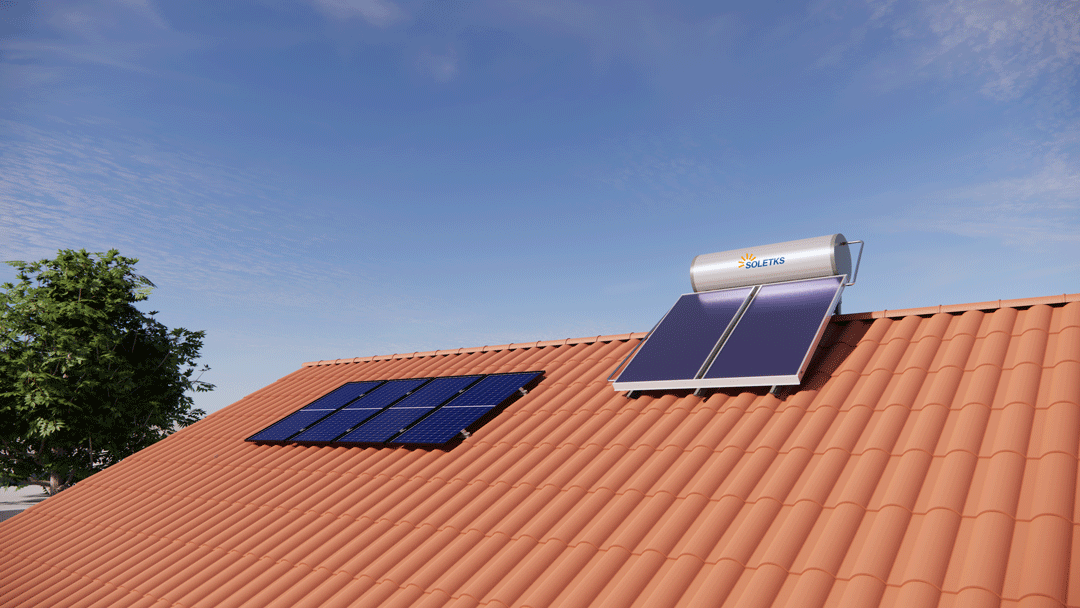
SOLETKS EFPC Series — engineering-grade large-format flat plate collector (up to 15 m² per panel)
| Parameter | EFPC115 | EFPC150 |
|---|---|---|
| Dimensioner (mm) | 5030 × 2270 × 140 | 5960 × 2520 × 166 |
| Surface area (m²) | 11.42 | 15.00 |
| Aperture (lighting) area (m²) | 10.48 | 13.92 |
| Net weight (kg) | 235 | 315 |
| Working pressure (MPa) | 1.0 MPa (10 bar) | |
| Max operating temperature (°C) | 150 | |
| Peak efficiency (η₀) | 0.79 | 0.81 |
| Rated efficiency | 0.66 | 0.68 |
| Heat-loss coefficient | as low as 2.2 W/(m²·K) | |
| Peak power (kW) | 8.28 | 11.26 |
| Specified power @ 400 W/m² | 1.70 kW | 2.03 kW |
| Specified power @ 700 W/m² | 4.30 kW | 5.84 kW |
| Specified power @ 1000 W/m² | 6.85 kW | 9.40 kW |
| Displacement volume (L) | 11.5 | 13.8 |
| Pressure drop | 2 kPa @ 0.22 kg/(m²·s) | |
| Kontakt | HTC40 Quick Connector × 2 (tool-free) | |
Why Large-Format Matters for European Projects
−62 % Installation Space
Fewer panels mean fewer rows, fewer inter-row gaps, and more usable roof area. Critical on commercial rooftops with HVAC equipment, skylights, and safety setbacks.
−64 % Material & Heat Loss
Shorter manifold runs, fewer connections, and reduced edge-loss ratio per m² of absorber. Pipeline length drops directly, cutting both copper cost and thermal loss.
80 % Faster Installation
Modular standardisation with tool-free HTC40 quick connectors. A crew of four can install an EFPC150 array in under a day versus 3–4 days for equivalent standard panels.
+60 % Energy Output
Advanced BLUE CORE™ PVD coating, FEM-optimised flow channels, and insulation-chamber design push annual yield well above conventional flat plates.
Best for: Hotels with 50–200+ rooms, hospitals, district heating, solar cooling, industrial process heat. For a deeper dive into commercial system design, see our kommersiella solvarmvattenanläggningar engineering guide.
5. Flat Plate vs Evacuated Tube — Engineering Comparison
This is the most common comparison question in European tenders. The answer depends on project specifics, but the data consistently favours flat plates for most European DHW and space-heating applications.
| Kriterium | Plattkollektorsystem | Evacuated Tube Collector |
|---|---|---|
| Topp effektivitet | 75–81 % (EFPC150: 0.81) | 70–80 % |
| Heat-loss coefficient a₁ | 2.2–4.0 W/(m²·K) | 1.0–2.5 W/(m²·K) |
| Optimal temperature range | 40–80 °C (DHW + heating sweet spot) | 60–120 °C |
| Durability | No single-point glass failure; 20–25 yr lifespan | Individual tube breakage possible; seal degradation |
| Maintenance | Low — clean glass, check fluid, inspect seals | Higher — tube replacement, vacuum monitoring |
| Wind / hail resistance | Excellent — tempered glass rated for 25 mm hail | Moderate — glass cylinders vulnerable to impact |
| Stagnationstemperatur | 150–200 °C | 200–300+ °C (higher stagnation risk) |
| Roof integration | Flush mount, low profile, aesthetic | Protruding tubes, less aesthetic |
| Cost per m² (installed) | Nedre | Higher |
| Best European use case | DHW, multi-family, hotels, district heating | Industrial process heat >80 °C, cold-climate niche |
Bottom line for European procurement: Evacuated tubes win when you need temperatures above 80 °C or operate in extreme-cold conditions (below −20 °C consistently). For the vast majority of European DHW and space-heating projects (40–60 °C delivery), flat plate collectors deliver better lifetime value per euro invested.
6. Key Components of a Flat Plate Collector
Understanding each layer of the collector helps procurement teams evaluate quality claims and compare suppliers objectively.
Glazing (Cover)
Material: Low-iron super-white tempered glass, 3.2–4.0 mm thick
Transmittance: ≥ 91.5 % (single AR); ≥ 95 % (double AR)
Function: Maximises solar transmission, blocks IR re-radiation, protects absorber from weather
Quality test: EN 12975 hail impact, thermal shock, internal pressure
Absorber & Selective Coating
Substrate: Copper or aluminium sheet (full-area or tube-sheet)
Coating: PVD blue-titanium or black-chrome selective; α ≥ 0.94 (±0.02 @ AM1.5); ε ≤ 0.06 (±0.02 @ 80 °C)
Bond: Laser-welded, ultrasonic, or soldered to riser tubes
SOLETKS edge: In-house BLUE CORE™ PVD coating line; lab-tested η = 0.813
Fluid Circuit (Risers & Headers)
Material: Copper risers (φ8–12 mm); copper headers (φ22–42 mm)
Configuration: Harp, serpentine, or full-area tube-sheet
EFPC header: Copper φ42 × 1.5 mm with HTC40 quick connector
Test pressure: 16 bar (EFPC series); working pressure 10 bar
Insulation & Frame
Bottom insulation: Glass wool 50–80 mm (EFPC: 80 mm glass wool)
Side insulation: Carton fibre 30 mm
Heat-loss coefficient: as low as 2.2 W/(m²·K) — SOLETKS "insulation chamber" design
Frame: High-grade aluminium 6063-T5, frosted white finish; galvanised steel back sheet 0.4 mm
Wind rating: Tested for 14-level wind loads (42–45 m/s)
7. Performance Metrics That Matter for Procurement
Datasheets are full of numbers. Here are the metrics that actually determine system economics and should appear in every tender evaluation matrix.
| Metrik | What It Means | Good Value | SOLETKS EFPC150 |
|---|---|---|---|
| η₀ (peak / optical efficiency) | Maximum efficiency at zero temperature difference | ≥ 0.75 | 0.81 |
| a₁ (1st-order heat loss) | Linear heat loss — lower is better | ≤ 3.5 W/(m²·K) | ~2.2 W/(m²·K) |
| Rated efficiency | Real-world operating efficiency at standard conditions | ≥ 0.60 | 0.68 |
| Stagnationstemperatur | Max absorber temp with no flow — affects glycol life | ≤ 200 °C | 150 °C |
| Arbetstryck | Max sustained operating pressure | ≥ 6 bar | 10 bar (1.0 MPa) |
| Pressure drop | Flow resistance — affects pump sizing | ≤ 5 kPa typical | 2 kPa @ 0.22 kg/(m²·s) |
| Annual yield (kWh/m²) | Total energy per m² per year (climate-dependent) | 400–700 kWh/m² (Central Europe) | 60 % higher than typical flat plates (manufacturer claim) |
How to Read Solar Keymark Datasheets
Every Solar Keymark certificate publishes η₀, a₁, and a₂ based on aperture area (not gross area). When comparing two collectors, always ensure you are comparing the same reference area. A collector with a high η₀ but also a high a₁ will under-perform in cold climates compared to one with a slightly lower η₀ but much lower a₁.
8. EN 12975, EN ISO 9806 & Solar Keymark — What European Buyers Must Know
In Europe, solar collector certification is not optional—it is a market-access requirement. Most national subsidy programmes, building codes, and tender specifications demand Solar Keymark certification, which is based on the harmonised European standards EN 12975 (general requirements) and EN ISO 9806 (test methods).
What Does Solar Keymark Certify?
- Thermal performance: Steady-state and quasi-dynamic efficiency parameters (η₀, a₁, a₂, Kθ) tested under controlled conditions
- Durability and reliability: Exposure test (30 days), high-temperature resistance, rain penetration, thermal shock, mechanical load (snow/wind)
- Säkerhet: Stagnation behaviour, internal pressure test, material toxicity
- Quality management: Factory inspection by a notified body; annual surveillance audits
SOLETKS Certification Portfolio
| Certificate | Scope | Relevance |
|---|---|---|
| Solar Keymark | Flat plate collectors, vacuum tube collectors, solar water heaters | Required for EU market access & subsidies |
| ISO 9001 | Quality management system | Manufacturing consistency |
| ISO 14001 | Environmental management | Green procurement compliance |
| ISO 45001 | Occupational health & safety | Supply-chain due diligence |
| Product certificates | Flat plate, air solar, PVT hybrid, vacuum tube, solar water heater | Full product-line coverage |
Red Flag for Importers
If a supplier cannot provide a valid Solar Keymark certificate number that you can verify on the solarkeymark.eu database, their product is not legally certifiable for most European subsidy programmes. Do not accept "CE marking only" as a substitute—CE does not test solar thermal performance.
9. Sizing Flat Plate Collectors for European Projects
Correct sizing determines whether a solar thermal investment meets its payback target. Undersized arrays disappoint clients; oversized arrays waste capital and create stagnation risk. The methodology below follows EN 15316 (energy performance of buildings) principles and is adapted for quick procurement-level estimation.
Step 1 — Define Daily Hot-Water Demand
| Byggnadstyp | Demand Benchmark | Exempel |
|---|---|---|
| Residential (per person) | 40–60 L/day @ 45 °C | 4-person home → 160–240 L/day |
| Hotel (per room) | 80–120 L/day @ 50 °C | 80-room hotel → 6,400–9,600 L/day |
| Hospital (per bed) | 100–150 L/day @ 55 °C | 200-bed hospital → 20,000–30,000 L/day |
| School (per student) | 5–15 L/day @ 45 °C | 500 students → 2,500–7,500 L/day |
| Industrial laundry | 15–25 L/kg processed @ 60 °C | 2,000 kg/day → 30,000–50,000 L/day |
Step 2 — Calculate Thermal Load
Q = m × cp × ΔT
Where Q is daily thermal energy (kWh), m is daily water mass (kg), cp is specific heat of water (1.163 Wh/(kg·K)), and ΔT is temperature rise (delivery temp minus cold-water inlet).
Exempel: 80-room hotel, 8,000 L/day, inlet 10 °C, delivery 50 °C → Q = 8,000 × 1.163 × 40 / 1000 = 372 kWh/day
Step 3 — Determine Target Solar Fraction
The solar fraction (SF) is the percentage of annual DHW load supplied by solar energy. In European climates, the economic sweet spot is typically SF = 50–70 %. Going above 70 % requires disproportionately more collector area and increases stagnation risk in summer.
Step 4 — Size the Collector Array
| European Climate Zone | Annual Irradiance (kWh/m²) | Collector Area per 1,000 L/day Demand | EFPC150 Panels per 1,000 L/day |
|---|---|---|---|
| Southern (Spain, Greece, S. Italy) | 1,600–2,000 | 1.5–2.5 m² | ~0.15 panels |
| Central (France, Germany, Austria) | 1,000–1,400 | 2.5–4.0 m² | ~0.25 panels |
| Northern (UK, Scandinavia, Baltics) | 700–1,000 | 4.0–6.0 m² | ~0.40 panels |
Step 5 — Size Storage
Rule of thumb for forced-circulation systems: 50–80 L of storage per m² of collector area, or 1.0–1.5 × daily demand. A dual-tank strategy (solar buffer + consumption tank) is recommended for loads above 5,000 L/day to decouple collection from delivery. Tank options range from 150 L residential to 10,000 L commercial, insulated with 50–70 mm polyurethane or mineral wool, in SUS304/316L stainless steel or enamel-coated mild steel.
Need a Detailed Sizing Calculation?
The rules above are for quick estimation. For tender-grade sizing, SOLETKS engineering provides free project-specific calculations including T*SOL or Polysun simulation, hydraulic schematic, and BOM. Send your building type, daily demand, location, and current energy source to our project team.
10. Application Scenarios Across Europe
Residential DHW
1–3 standard collectors (BTE 2.0-2) with a 150–300 L pressurised tank. Covers 60–80 % of annual DHW for a 2–5 person household. Ideal as an integrated thermosiphon in southern Europe or as a Platt solvärmare med delad solpanel in colder regions.
Hotell & Resorter
50–200 room properties require 6,000–24,000 L/day DHW. EFPC large-format collectors reduce rooftop footprint and installation time. Solar fraction 60–85 % achievable in Mediterranean climates; payback 1.8–4.5 years. See our kommersiella solvarmvattenanläggningar guide for sizing tables.
Flerfamiljshus
Centralised solar DHW systems with 30–100+ m² of collector area serve apartment blocks efficiently. Pressurised forced-circulation loops with glycol ensure consistent delivery to all floors. Required by several EU member-state building codes for new construction.
Hospitals & Care Homes
Zero-seasonality DHW loads (sterilisation, laundry, patient bathing) make hospitals ideal for solar thermal. The constant base load maximises solar utilisation and minimises stagnation. Legionella-compliant delivery at 55–60 °C with backup boiler integration.
District Heating (SDH)
Large-scale solar district heating arrays of 1,000–100,000+ m² use EFPC-type collectors. The Shigatse project (Tibet, 107,000 m²) demonstrates flat-plate viability at extreme scale and altitude, replacing 2,424 tonnes of coal annually.
Industriell processvärme
Pre-heating boiler feed water, wash-water for food processing, or drying processes up to 80 °C. Flat-plate collectors integrate with existing process loops via plate heat exchangers. ROI is strongest where gas prices are high and solar irradiance is moderate-to-good.
11. Real-World Case Studies — SOLETKS Projects
Specifications and lab data matter, but nothing validates a product like deployed projects operating under real conditions. Here are five reference installations spanning residential, commercial, and district-heating scales.
| Project | Year | Location | Scale | Key Outcome |
|---|---|---|---|---|
| Saga County Solar District Heating | 2019 | Shigatse, Tibet (4,600 m altitude) | 107,000 m² heated area | Replaces 2,424 t coal/yr; world's first high-altitude solar centralised heating |
| APEC Summit Hotel DHW | 2014 | Beijing, China | 50 t/day hot water | Saves 150,000 kWh/yr; reduces CO₂ by 74 t/yr |
| Tianjin School TPV Pro+ | 2024 | Tianjin, China | 3,000 m² system | Combined solar heating + on-site electricity generation via PVT/heat-pump hybrid |
| Florida Resort Villas | 2022 | Florida, USA | 200 L/day per villa | Individual flat-plate water heaters per unit; high solar fraction year-round |
| Harz Church DHW | 2021 | Harz, Germany | 22 t/day hot water | Series/parallel collector configuration; reliable cold-climate performance |
European Relevance: The Harz Church project (Germany, 2021) is particularly instructive for European procurement. Located in a cold Central-European climate with limited winter irradiance, the system demonstrates that correctly engineered flat-plate arrays deliver reliable DHW even when conditions are far from Mediterranean. Series/parallel hydraulic design and glycol-based freeze protection are key enablers.
12. Flat Plate Collector Selection Checklist for European Projects
Use this checklist when evaluating collector offers from any supplier. Every item should have a clear, documented answer before you issue a purchase order.
Pre-Purchase Evaluation Checklist
- Solar Keymark certificate: Valid number verifiable on solarkeymark.eu; tested per EN ISO 9806
- Efficiency parameters: η₀ ≥ 0.75; a₁ ≤ 3.5 W/(m²·K); a₂ documented
- Absorber coating: Selective type specified (PVD, sputtered, or electroplated); α ≥ 0.94, ε ≤ 0.06
- Glazing: Low-iron tempered glass ≥ 3.2 mm; transmittance ≥ 91 %; AR coating if specified
- Frame material: Aluminium 6063-T5 or equivalent; corrosion protection for coastal/industrial environments
- Working pressure: ≥ 6 bar for residential; ≥ 10 bar for commercial/district heating
- Test pressure: ≥ 1.5 × working pressure documented
- Insulation: ≥ 50 mm mineral wool or equivalent; back-plate specification
- Connection type: Standard compression, quick-connect, or flanged; compatible with your hydraulic design
- Wind-load rating: Documented for your installation region (Eurocode wind zones)
- Stagnation temperature: Documented; compatible with your glycol and system design
- Garanti: ≥ 10 years on collector; ≥ 5 years on absorber coating
- ISO certifications: 9001 (quality), 14001 (environmental), 45001 (safety)
- Factory audit: Available for OEM/large orders; third-party audit reports accessible
- Reference projects: Verifiable installations in similar climate and building type
- Engineering support: System sizing, hydraulic design, T*SOL/Polysun simulation available
- Logistics: Packaging for sea/road transport; pallet dimensions compatible with your warehouse
- Spare parts: Glass, seals, and absorber available for 15+ years
Quick Decision Matrix — Which Collector Type?
Match your project profile to the right flat-plate category:
- Residential DHW (1–5 persons, warm/moderate climate): Standard glazed collector (e.g., SOLETKS BTE 2.0-2) in thermosiphon or split configuration
- Multi-family or small commercial (10–50 m² array): Standard glazed collectors in forced-circulation loop with glycol
- Large commercial / hotel / hospital (>50 m² array): Large-format EFPC collectors for fastest installation and lowest per-m² installed cost
- District heating / industrial (>500 m² array): EFPC large-format with custom hydraulic design; contact SOLETKS engineering
- Pool heating only (25–32 °C delivery): Unglazed polymer collectors (not SOLETKS core product)
13. Conclusion — Specifying Flat Plate Collectors With Confidence
The flat plate solar collector is the proven backbone of European solar thermal infrastructure. Its combination of durability, predictable mid-temperature performance, architectural integration, and competitive lifecycle cost makes it the default choice for DHW, space heating, and an expanding range of commercial and industrial applications.
For European B2B buyers, the selection process comes down to five decisions: collector type (glazed standard vs large-format), performance class (η₀ and a₁ parameters), certification validity (Solar Keymark), system architecture (thermosiphon vs forced circulation), and supplier capability (engineering support, warranty, and reference projects).
The right collector is not the one with the highest peak efficiency on paper—it is the one that delivers the most kWh per euro over 20 years in your specific climate, on your specific building, with your specific maintenance capacity. That requires engineering, not just a datasheet.
SOLETKS offers the full spectrum—from the compact BTE 2.0-2 (78 % optical efficiency, 2 m² aperture, 7 bar system pressure) for residential split and integrated systems, to the EFPC150 (peak efficiency 0.81, 15 m² aperture, 10 bar, heat-loss coefficient 2.2 W/(m²·K)) for commercial mega-projects. With 117+ patents, Solar Keymark and ISO triple certification, and a project portfolio spanning 236,000+ m² of installed collector area across four continents, the engineering depth is there to back every quote.
Ready to Specify? Three Ways to Start
Whether you need a quick budgetary quote, a full engineering package, or OEM/private-label supply, SOLETKS engineering is ready to support your European project.
Option A — Quick Quote
Send collector model, quantity, and destination. Receive FOB pricing within 24 hours.
Option B — Project Design
Send building type, daily demand (L/day), location, and current energy source. Receive system sizing, hydraulic schematic, ROI analysis, and full BOM within 48 hours.
Option C — OEM / Distribution
Discuss private-label, MOQ, packaging, and logistics for European warehouse delivery. Factory audit welcome.
Or email directly: export@soletksolar.com
Frequently Asked Questions
Q1: What is the lifespan of a flat plate solar collector?
A well-manufactured glazed flat plate collector has a design life of 20–25 years. The absorber coating and glass are the longest-lived components. Seals and insulation may need replacement after 15–20 years. SOLETKS EFPC collectors are designed for continuous operation with minimal degradation thanks to the BLUE CORE™ PVD coating and insulation-chamber structure.
Q2: Do flat plate collectors work in cloudy European climates?
Yes. Flat plate collectors capture both direct and diffuse solar radiation. In northern-European climates (UK, Scandinavia), annual yields of 350–500 kWh/m² are typical for high-quality collectors, delivering 40–60 % solar fraction for DHW. The EFPC series' high optical efficiency (η₀ = 0.81) and low heat-loss coefficient (2.2 W/(m²·K)) maximise output in low-irradiance conditions.
Q3: How does a flat plate collector compare to a PV panel for hot water?
A flat plate collector converts roughly 60–75 % of intercepted solar energy into heat, versus 18–22 % electricity from a PV panel. For dedicated DHW production, solar thermal delivers 3–4× more useful energy per m² than a PV panel powering a resistance heater. However, PV + heat pump can compete on efficiency. The choice depends on electricity price, available roof space, and whether you also need electricity. SOLETKS also offers PVT hybrid systems that combine both functions.
Q4: What freeze protection do I need in Europe?
For any European location where temperatures may drop below 5 °C, a closed-loop glycol system is mandatory. The collector loop circulates a propylene-glycol/water mixture (typically 30–40 % glycol concentration, depending on minimum expected temperature) and transfers heat to potable water via a heat exchanger. Glycol should be tested annually and replaced every 3-5 år. SOLETKS forced-circulation systems come with pre-configured pump stations (Grundfos 15-65 130 or Wilo ST20/11) and differential-temperature controllers (SR258 or FTC-6) designed for glycol loops.
Q5: Is Solar Keymark certification really necessary?
For the European market, yes. Solar Keymark is the de facto standard for accessing national subsidy programmes (Germany's BAFA, France's MaPrimeRénov', etc.), meeting building-code energy-performance requirements, and satisfying tender specifications. It is based on EN 12975 and EN ISO 9806 testing at accredited laboratories. SOLETKS holds valid Solar Keymark certificates for its flat-plate, vacuum-tube, and solar water heater product lines.
Q6: Can I use flat plate collectors for space heating, not just DHW?
Absolutely. Flat plate collectors are widely used for solar combisystems that supply both DHW and underfloor/radiator heating. The key is sizing the collector array and buffer tank for the combined load, and ensuring the system controller prioritises DHW over space heating. In well-insulated European buildings with low-temperature heating (30–40 °C flow), flat-plate combisystems can achieve 30–50 % annual solar fraction for the total heating load.
Q7: What maintenance does a flat plate collector system require?
Annual maintenance includes: visual inspection of glazing and frame for damage, checking glycol concentration and pH (replace if degraded), verifying pump operation and controller settings, flushing the system if pressure drop increases, and cleaning the glass cover if soiled. Budget $200–400/year for routine professional service. Total 25-year maintenance cost: $7,000–16,000 depending on system size.
Related SOLETKS Resources
Product Pages
Plan solfångare - Standardspecifikationer för BTE-serien
Storformatssolfångare av hög teknisk kvalitet - EFPC-serien
Plattplatt delad solvärmd varmvattenberedare - Kompletta system för forcerad cirkulation
Integrerad solvärmd varmvattenberedare - Termosifonenheter
Guider och artiklar
Komplett guide för val av solvärmd varmvattenberedare
Kommersiella solvärmesystem för varmvatten - tekniska principer
Vanliga frågor om solvärmda varmvattenberedare för bostäder
Kom igång
Kontakt SOLETKS - Begär en offert, projektdesign eller fabriksrevision
Om SOLETKS - Företagsprofil, patent och global ranking