
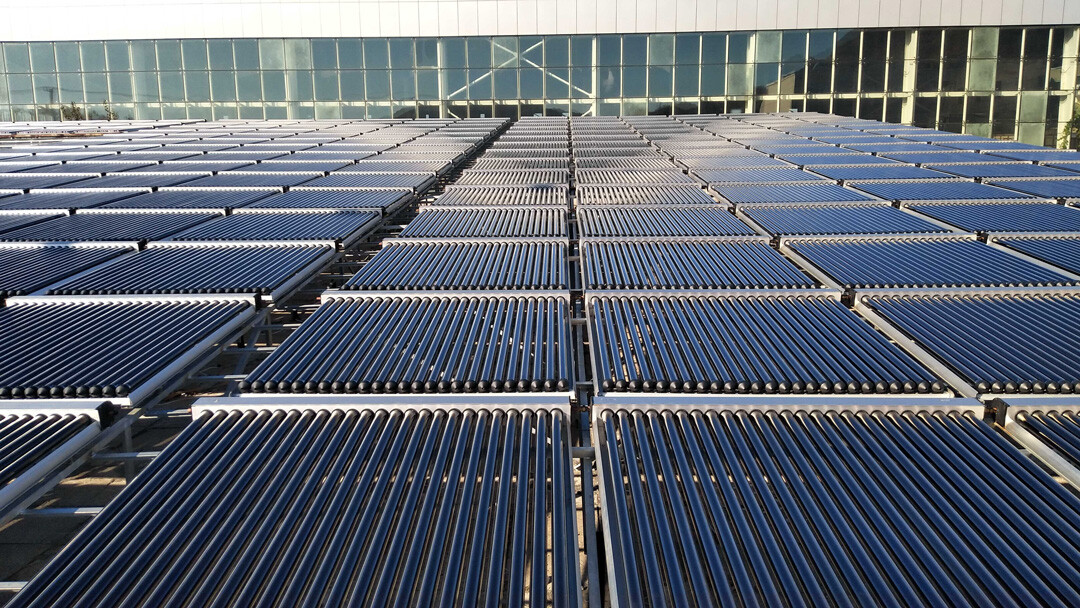
Most explanations of evacuated tubes stop at "the vacuum keeps the heat in." That is true, but it doesn't help you choose a collector. The questions buyers and engineers actually ask are practical. How does heat get out of the tube? What happens in winter? Why does one quotation have a 0.6 MPa rating while another can't be pressurized at all? This guide answers those questions step by step.
1. The anatomy of an evacuated tube
Every evacuated tube, whatever the collector design, is built from the same basic parts:
| Part | What it does |
|---|---|
| Outer glass tube | A transparent borosilicate glass shell. It lets solar radiation in and forms the outer wall of the vacuum. |
| Inner glass tube | Carries a selective absorber coating on its outer surface. The coating absorbs most of the incoming sunlight and gives off very little heat as infrared radiation. |
| Vacuum gap | The evacuated space between the two glass walls. With almost no air present, heat can't escape by conduction or convection. |
| Barium getter | A small deposit at the tube end that absorbs stray gas molecules and keeps the vacuum intact. It looks silver when the vacuum is good. |
| Heat-extraction element | The part that carries heat out of the tube. This can be a heat pipe with an aluminium fin, a copper U-pipe with a fin, or simply the water inside the tube. |
As a reference point, SOLETKS HPC heat-pipe collectors use Φ58 × 1800 mm vacuum tubes. The outer wall is 2.0 mm thick and the inner wall 1.6 mm. Inside, 3003 anti-rust aluminium fins (0.2 mm thick, 1620 mm long) transfer heat from the glass to the heat pipe.
2. Why the vacuum matters
A solar collector loses heat in three ways: conduction, convection and radiation.
- Conduction and convection need a medium: air touching hot surfaces and carrying heat away. In a flat plate collector, the air gap between glazing and absorber loses heat this way, and the loss grows as the absorber gets hotter than the outside air.
- In an evacuated tube, the vacuum removes that medium. Conduction and convection losses from the absorber are almost eliminated.
- Radiation still crosses a vacuum. The selective coating keeps it low because the coating is designed to absorb short-wave sunlight well and emit very little long-wave infrared.
The practical result is that evacuated tubes lose heat slowly even when the absorber is much hotter than the surrounding air (see the U.S. Department of Energy's overview of solar water heaters and collector types). That is why they hold up well in cold, windy climates and in applications that need higher temperatures.
Common misconception: "evacuated tubes are always more efficient." They aren't. At low temperature differences, such as pool heating or warm-climate preheating, a good flat plate collector can deliver as much heat per square metre of roof, and sometimes more. The advantage of evacuated tubes grows as the difference between collector temperature and outdoor temperature grows. See our evacuated tube vs flat plate comparison for the full trade-off.
3. Three ways to get the heat out
The vacuum keeps heat in the tube. The heat-extraction design decides how that heat reaches your storage tank, and this is where evacuated tube collectors really differ.
3.1 Heat-pipe collectors (e.g., SOLETKS HPC series)
A heat pipe is a sealed copper tube holding a small amount of working fluid under low pressure. It sits inside the evacuated tube, pressed against an aluminium fin that touches the inner glass wall.
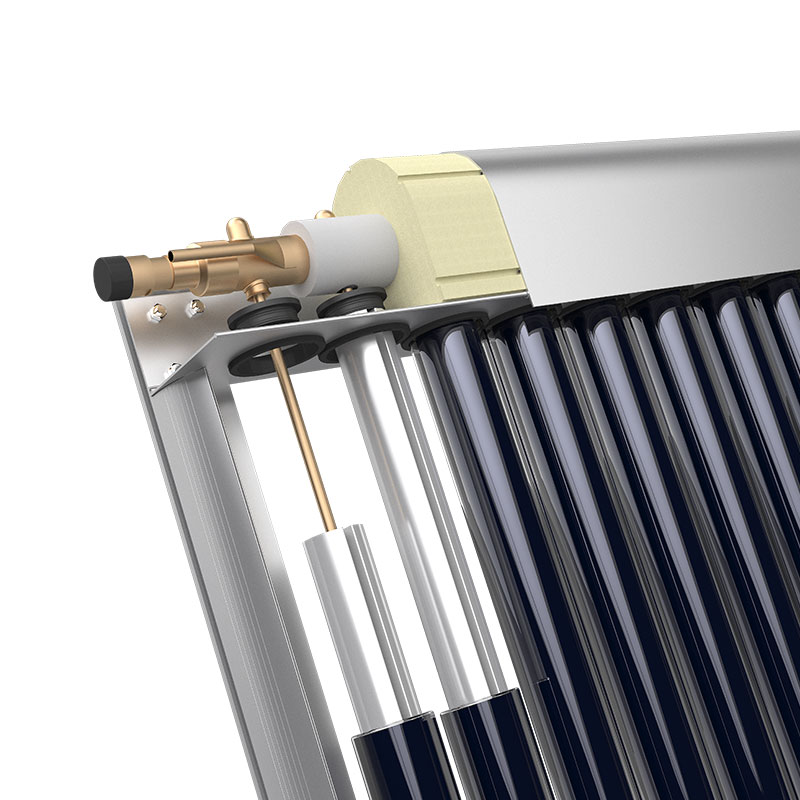
How it works, step by step:
- Sunlight passes through the outer glass and is absorbed by the selective coating on the inner tube.
- The aluminium fin conducts that heat to the copper heat pipe.
- The working fluid in the heat pipe evaporates at a low temperature because of the low internal pressure.
- The vapour rises to the condenser bulb at the top of the heat pipe. The bulb sits in a dry pocket in the insulated manifold.
- The vapour condenses and releases its latent heat through the pocket wall into the system fluid flowing through the manifold.
- The condensed liquid runs back down the heat pipe by gravity, and the cycle repeats while the sun shines.
What this means in practice:
- System fluid never enters the glass tubes. It only flows through the manifold header, so the collector can run as a pressurized closed loop. SOLETKS HPC collectors are rated for 0,6 MPa çalışma basıncı hem de 120 °C maksimum çalışma sıcaklığı.
- Tubes can be replaced without draining the system. A "dry" connection means a broken tube can be swapped while the loop stays full and pressurized.
- Heat flows one way. At night, heat doesn't easily travel back from the manifold to the cold tubes. This helps cold-climate heat retention.
- Tilt matters. The condensed liquid needs gravity to return, so heat pipes must be installed above a minimum tilt angle. Always check the allowed tilt range in the installation manual for the exact model.
3.2 U-pipe (direct-flow) collectors
In a U-pipe collector, a copper U-shaped pipe runs down inside each evacuated tube and back up, pressed against an aluminium fin. The system fluid itself flows through every tube.
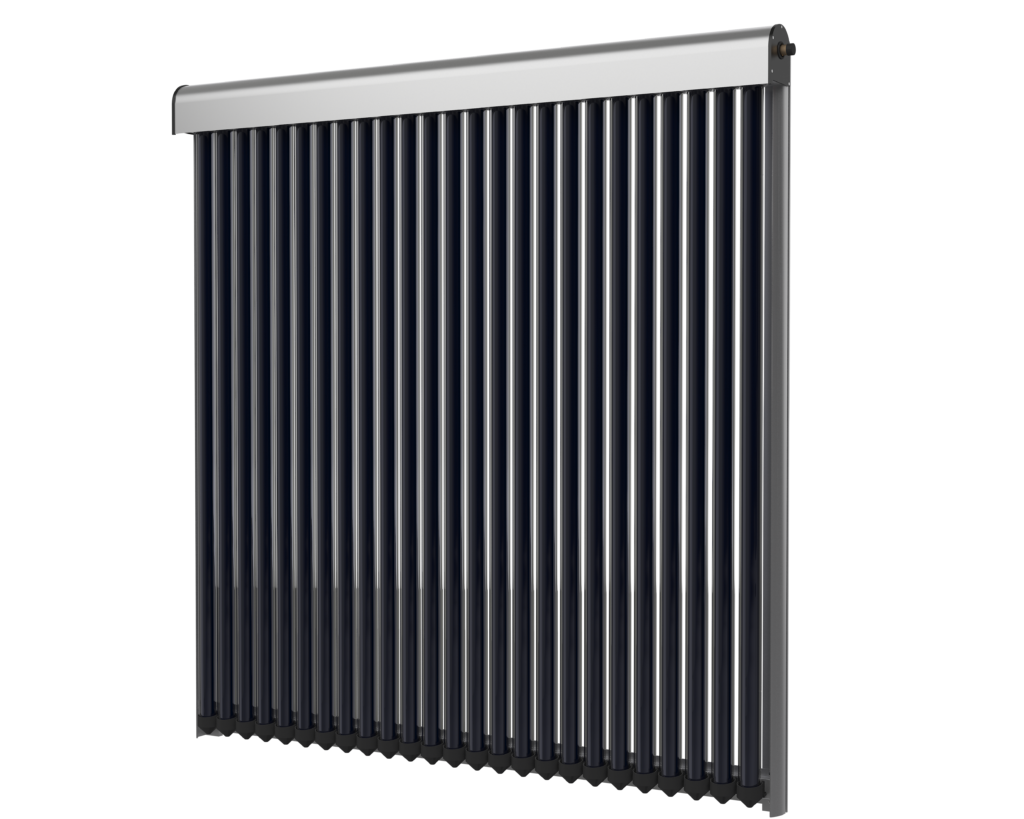
- Heat passes directly from the fin into the moving fluid, with no phase change and no condenser step. Response is quick and tilt angle is flexible, including horizontal or wall mounting.
- The circuit can be pressurized because the fluid stays inside copper, not glass.
- The trade-offs: a broken glass tube doesn't release fluid, but you can't remove the copper U-pipe without opening the circuit. Donma koruması must cover the fluid path through every tube. In cold climates that usually means an indirect glycol loop or a drainback design. Flow balancing across large arrays also needs careful hydraulic design.
3.3 Water-in-glass (all-glass thermosiphon) collectors
The simplest design. Water from the storage tank fills the inner glass tube directly.
- Water heated against the absorber becomes lighter and rises into the tank. Cooler water sinks down the other side of the same tube. This continuous thermosiphon micro-circulation heats the tank without a pump.
- Low cost and simple. That's why this design is common on rooftop compact solar water heaters.
- Limitations: the glass tube holds the water, so the system is usually non-pressurized or low-pressure. If a tube breaks, water escapes and the system must be refilled. Hard water can scale the inside of the tubes. In freezing climates, the exposed water and connections need their own protection.
Side-by-side comparison
| Faktör | Heat pipe | U-pipe / direct-flow | Water-in-glass |
|---|---|---|---|
| Does system fluid enter the glass? | No (manifold only) | Yes (inside copper) | Yes (directly in glass) |
| Pressurized operation | Yes, typical | Yes, possible | Usually no / low pressure |
| Tüp değişimi | Dry swap, no draining | Opens the circuit | Drain and refill |
| Installation tilt | Must be above a minimum angle | Flexible, including horizontal | Must suit thermosiphon flow |
| Freeze exposure inside tubes | Very small fluid volume, sealed | Full fluid path exposed | Water directly exposed |
| Typical use | Pressurized DHW, commercial, cold climates, preheating | Facades, flat roofs, flexible layouts | Compact residential heaters, warm climates |
4. How much heat does an evacuated tube collector actually deliver?
Collector output depends on three things: how much sun hits the aperture, how efficiently the coating captures it, and how fast the collector loses heat as it gets hotter. A simplified first-order model is:
η ≈ η₀ − a₁ × (T_collector − T_ambient) / G
where η₀ is the optical (peak) efficiency, a₁ is the heat-loss coefficient, and G is the solar irradiance in W/m².
Illustration using published SOLETKS HPC values. The published values are 0.724 peak efficiency and a total heat-loss coefficient of 2.453 W/(m²·K). Take G = 1,000 W/m² and a collector running 40 K above the outdoor air:
- η ≈ 0.724 − 2.453 × 40 / 1,000 ≈ 0.724 − 0.098 ≈ 0.63
Now take a cloudy-bright winter day with G = 500 W/m² and the same 40 K difference:
- η ≈ 0.724 − 2.453 × 40 / 500 ≈ 0.724 − 0.196 ≈ 0.53
Efficiency falls as the temperature difference grows and as sunlight weakens. It falls slowly here because the vacuum keeps the heat-loss coefficient small. This is the physics behind the claim that evacuated tubes "perform in winter."
This is a simplified illustration, not a yield guarantee. Real output depends on the full test curve (including second-order losses), the reference area, incidence angle, flow rate, pipe losses, storage, controls and local weather. For project sizing, ask for the model-specific test data and an annual yield calculation.
SOLETKS publishes the specified power at 1,000 W/m² for each HPC model: 0.72 kW to 1.80 kW, rising with tube count. The five models are HPC182, HPC240, HPC298, HPC370 and HPC442, with 12, 16, 20, 25 or 30 tubes. Gross collector area runs from 1.82 to 4.42 m² and lighting (aperture) area from 1.20 to 3.00 m². Compare collectors on the same area basis. Gross area and aperture area give very different efficiency figures for the same product.
5. What happens in winter, at night and on very hot days
Cold weather. The vacuum insulates the absorber, so evacuated tubes keep collecting useful heat in cold, sunny conditions where many flat plate collectors struggle. The rest of the system still needs freeze protection: the manifold, outdoor piping and heat exchanger. Heat-pipe tubes hold very little sealed fluid, but they don't remove the need for a freeze strategy. See freeze protection for solar hot water systems.
Snow. The vacuum insulates so well that the outer glass stays close to air temperature. Snow on the tubes can therefore melt more slowly than on a flat plate collector. Plan tilt, row spacing and snow clearance for snowy sites.
Night. Heat-pipe collectors act almost like a one-way valve. Heat doesn't easily flow back from the warm manifold into cold tubes. Pumped systems still need correct controller logic so the pump doesn't run when the collector is colder than the tank.
Stagnation and overheating. Good insulation means high stagnation temperatures when there is no heat demand, for example a closed school in summer. The system must be designed for this: expansion vessels sized for steam, pressure relief, heat-dump or night-cooling strategies, and fluids rated for the temperatures involved. The HPC series' 120 °C maximum operating temperature is a design boundary for the system, not a target.
Project example: evacuated tubes in a Central Asian winter
The vacuum's cold-weather advantage shows up clearly in SOLETKS' Orta Asya Temiz Kampüs Isıtma Projesi in Kazakhstan (2023). The project uses U-tube evacuated collectors, the direct-flow design described in section 3.2, chosen for their thermal efficiency and resistance to low temperatures. According to SOLETKS project records, the system covers a total heating area of 12,600 m² and meets the winter heating demand of the campus office buildings, teaching buildings and laboratories. The U-tube design suited the project because heat has to reach the building's heating circuit directly in deep winter, with a closed, pressurized fluid path through every tube. See more on the SOLETKS featured projects page.

6. Evacuated tube or flat plate: when does each make sense?
Evacuated tubes are usually the stronger candidate when:
- the required temperature is well above the outdoor temperature (higher-temperature hot water, process preheating);
- the site is cold, windy or has long winters;
- roof area is limited and output per square metre at high temperature difference matters;
- you need a pressurized collector loop with tube-level serviceability (heat pipe).

Flat plate collectors are often the better fit for moderate-temperature domestic hot water in mild or sunny climates, large commercial arrays where robustness and simple maintenance come first, and integration into architecture. SOLETKS manufactures both. Flat plate solar collectors are the group's core product, and we specify the collector that fits the load, not the one that sounds more advanced.
7. The SOLETKS evacuated tube range
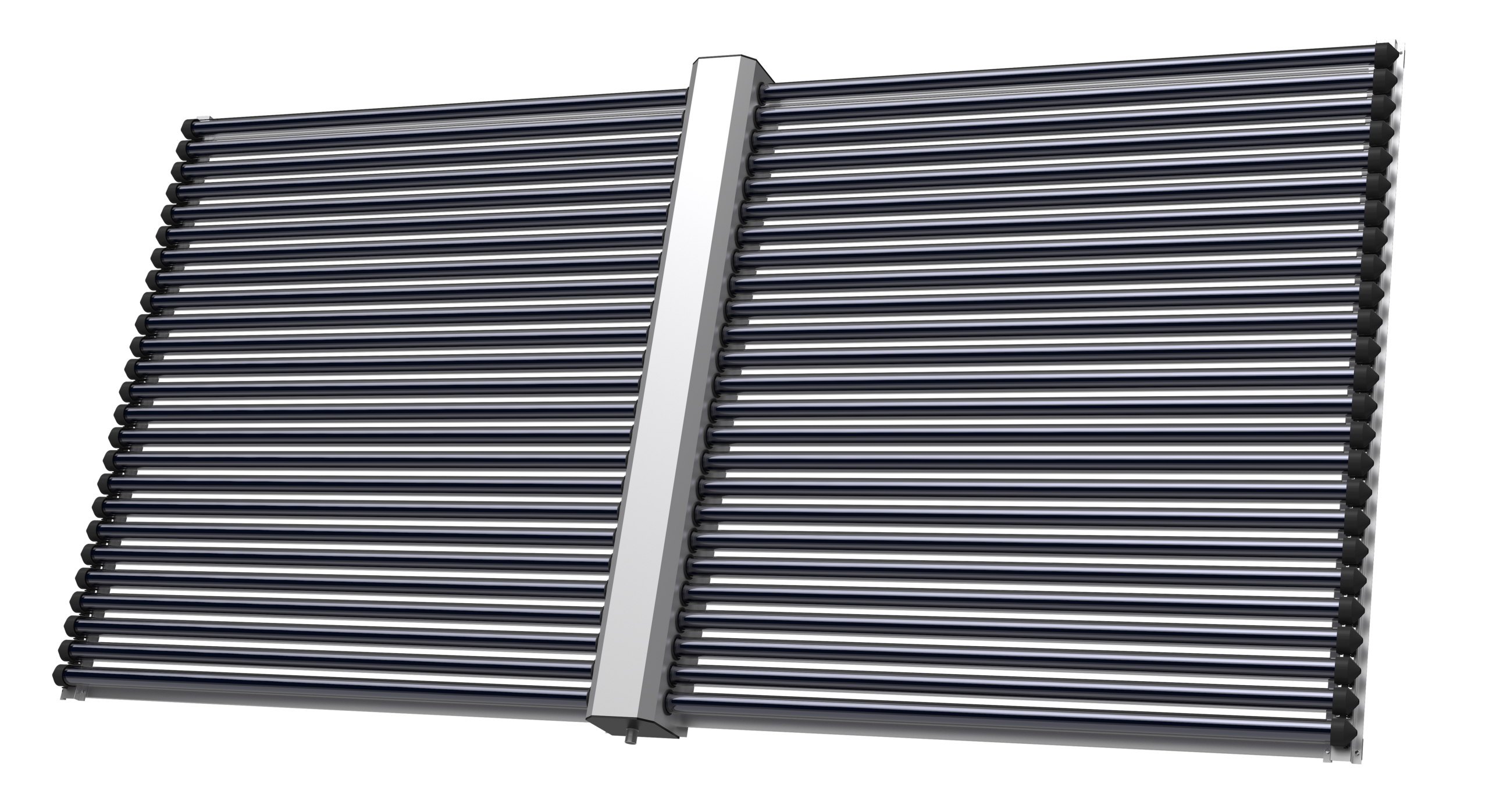

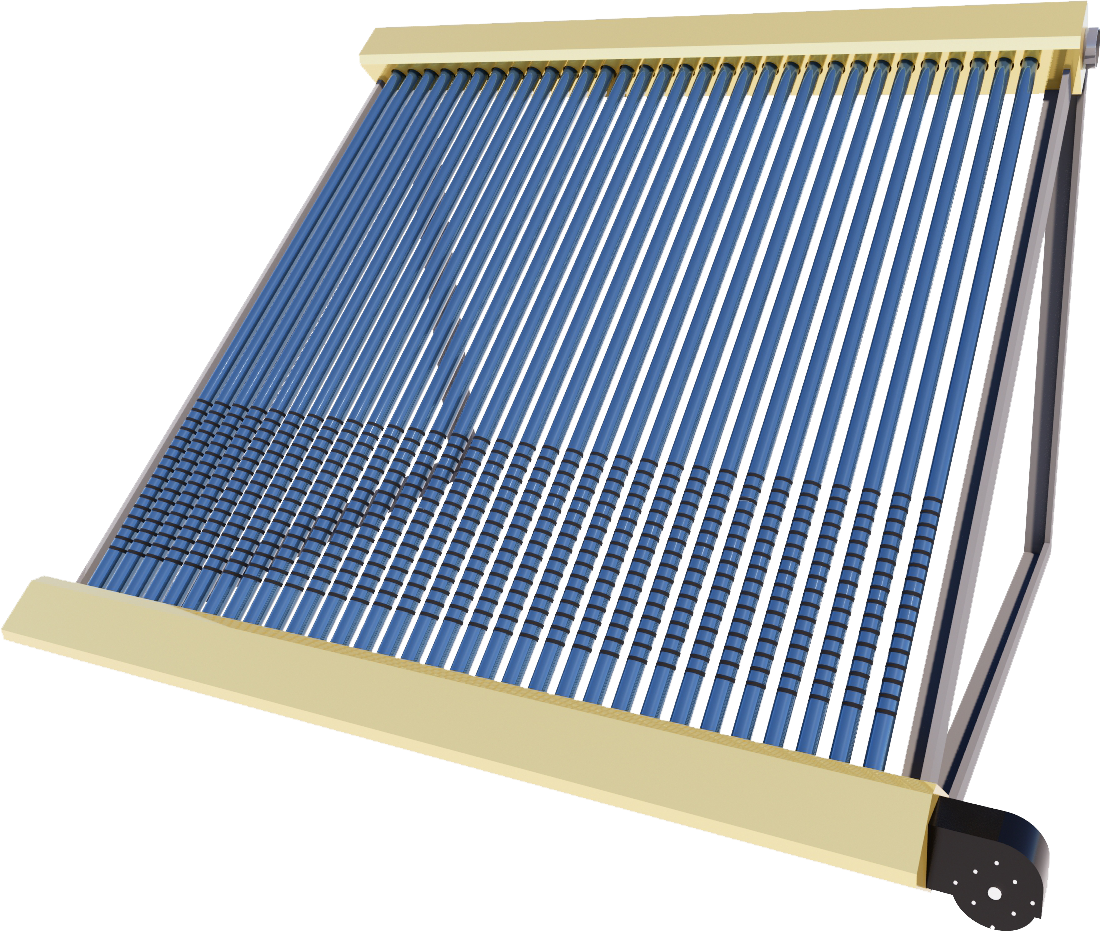
| Range | Heat-transfer approach | Best suited to |
|---|---|---|
| HPC heat-pipe collector | Sealed heat pipes into a manifold; pressurized | Split solar water heaters, commercial hot water, hotels, schools, hospitals, factories, industrial preheating, cold-climate projects |
| CTC hot-water collector | Evacuated-tube hot-water collector | Domestic hot water, central supply and thermal process projects; confirm the exact fluid path and pressure rating on the current model datasheet |
| DVC air collector | All-glass double-pass vacuum tube using air as the medium | Space heating, ventilation preheating and drying, not water heating |
Unsure whether CTC or HPC suits your project? Read our CTC vs HPC selection guide. Full HPC model data is in the HPC heat-pipe collector guide. For system-level design (array layout, hydraulics, storage and RFQ data), see the evacuated tube collector selection and engineering guide.
8. Frequently asked questions
How do evacuated tubes work in simple terms?
Each tube works like a thermos flask. Sunlight gets in through clear glass, a dark selective coating turns it into heat, and the vacuum stops that heat escaping. A heat pipe, a copper U-pipe or the water itself then carries the heat to your tank.
Do evacuated tube collectors work on cloudy days?
They collect diffuse light as well as direct sunlight, so they produce some heat under bright cloud. Output is much lower than in full sun, though. Size the system on annual irradiation data and include backup heating.
Can I replace a broken evacuated tube myself?
In a heat-pipe collector, tubes connect "dry" to the manifold and can usually be replaced without draining the system. Follow the manufacturer's procedure and safety guidance. Glass can break, and the heat pipe may be very hot in sunlight. Water-in-glass systems must be drained first.
What is the white or clear patch at the bottom of a tube?
The silver barium getter shows the vacuum is intact. If it turns white or milky, the tube has lost its vacuum and should be replaced.
Are heat-pipe tubes and water-in-glass tubes interchangeable?
No. They use different internal parts and different manifold connections. Always order replacement tubes that match the exact collector model.
Does a heat pipe remove the need for antifreeze?
Not on its own. The heat pipe contains only a small sealed charge, but the manifold, piping and heat exchanger still need a complete freeze-protection strategy for your climate.