
Durable Flat Plate Solar Collectors Selection Criteria for Commercial Hot Water
Durable flat plate solar collectors selection criteria covering absorber coating, glazing, frame, efficiency curve, degradation, warranty, and RFQ data.
بواسطة فريق SOLETKS الهندسي — the solar collector application group at a Top-5 global flat-plate manufacturer with 117 براءة اختراع وأكثر, أكثر من 160 خطوة فحص أثناء الإنتاج, and a proprietary nano-absorption selective coating. We have deployed flat-plate collectors at every scale: Florida coastal villas (USA, 2022), ، الـ فندق قمة آبيك (بكين، 2014، 50 طنًا في اليوم، توفير 150,000 كيلوواط/ساعة سنويًّا), ، الـ engineering-grade Harz church plant in Germany (2021, 22 t/day), ، و EFPC115 large-aperture array at Saga County, Tibet (2019, 107,000 m², 2,424 t coal/yr avoided) — the world’s first high-altitude centralized solar heating plant.
Scope of this guide: durability and procurement checks for absorber coating, glazing, frame, insulation, pressure rating and warranty evidence. It does not repeat the site’s basic flat-plate working-principle or annual-yield comparison guides.
TL;DR — إجابة موجزة
A durable flat plate solar collector is selected by 10 parameters, not just sticker efficiency:
- مساحة الفتحة (NOT gross area — see §3)
- Absorber coating (selective coating type + emissivity)
- Glazing (tempered solar glass + seal detail)
- Frame material (aluminium standard, coastal/industrial may need upgrade)
- ضغط العمل (must match hydraulic boundary)
- Optical efficiency (η₀) + heat-loss coefficients (a1, a2)
- درجة حرارة الركود (defines worst-case glycol exposure)
- Test certificate (ISO 9806 + Solar Keymark for EU markets)
- Mounting compatibility (roof load, wind, snow)
- سهولة الخدمة (sensor ports, hydraulic connection style)
A durable collector is NOT the panel with the most attractive brochure photo. It is the collector that keeps useful heat output, weather resistance, and serviceability under the project’s real climate and water-heating temperature.
النقاط الرئيسية:
1. Compare aperture area instead of only gross size.
2. Ask for optical AND heat-loss test data (the η₀, a1, a2 triple).
3. Match working pressure to the system boundary.
4. Specify corrosion and insulation requirements based on site climate.
5. Link collector choice to storage, pump station, and backup heat — never select in isolation.
SOLETKS publishes flat plate solar collector ranges under its solar collector category and engineered commercial hot-water plants under the نظام تسخين المياه بالطاقة الشمسية التجاري/الصناعي scope.[1]
1. Selection Answer
A durable flat plate collector should be selected by the heat the project needs, the temperature it must deliver, the climate it will face, and the maintenance plan the owner can actually follow. The U.S. Department of Energy describes flat-plate collectors as insulated, weatherproof boxes containing a dark absorber under transparent cover plates — which is why glazing, insulation, absorber, and frame quality all affect durability.[2] ASHRAE’s HVAC Applications Handbook treats collector durability as a system-level outcome — not a panel-level rating.[10]
| معيار | Good fit for flat plate | Risk trigger |
|---|---|---|
| Hot-water range | 45–70 °C commercial hot water[1] | Higher temperature demand with limited area → consider ET/heat-pipe |
| المناخ | Warm, temperate, or mixed | Harsh freeze climate without closed-loop design |
| Mounting | Roof or ground with service access | Hidden roof zones with no walkway |
| Water loop | Direct (low-risk climates) OR indirect glycol | Hard water, chloride risk, freeze exposure |
| Durability focus | Glazing + coating + frame + seal + insulation | Only comparing price per panel |
2. SOLETKS Flat-Plate Range — Models in Real Projects
| Model family | Typical use | Reference project |
|---|---|---|
| Standard flat plate (2.0 m²) | Residential + small commercial | Florida resort villas (USA, 2022) — coastal UV exposure |
| Engineering hot-water collector | Mid-size commercial (hotel / dormitory / hospital) | APEC Summit hotel (Beijing, 2014, 50 t/day) + Harz church (Germany, 2021, 22 t/day) |
| EFPC115 large-size flat plate | Industrial / large-area centralized heating | Saga County, Tibet (2019, 107,000 m²) — enlarged absorption area lowers cost per watt at scale |
| نظام هجين PVT (related product line) | Hybrid heat + power applications | Tianjin school PVT Pro+ (2024, 3,000 m²) |
Why this matters for procurement: matching the right product line to project scale reduces installed cost per useful kWh by 10–25%. Asking a residential 2.0 m² model to serve a 50 t/day hotel is theoretically possible but operationally inefficient — module count, plumbing complexity, and roof penetrations multiply.
For full product details, see:
- Standard Flat Plate Solar Collector
- مجمّع المياه الساخنة الهندسي المسطح
- مجمّع الطاقة الشمسية اللوحي الكبير الحجم
3. Aperture Area vs Gross Area — The Most Important Number
| Term | What it is | لماذا هذا مهم؟ |
|---|---|---|
| Gross area | Total external dimension (length × width) | Used for roof layout, packaging, shipping |
| مساحة الفتحة | The active glass area exposed to sunlight | Used for thermal performance comparison |
| Absorber area | The actual absorber plate area inside | Used for ISO 9806 efficiency reporting (varies by manufacturer convention) |
Procurement rule: always compare aperture area, never gross area. Two collectors with identical 2.00 m² gross can have 1.75–1.95 m² aperture depending on frame width — a ~10% difference in real output for the same advertised size.
SOLETKS BTE2.0-2 reference data
| معامل | القيمة |
|---|---|
| Gross area | 2.00 م² |
| مساحة الفتحة | 1.87 متر مربع |
| الأبعاد | 2,000 × 1,000 × 80 mm |
| ضغط العمل المقنن | 0.6 bar (system-design dependent) |
| Optical efficiency η₀ | 78% (typical) |
| امتصاصي | Aluminium + selective absorption coating |
| الإطار | الألمنيوم |
4. How to Read η₀, a1, a2 — The Engineer’s Triple
ISO 9806 collector tests produce three coefficients that fully define collector thermal performance. Most brochures only show η₀ (optical efficiency), but the full triple is what matters in real climate calculations:
| Coefficient | What it means | Typical good value |
|---|---|---|
| η₀ (optical efficiency) | Fraction of solar radiation entering the collector when it is at ambient temperature | 0.75–0.82 |
| a1 (first-order heat loss, W/m²·K) | Linear conduction + convection losses | 3.5–4.5 |
| a2 (second-order heat loss, W/m²·K²) | Wind-driven and radiative loss at high ΔT | 0.005–0.020 |
How to use the triple
Useful collector output at any operating temperature is:
η = η₀ − a1 × (Tm − Ta) / G − a2 × (Tm − Ta)² / GWhere Tm = mean fluid temperature, Ta = ambient temperature, G = solar irradiance.
Practical buyer rule: do not compare two collectors only on η₀. A collector with η₀ = 0.82 but a1 = 5.0 may produce less useful heat in a cold climate than a collector with η₀ = 0.78 and a1 = 3.8. Ask the supplier for the full η₀, a1, a2 triple — if they cannot provide it from a recent ISO 9806 test, the collector is not commercial-grade.
For Saga County (Tibet, 4,000+ m) and Harz church (Germany, cold winter), SOLETKS engineering selected models with a1 ≤ 4.0 to keep heat loss low in cold ambient.
6. Collector Area Calculation
The first sizing calculation should estimate useful collector area قبل comparing model counts.
ملاحظة بشأن المصدر: screening calculation; final sizing requires local solar resource, tilt, shading, collector test data, pipe losses, and storage temperature.[2]
مثال على المدخلات
| معامل | القيمة |
|---|---|
| حجم الماء الساخن اليومي | 1,000 L/day |
| مدخل المياه الباردة | 15 درجة مئوية |
| Target hot water | 55 درجة مئوية |
| Temperature rise (ΔT) | 40 درجة مئوية |
| Desired solar contribution | 55% |
| الإنتاجية الشمسية المفيدة (افتراض) | 3.5 kWh/m²/day |
| Collector aperture per panel | 1.87 m² (BTE2.0-2 example) |
الصيغة
Daily heat demand = liters × ΔT × 4.186 / 3600
Aperture area     = (heat demand × solar fraction) ÷ useful yield
Collector count   = aperture area ÷ aperture per panel
الاستبدال
Daily heat demand     = 1,000 × 40 × 4.186 / 3600 = 46.5 kWh/day
Solar heat target     = 46.5 × 55%                = 25.6 kWh/day
Aperture area needed  = 25.6 ÷ 3.5                = 7.3 m²
Collector count       = 7.3 ÷ 1.87                ≈ 4 collectors
التوصية: start with 4 collectors at this example aperture area, then adjust by climate, tilt, storage temperature, pipe length, and backup-heater plan. If the project needs 60 °C tank target, rerun the calculation — collector efficiency drops as operating temperature rises.
Useful yield reference values by climate
| Climate band | Typical useful yield (kWh/m²/day) |
|---|---|
| Northern Europe (Germany, UK, Netherlands) | 2.5–3.2 |
| Central Europe / Eastern Europe | 3.0–3.7 |
| Mediterranean (Spain, Italy, Portugal) | 4.0–4.8 |
| Subtropical (Florida, southern China) | 4.2–5.0 |
| Continental / North China (Beijing) | 3.4–4.2 |
| High plateau (Tibet 4,000+ m — high solar input despite altitude) | 4.5–5.5 |
ملاحظة ميدانية (مقاطعة ساغا، التبت، 2019): despite freezing temperatures, the annual useful yield exceeded 5 kWh/m²/day because the high-altitude solar resource is intense and atmospheric attenuation is minimal. This is why flat-plate collectors with proper freeze protection are competitive even in extreme cold climates — the solar input compensates for thermal losses.
7. Durability Matrix
Durability is a set of design choices, not a single claim.
| Durability factor | What to specify | Service effect |
|---|---|---|
| Glazing | Tempered solar glass + seal detail (EPDM or silicone) | Inspect every 12 months for cracks + seal failure[1] |
| Absorber coating | Selective coating type + emissivity ε + test data | Compare output against baseline after 12 months |
| الإطار | Aluminium standard; stainless or coated for coastal/industrial | Inspect mounting + corrosion every 6–12 months |
| عزل | Mineral wool or polyurethane back + side insulation | Damaged insulation raises heat loss immediately |
| Hydraulic path | Working pressure + pressure test | Match system pressure before commissioning |
| Mounting | Wind + snow + roof interface load | Use local structural rule + safe access plan |
Mechanism of failure
- Cracked glazing → admits moisture → reduces insulation performance → accelerates corrosion
- Poor seals → humid air into the collector box → fogs the cover → lowers solar transmission
- Weak insulation → increased back loss → collector looks intact but useful heat drops
- Coating degradation → emissivity rises → night radiation loss rises → annual yield drops
Field case (Florida resort villas, USA, 2022): coastal UV + salt aerosol exposure required upgraded frame sealing + corrosion-resistant fasteners. The first batch used standard aluminium frames; the second batch (after 12-month inspection) added stainless mounting hardware and silicone-grade seals. الدرس: climate matters as much as collector quality — specify frame and seal materials based on the actual installation environment, not catalog defaults.
8. Lifecycle Selection Matrix
ملاحظة بشأن المصدر: values are planning ranges for procurement comparison; final service intervals come from the supplied collector manual, local climate, and inspection results.
| Selection item | Planning range | Inspection interval | Buyer rule |
|---|---|---|---|
| Collector frame + glazing | 15–20 سنة[1] | 12 شهرًا | Reject designs with no seal or glazing service guidance |
| Absorber + selective coating | 20+ years with stable coating | 12 months yield check | Compare emissivity ε at year 5 vs year 0 |
| Mounting hardware | 10–20 years[1] | 6–12 months | Match wind, snow, roof interface |
| Pipe insulation near collector | 5–10 years[1] | 6 أشهر | Replace UV-damaged insulation before heat loss rises |
| Temperature sensors | 3-5 سنوات[1] | 6 أشهر | Replace if deviation > 2 °C |
| تنظيف المجمعات | Project-specific | 6–12 months | Shorten in dusty or coastal sites |
Long-term yield degradation
Modern selective-coating flat-plate collectors typically degrade at 0.5–1.0% per year in useful annual output:
- After 10 years: ~92–95% of original
- After 20 years: ~84–90% of original (with maintained glazing and clean absorber)
مقارنة: poorly specified collectors with black-paint absorbers can lose 20–30% in 5 years. The selective-coating choice has long-term ROI implications.
9. Flat Plate vs Evacuated Tube Decision
Flat-plate collectors fit many commercial hot-water projects, but they are not the only option. Evacuated tube or heat pipe collectors become stronger when winter heat loss, limited roof area, or higher temperature demand controls the project.
| الحالة | لوحة مسطحة | Evacuated tube / heat pipe |
|---|---|---|
| Moderate hot water (45–70 °C) | Strong fit[1] | Also works, may cost more |
| Cold, windy winter | Needs careful loop + insulation design | Lower convective heat loss |
| Roof appearance | Clean rectangular panel | Tube array appearance |
| Service mode | Panel-level service | Tube or heat-pipe component service |
| Budget priority | Often lower first cost per area | Stronger when ΔT is large |
| Snow load | Better (sheds snow) | Tubes can trap snow between |
| Hail durability | Tempered glass (large surface) | Multiple small tubes (smaller risk) |
| Coastal corrosion | Frame design dependent | Tube + manifold corrosion risk |
For evacuated tube comparison, see مجمّع الأنبوب المفرغ الشمسي and ask SOLETKS to calculate annual useful heat rather than only first price.
For European cold-climate heat-pipe selection, see Heat Pipe Solar Water Heater for European Cold Climates.
10. المعايير والوثائق
| المعيار / الشهادة | حيثما ينطبق ذلك | قاعدة طلب عرض الأسعار |
|---|---|---|
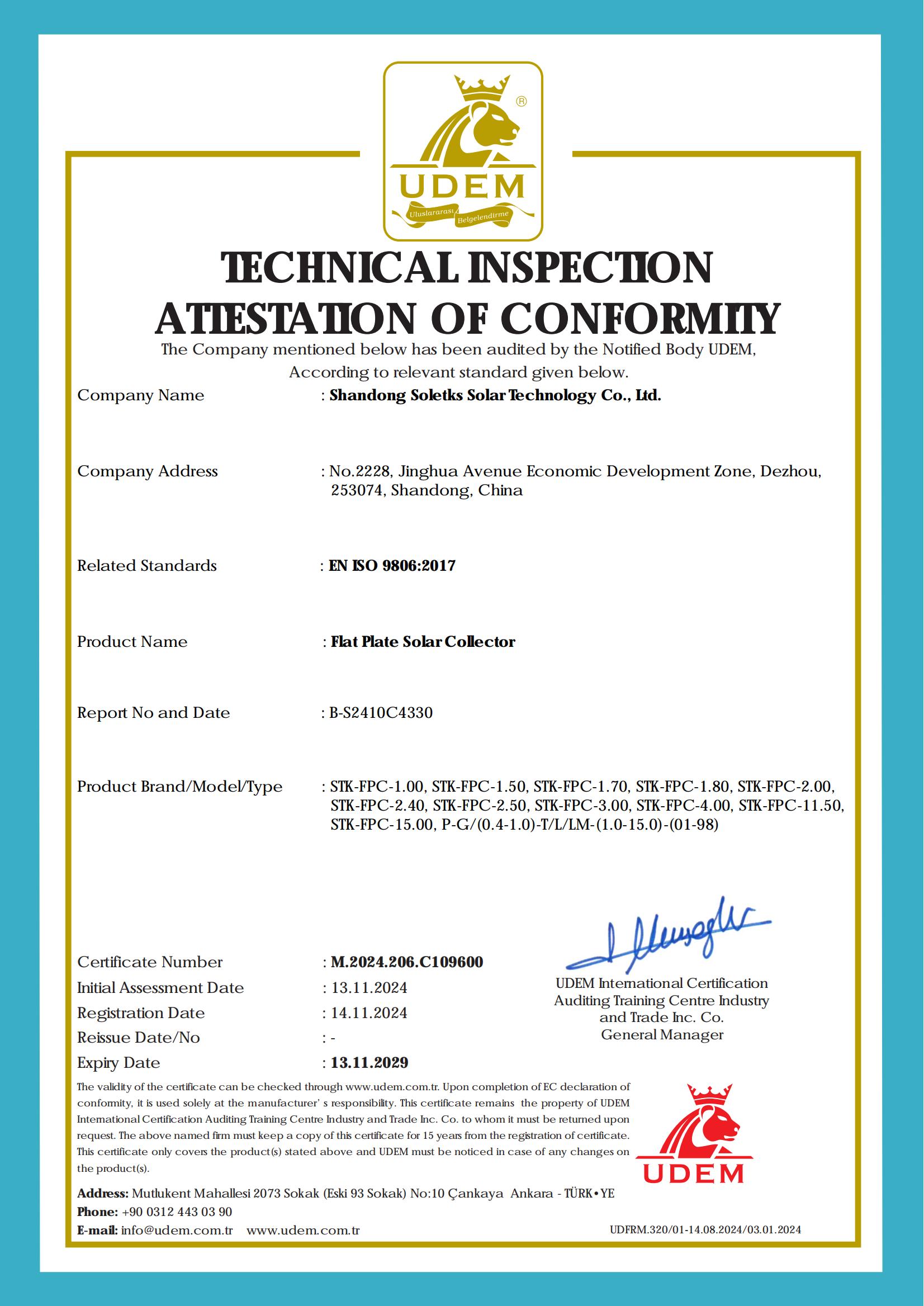
| ISO 9806:2017 | طرق اختبار المجمعات الحرارية الشمسية | Request model-specific collector test data.[3] |
| علامة الشمس المفتاحية | European solar thermal certification | Required for EU procurement.[4] |
| ISO 9001 | نظام إدارة الجودة | أدلة تتعلق بعمليات الموردين.[5] |
| UL 508A | لوحات التحكم | UL-market control panel.[6] |
| ASME BPVC | معدات الضغط | قواعد الخزانات/الأوعية المضغوطة.[7] |
| NSF/ANSI 61 | المواد التي تتلامس مع مياه الشرب | اعتماد ملاءمة ماء الشرب.[8] |
| تطبيقات أنظمة التدفئة والتهوية وتكييف الهواء (HVAC) وفقًا لمعايير ASHRAE | هندسة تسخين مياه الخدمة | System integration reference.[10] |
SOLETKS holds Solar Keymark, CE, TÜV, UL, IEC 61215, IEC 61730, ISO 9001, ISO 14001, and ISO 45001 certifications, with individual product test reports for flat-plate, vacuum tube, PVT, and air collector ranges. See the صفحة ضمان الجودة في SOLETKS for the complete certificate set.[9]
11. How to Read a Commercial Solar Collector Warranty
B2B buyers often skip the fine print in collector warranties. The most common gotchas:
| Warranty term | Typical commercial offering | Buyer rule |
|---|---|---|
| Frame + glazing | 10–15 years | Verify weather + seal failure are covered |
| Selective absorber coating | 10–20 years against degradation | Ask for measurable degradation threshold (e.g., “ε rise > 0.10”) |
| Manifold + hydraulic path | 5–10 years against material defect | Excludes freeze damage if antifreeze design is wrong |
| Mounting hardware | 5–10 years | Excludes coastal corrosion without stainless upgrade |
| الأداء | Rarely covered explicitly | Ask if annual yield drop > X% is a warranty event |
| Exclusions | Stagnation, freeze, hard water, scaling | All operating conditions matter |
What voids warranty (typical industry standard)
- Skipped annual maintenance + missing service log
- Glycol pH out of range with no records
- Repeated stagnation events without protection
- Hard-water scaling on direct loop without descaling plan
- Mounting outside engineering drawings (wind/snow exceeded)
SOLETKS warranty principle: warranties cover material and workmanship. The owner’s job is to maintain the operating envelope (loop chemistry, stagnation protection, mounting integrity, annual service). For full warranty terms, request the exact document during RFQ — and read it before signing.
12. مدخلات طلبات عروض الأسعار (RFQ) الخاصة بـ SOLETKS
اطلب الدعم الهندسي من خلال صفحة الاتصال بـ SOLETKS when collector durability, tank sizing, pump station, and system pressure must be selected together.
Project site
- City, climate band, roof area, tilt, shading
- Daily hot-water volume + target temperature
- Wind / snow load + altitude (if > 2,000 m)
Loop + system
- Direct or indirect loop requirement
- Working pressure, potable-water requirement, water quality
- نوع السخان الاحتياطي
Collector preference
- Standard / engineering / large-size range
- Required certifications: ISO 9806, Solar Keymark, ISO 9001, UL, NSF/ANSI 61, or local code
المستندات
- Datasheet, drawing, mounting detail, pressure rating, packing list, commissioning sheet, individual product test report, warranty terms
13. قائمة مراجعة المواصفات
| عنصر | القيمة المطلوبة |
|---|---|
| Gross + aperture area | m², both values |
| Dimensions + weight | L × W × D, kg |
| امتصاصي | Material, coating type, emissivity ε |
| Glazing | Glass type, thickness, seal detail |
| ضغط العمل | bar or MPa |
| درجة حرارة الركود | درجة مئوية |
| Test basis | ISO 9806 data + supplied report (η₀, a1, a2 triple) |
| Mounting | Wind, snow, roof interface, service access |
| System match | Storage, pump, HX, backup heater |
| Certificates | Solar Keymark, CE, TÜV, ISO as required |
| الضمان | Frame/glazing/coating/mounting terms + exclusions |
الأسئلة الشائعة
What makes a flat plate solar collector durable?
Durability comes from stable selective coating (emissivity ε ≤ 0.10), sealed glazing, suitable frame material for the climate, correct working pressure, and safe mounting. Durability also depends on system design — freezing, stagnation, hard water, or poor flow damages a collector faster than ordinary weather exposure.
Aperture area or gross area — which one matters more?
مساحة الفتحة matters for thermal performance comparison. Gross area matters for roof layout and shipping. Two collectors with identical 2.00 m² gross can have 1.75–1.95 m² aperture — a ~10% real output difference. Always specify aperture in the RFQ.
What is the difference between flat plate and evacuated tube collectors?
Flat plate is the default choice for moderate-temperature commercial hot water (45–70 °C) with available roof area. Evacuated tube performs better in very cold climates, very high ΔT, or limited roof area. Compare on annual useful heat, not peak efficiency.
What selective coating should a commercial flat plate collector use?
Look for sputtered selective coating with emissivity ε ≤ 0.10 (e.g., TiNOX-class or SOLETKS nano-absorption coating). Older black chrome (ε ~0.18) and especially black paint (ε ~0.85) cause significant night radiation loss and faster degradation.
What are η₀, a1, and a2 in collector specifications?
η₀ is optical efficiency (light entry at zero temperature difference). a1 is linear heat loss in W/m²·K. a2 is second-order heat loss in W/m²·K². Useful collector output = η₀ − a1·(Tm−Ta)/G − a2·(Tm−Ta)²/G. A collector with low a1 (≤ 4.0) performs better in cold climates than one with a higher η₀ but higher a1. Always request the full η₀, a1, a2 triple from the supplier’s ISO 9806 test report.
How long does a commercial flat plate collector last?
A properly specified commercial flat plate collector with selective coating + tempered glazing + aluminium frame delivers 20+ years of useful service. Annual yield typically degrades at 0.5–1.0% per year — after 20 years, expect ~85–90% of original output with maintained glazing and clean absorber.
What climate-specific upgrades are needed?
Coastal sites (salt + UV) → stainless mounting + silicone seals. High-altitude (> 2,000 m) → higher cold-fill pressure + deeper glycol concentration. Heavy snow → reinforced mounting + steeper tilt. Sandy/dusty regions → shorter cleaning interval (3–6 months).
What does a typical commercial solar collector warranty cover?
Frame + glazing: 10–15 years against material defects. Selective absorber coating: 10–20 years against degradation (ask for measurable threshold). Manifold + hydraulic path: 5–10 years against material defects. Mounting hardware: 5–10 years. Performance warranty (annual yield drop) is rarely included — request it explicitly if needed. Always read exclusions: stagnation events, freeze damage from wrong fluid design, and skipped maintenance typically void coverage.
Which SOLETKS flat-plate model fits my project?
- 2.0 m² standard → residential / small commercial / villa
- Engineering hot-water collector → hotel, dormitory, hospital, school (50–500 m² array)
- EFPC115 large-size → industrial / centralized heating / large-area (1,000+ m²) — proven at 107,000 m² scale in Tibet
- نظام هجين PVT → combined heat + power applications (e.g., 3,000 m² Tianjin school PVT Pro+ plant)
What RFQ data is needed for flat plate collector selection?
Project city + climate + roof area + daily water volume + target temperature + loop type + working pressure + water quality + mounting conditions + certification needs + backup-heater plan + warranty terms. Without these inputs, a collector price cannot show real durability or useful heat output.
المصادر
[1] SOLETKS،, منتجات المجمع الشمسي.
[2] Pacific Northwest National Laboratory, Solar Water Heating Systems.
[3] ISO، ISO 9806:2017 الطاقة الشمسية – المجمعات الحرارية الشمسية – طرق الاختبار.
[4] "سولار كي مارك"،, برنامج شهادة «سولار كي مارك».
[5] ISO، ISO 9001:2015 أنظمة إدارة الجودة.
[6] UL Solutions،, Industrial Control Panels and Panel Shop Program.
[7] ASME،, Boiler and Pressure Vessel Code standards.
[8] NSF، معايير أنظمة معالجة المياه، بما في ذلك سياق معيار NSF/ANSI 61.
[9] SOLETKS،, ضمان الجودة — 117+ patents, 160+ in-process inspection steps, nano-absorption coating technology.
[10] ASHRAE،, ASHRAE Handbook — HVAC Applications, Service Water Heating chapter.
[11] معهد فراونهوفر لأنظمة الطاقة الشمسية (ISE)،, Solar Thermal Collector Long-Term Performance Research.
Original engineering review: 2025-07-01 by SOLETKS Engineering Team. Publication QA updated: 2026-08-06. Project data referenced: Saga County (Tibet, 2019, EFPC115 large-aperture, 107,000 m², 2,424 t coal/yr avoided), APEC Summit (Beijing, 2014, engineering grade, 150,000 kWh/yr saved), Harz church (Germany, 2021, engineering grade), Florida resort villas (USA, 2022, coastal upgrade), Tianjin school PVT Pro+ (2024, 3,000 m², hybrid reference).
هل تحتاج إلى مراجعة هندسية خاصة بمشروع معين؟
يرجى إرسال المعلومات المتعلقة بالمناخ في الموقع، والحمل اليومي، والقيود المتعلقة بالسقف أو غرفة المعدات، ونطاق المنتج، ومتطلبات التوثيق المستهدفة إلى SOLETKS، حتى يتمكن فريق الهندسة من تقديم توصية تجارية عملية.
اتصل بشركة SOLETKS