
Durable Flat Plate Solar Collectors Selection Criteria for Commercial Hot Water
Durable flat plate solar collectors selection criteria covering absorber coating, glazing, frame, efficiency curve, degradation, warranty, and RFQ data.
Par le Équipe d'ingénieurs de SOLETKS — le groupe chargé des applications de capteurs solaires au sein d'un fabricant mondial figurant parmi les cinq premiers dans le domaine des capteurs plans, avec Plus de 117 brevets, 160+ in-process inspection steps, and a proprietary nano-absorption selective coating. We have deployed flat-plate collectors at every scale: Florida coastal villas (USA, 2022), the Hôtel du sommet de l'APEC (Pékin, 2014, 50 t/jour, 150 000 kWh/an d'économies), the engineering-grade Harz church plant in Germany (2021, 22 t/day), and the EFPC115 large-aperture array at Saga County, Tibet (2019, 107,000 m², 2,424 t coal/yr avoided) — la première centrale solaire thermique centralisée au monde située en haute altitude.
Portée du présent guide : durability and procurement checks for absorber coating, glazing, frame, insulation, pressure rating and warranty evidence. It does not repeat the site’s basic flat-plate working-principle or annual-yield comparison guides.
TL;DR — Réponse rapide
A durable flat plate solar collector is selected by 10 parameters, not just sticker efficiency:
- Zone d'ouverture (NOT gross area — see §3)
- Absorber coating (selective coating type + emissivity)
- Glazing (tempered solar glass + seal detail)
- Frame material (aluminium standard, coastal/industrial may need upgrade)
- Pression de travail (doit correspondre à la limite hydraulique)
- Optical efficiency (η₀) + heat-loss coefficients (a1, a2)
- Température de stagnation (defines worst-case glycol exposure)
- Test certificate (ISO 9806 + Solar Keymark for EU markets)
- Mounting compatibility (roof load, wind, snow)
- cURL Too many subrequests. (sensor ports, hydraulic connection style)
A durable collector is NOT the panel with the most attractive brochure photo. It is the collector that keeps useful heat output, weather resistance, and serviceability under the project’s real climate and water-heating temperature.
Points clés à retenir :
1. Compare surface d'ouverture instead of only gross size.
2. Ask for optical AND heat-loss test data (the η₀, a1, a2 triple).
3. Match working pressure to the system boundary.
4. Specify corrosion and insulation requirements based on site climate.
5. Link collector choice to storage, pump station, and backup heat — never select in isolation.
SOLETKS publishes flat plate solar collector ranges under its solar collector category and engineered commercial hot-water plants under the Système solaire de production d'eau chaude à usage commercial / industriel scope.[1]
1. Selection Answer
A durable flat plate collector should be selected by the heat the project needs, the temperature it must deliver, the climate it will face, and the maintenance plan the owner can actually follow. The U.S. Department of Energy describes flat-plate collectors as insulated, weatherproof boxes containing a dark absorber under transparent cover plates — which is why glazing, insulation, absorber, and frame quality all affect durability.[2] ASHRAE’s HVAC Applications Handbook treats collector durability as a system-level outcome — not a panel-level rating.[10]
| Criterion | Good fit for flat plate | Risk trigger |
|---|---|---|
| Hot-water range | 45–70 °C commercial hot water[1] | Higher temperature demand with limited area → consider ET/heat-pipe |
| Climate | Warm, temperate, or mixed | Harsh freeze climate without closed-loop design |
| Montage | Roof or ground with service access | Hidden roof zones with no walkway |
| Water loop | Direct (low-risk climates) OR indirect glycol | Hard water, chloride risk, freeze exposure |
| Durability focus | Glazing + coating + frame + seal + insulation | Only comparing price per panel |
2. SOLETKS Flat-Plate Range — Models in Real Projects
| Model family | Typical use | Reference project |
|---|---|---|
| Standard flat plate (2.0 m²) | Residential + small commercial | Florida resort villas (USA, 2022) — coastal UV exposure |
| Engineering hot-water collector | Mid-size commercial (hotel / dormitory / hospital) | APEC Summit hotel (Beijing, 2014, 50 t/day) + Harz church (Germany, 2021, 22 t/day) |
| EFPC115 large-size flat plate | Industrial / large-area centralized heating | Saga County, Tibet (2019, 107,000 m²) — enlarged absorption area lowers cost per watt at scale |
| Hybride PVT (related product line) | Hybrid heat + power applications | Tianjin school PVT Pro+ (2024, 3,000 m²) |
Why this matters for procurement: matching the right product line to project scale reduces installed cost per useful kWh by 10–25%. Asking a residential 2.0 m² model to serve a 50 t/day hotel is theoretically possible but operationally inefficient — module count, plumbing complexity, and roof penetrations multiply.
For full product details, see:
- Standard Flat Plate Solar Collector
- Capteur plan d'eau chaude technique
- Capteur solaire plan de grande taille
3. Aperture Area vs Gross Area — The Most Important Number
| Term | What it is | Pourquoi est-ce important ? |
|---|---|---|
| Surface brute | Total external dimension (length × width) | Used for roof layout, packaging, shipping |
| Zone d'ouverture | The active glass area exposed to sunlight | Used for thermal performance comparison |
| Surface d'absorption | The actual absorber plate area inside | Used for ISO 9806 efficiency reporting (varies by manufacturer convention) |
Règle relative aux marchés publics : always compare aperture area, never gross area. Two collectors with identical 2.00 m² gross can have 1.75–1.95 m² aperture depending on frame width — a ~10% difference in real output for the same advertised size.
SOLETKS BTE2.0-2 reference data
| Paramètre | Valeur |
|---|---|
| Surface brute | 2,00 m² |
| Zone d'ouverture | 1.87 m² |
| Dimensions | 2 000 × 1 000 × 80 mm |
| Pression de service nominale | 0.6 bar (system-design dependent) |
| Optical efficiency η₀ | 78% (typical) |
| Absorber | Aluminium + selective absorption coating |
| Cadre | Aluminium |
4. How to Read η₀, a1, a2 — The Engineer’s Triple
ISO 9806 collector tests produce three coefficients that fully define collector thermal performance. Most brochures only show η₀ (optical efficiency), but the full triple is what matters in real climate calculations:
| Coefficient | Ce que cela signifie | Typical good value |
|---|---|---|
| η₀ (optical efficiency) | Fraction of solar radiation entering the collector when it is at ambient temperature | 0.75–0.82 |
| a1 (first-order heat loss, W/m²·K) | Linear conduction + convection losses | 3.5–4.5 |
| a2 (second-order heat loss, W/m²·K²) | Wind-driven and radiative loss at high ΔT | 0.005–0.020 |
How to use the triple
Useful collector output at any operating temperature is:
η = η₀ − a1 × (Tm − Ta) / G − a2 × (Tm − Ta)² / GWhere Tm = mean fluid temperature, Ta = ambient temperature, G = solar irradiance.
Practical buyer rule: do not compare two collectors only on η₀. A collector with η₀ = 0.82 but a1 = 5.0 may produce less useful heat in a cold climate than a collector with η₀ = 0.78 and a1 = 3.8. Ask the supplier for the full η₀, a1, a2 triple — if they cannot provide it from a recent ISO 9806 test, the collector is not commercial-grade.
For Saga County (Tibet, 4,000+ m) and Harz church (Germany, cold winter), SOLETKS engineering selected models with a1 ≤ 4.0 to keep heat loss low in cold ambient.
6. Collector Area Calculation
The first sizing calculation should estimate useful collector area avant comparing model counts.
Note sur la source : screening calculation; final sizing requires local solar resource, tilt, shading, collector test data, pipe losses, and storage temperature.[2]
Exemple de saisie
| Paramètre | Valeur |
|---|---|
| Volume quotidien d'eau chaude | 1,000 L/day |
| Arrivée d'eau froide | 15 °C |
| Target hot water | 55 °C |
| Élévation de température (ΔT) | 40 °C |
| Desired solar contribution | 55% |
| Rendement solaire utile (hypothèse) | 3.5 kWh/m²/day |
| Collector aperture per panel | 1.87 m² (BTE2.0-2 example) |
Formule
Daily heat demand = liters × ΔT × 4.186 / 3600
Aperture area     = (heat demand × solar fraction) ÷ useful yield
Collector count   = aperture area ÷ aperture per panel
Remplacement
Daily heat demand     = 1,000 × 40 × 4.186 / 3600 = 46.5 kWh/day
Solar heat target     = 46.5 × 55%                = 25.6 kWh/day
Aperture area needed  = 25.6 ÷ 3.5                = 7.3 m²
Collector count       = 7.3 ÷ 1.87                ≈ 4 collectors
Recommendation: start with 4 collectors at this example aperture area, then adjust by climate, tilt, storage temperature, pipe length, and backup-heater plan. If the project needs 60 °C tank target, rerun the calculation — collector efficiency drops as operating temperature rises.
Useful yield reference values by climate
| Climate band | Typical useful yield (kWh/m²/day) |
|---|---|
| Northern Europe (Germany, UK, Netherlands) | 2.5–3.2 |
| Central Europe / Eastern Europe | 3.0–3.7 |
| Mediterranean (Spain, Italy, Portugal) | 4.0–4.8 |
| Subtropical (Florida, southern China) | 4.2–5.0 |
| Continental / North China (Beijing) | 3.4–4.2 |
| High plateau (Tibet 4,000+ m — high solar input despite altitude) | 4.5–5.5 |
Field observation (Saga County, Tibet, 2019): despite freezing temperatures, the annual useful yield exceeded 5 kWh/m²/day because the high-altitude solar resource is intense and atmospheric attenuation is minimal. This is why flat-plate collectors with proper freeze protection are competitive even in extreme cold climates — the solar input compensates for thermal losses.
7. Durability Matrix
Durability is a set of design choices, not a single claim.
| Durability factor | What to specify | Service effect |
|---|---|---|
| Glazing | Tempered solar glass + seal detail (EPDM or silicone) | Inspect every 12 months for cracks + seal failure[1] |
| Absorber coating | Selective coating type + emissivity ε + test data | Compare output against baseline after 12 months |
| Cadre | Aluminium standard; stainless or coated for coastal/industrial | Inspect mounting + corrosion every 6–12 months |
| Isolation | Mineral wool or polyurethane back + side insulation | Damaged insulation raises heat loss immediately |
| Hydraulic path | Working pressure + pressure test | Match system pressure before commissioning |
| Montage | Wind + snow + roof interface load | Use local structural rule + safe access plan |
Mechanism of failure
- Cracked glazing → admits moisture → reduces insulation performance → accelerates corrosion
- Poor seals → humid air into the collector box → fogs the cover → lowers solar transmission
- Weak insulation → increased back loss → collector looks intact but useful heat drops
- Coating degradation → emissivity rises → night radiation loss rises → annual yield drops
Field case (Florida resort villas, USA, 2022): coastal UV + salt aerosol exposure required upgraded frame sealing + corrosion-resistant fasteners. The first batch used standard aluminium frames; the second batch (after 12-month inspection) added stainless mounting hardware and silicone-grade seals. Leçon : climate matters as much as collector quality — specify frame and seal materials based on the actual installation environment, not catalog defaults.
8. Lifecycle Selection Matrix
Note sur la source : values are planning ranges for procurement comparison; final service intervals come from the supplied collector manual, local climate, and inspection results.
| Selection item | Plage de planification | Fréquence des inspections | Règle de l'acheteur |
|---|---|---|---|
| Cadre de capteur + vitrage | 15 à 20 ans[1] | 12 mois | Reject designs with no seal or glazing service guidance |
| Absorber + selective coating | Plus de 20 ans with stable coating | 12 months yield check | Compare emissivity ε at year 5 vs year 0 |
| Mounting hardware | 10 à 20 ans[1] | 6 à 12 mois | Match wind, snow, roof interface |
| Pipe insulation near collector | 5 à 10 ans[1] | 6 mois | Replace UV-damaged insulation before heat loss rises |
| Capteurs de température | 3-5 ans[1] | 6 mois | Replace if deviation > 2 °C |
| cURL Too many subrequests. | Spécifique au projet | 6 à 12 mois | Shorten in dusty or coastal sites |
Long-term yield degradation
Modern selective-coating flat-plate collectors typically degrade at 0.5–1.0% per year in useful annual output:
- After 10 years: ~92–95% of original
- After 20 years: ~84–90% of original (with maintained glazing and clean absorber)
cURL Too many subrequests. poorly specified collectors with black-paint absorbers can lose 20–30% in 5 years. The selective-coating choice has long-term ROI implications.
9. Flat Plate vs Evacuated Tube Decision
Flat-plate collectors fit many commercial hot-water projects, but they are not the only option. Evacuated tube or heat pipe collectors become stronger when winter heat loss, limited roof area, or higher temperature demand controls the project.
| État | Flat plate | Evacuated tube / heat pipe |
|---|---|---|
| Moderate hot water (45–70 °C) | Strong fit[1] | Also works, may cost more |
| Cold, windy winter | Needs careful loop + insulation design | Lower convective heat loss |
| Roof appearance | Clean rectangular panel | Tube array appearance |
| Service mode | Panel-level service | Tube or heat-pipe component service |
| Budget priority | Often lower first cost per area | Stronger when ΔT is large |
| Charge de neige | Better (sheds snow) | Tubes can trap snow between |
| Hail durability | Tempered glass (large surface) | Multiple small tubes (smaller risk) |
| Coastal corrosion | Frame design dependent | Tube + manifold corrosion risk |
For evacuated tube comparison, see Capteur solaire à tubes sous vide and ask SOLETKS to calculate annual useful heat rather than only first price.
For European cold-climate heat-pipe selection, see Heat Pipe Solar Water Heater for European Cold Climates.
10. Normes et documentation
| Norme / certificat | Champ d'application | Règle relative aux appels d'offres |
|---|---|---|
| ISO 9806:2017 | Méthodes d'essai des capteurs solaires thermiques | Request model-specific collector test data.[3] |
| cURL Too many subrequests. | European solar thermal certification | Obligatoire pour les marchés publics de l'UE.[4] |
| ISO 9001 | Système de gestion de la qualité | Preuves relatives aux processus des fournisseurs.[5] |
| UL 508A | Panneaux de commande | UL-market control panel.[6] |
| ASME BPVC | Équipements sous pression | Règles relatives aux réservoirs et aux récipients sous pression.[7] |
| NSF/ANSI 61 | Matériaux en contact avec l'eau potable | Agrément pour le contact avec l'eau potable.[8] |
| Applications CVC de l'ASHRAE | Ingénierie en matière de chauffage de l'eau sanitaire | Référence en matière d'intégration de systèmes.[10] |
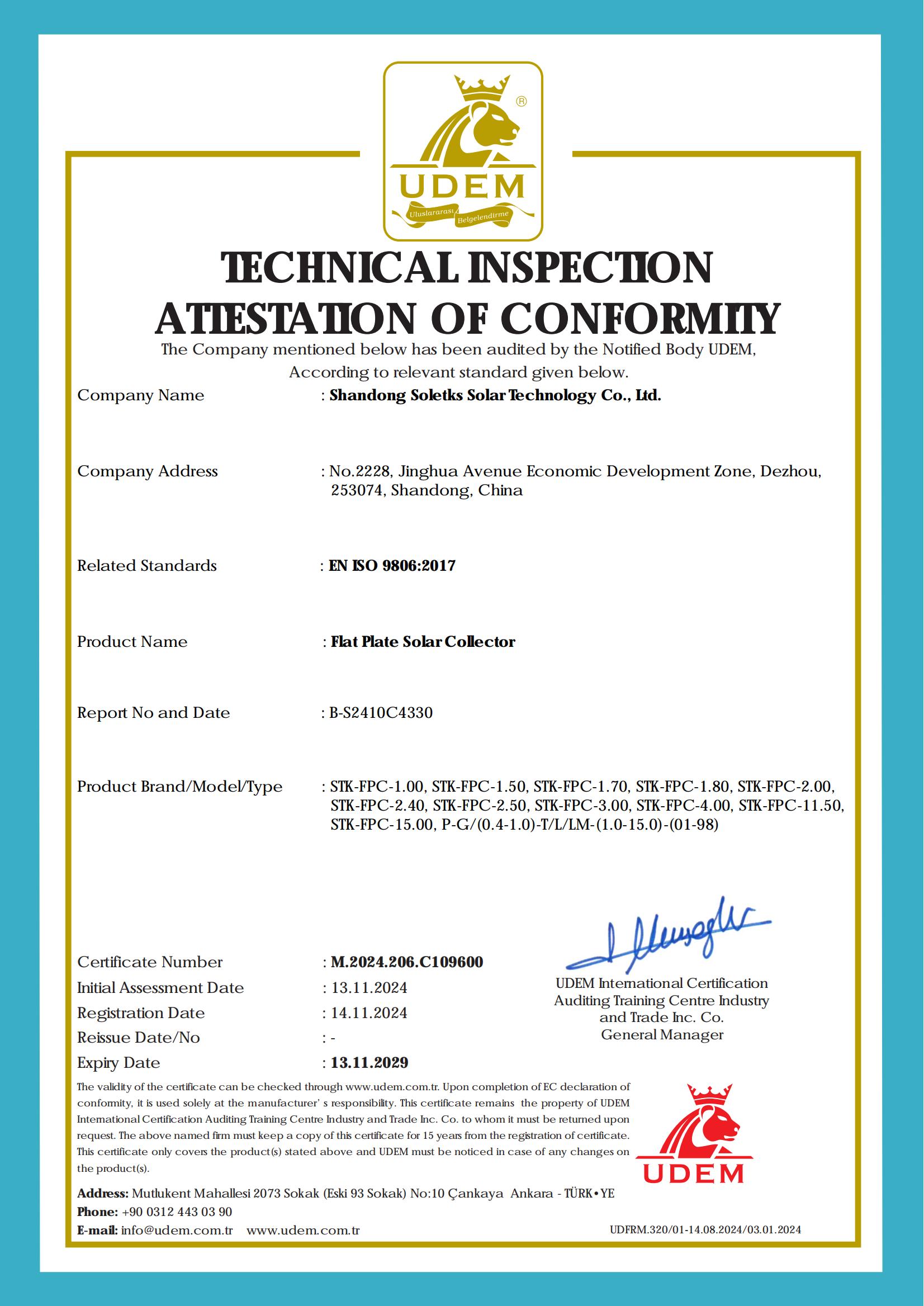
SOLETKS est titulaire des certifications Solar Keymark, CE, TÜV, UL, CEI 61215, CEI 61730, ISO 9001, ISO 14001 et ISO 45001., with individual product test reports for flat-plate, vacuum tube, PVT, and air collector ranges. See the Page « Assurance qualité » de SOLETKS pour l'ensemble complet des certificats.[9]
11. How to Read a Commercial Solar Collector Warranty
B2B buyers often skip the fine print in collector warranties. The most common gotchas:
| Warranty term | Typical commercial offering | Règle de l'acheteur |
|---|---|---|
| Frame + glazing | 10 à 15 ans | Verify weather + seal failure are covered |
| Selective absorber coating | 10–20 years against degradation | Ask for measurable degradation threshold (e.g., “ε rise > 0.10”) |
| Manifold + hydraulic path | 5–10 years against material defect | Excludes freeze damage if antifreeze design is wrong |
| Mounting hardware | 5 à 10 ans | Excludes coastal corrosion without stainless upgrade |
| Performance | Rarely covered explicitly | Ask if annual yield drop > X% is a warranty event |
| Exclusions | Stagnation, freeze, hard water, scaling | All operating conditions matter |
What voids warranty (typical industry standard)
- Skipped annual maintenance + missing service log
- Glycol pH out of range with no records
- Repeated stagnation events without protection
- Hard-water scaling on direct loop without descaling plan
- Mounting outside engineering drawings (wind/snow exceeded)
SOLETKS warranty principle: warranties cover material and workmanship. The owner’s job is to maintain the operating envelope (loop chemistry, stagnation protection, mounting integrity, annual service). For full warranty terms, request the exact document during RFQ — and read it before signing.
12. Données à fournir pour les appels d'offres SOLETKS
Demandez une assistance technique via le Page de contact de SOLETKS when collector durability, tank sizing, pump station, and system pressure must be selected together.
Project site
- City, climate band, roof area, tilt, shading
- Volume quotidien d'eau chaude + température souhaitée
- Wind / snow load + altitude (if > 2,000 m)
Loop + system
- Direct or indirect loop requirement
- Working pressure, potable-water requirement, water quality
- Type de chauffage d'appoint
Préférence des collectionneurs
- Standard / engineering / large-size range
- Required certifications: ISO 9806, Solar Keymark, ISO 9001, UL, NSF/ANSI 61, or local code
Documents
- Datasheet, drawing, mounting detail, pressure rating, packing list, commissioning sheet, individual product test report, warranty terms
13. Liste de contrôle des spécifications
| Article | Valeur obligatoire |
|---|---|
| Surface brute + surface d'ouverture | m², les deux values |
| Dimensions + weight | L × W × D, kg |
| Absorber | Material, coating type, emissivity ε |
| Glazing | Glass type, thickness, seal detail |
| Pression de travail | bar ou MPa |
| Température de stagnation | °C |
| Test basis | ISO 9806 data + supplied report (η₀, a1, a2 triple) |
| Montage | Wind, snow, roof interface, service access |
| System match | Storage, pump, HX, backup heater |
| Certificates | Solar Keymark, CE, TÜV, ISO as required |
| Warranty | Frame/glazing/coating/mounting terms + exclusions |
FAQ
What makes a flat plate solar collector durable?
Durability comes from stable selective coating (emissivity ε ≤ 0.10), sealed glazing, suitable frame material for the climate, correct working pressure, and safe mounting. Durability also depends on conception du système — freezing, stagnation, hard water, or poor flow damages a collector faster than ordinary weather exposure.
Aperture area or gross area — which one matters more?
Zone d'ouverture matters for thermal performance comparison. Surface brute matters for roof layout and shipping. Two collectors with identical 2.00 m² gross can have 1.75–1.95 m² aperture — a ~10% real output difference. Always specify aperture in the RFQ.
What is the difference between flat plate and evacuated tube collectors?
Flat plate is the default choice for moderate-temperature commercial hot water (45–70 °C) with available roof area. Evacuated tube performs better in very cold climates, very high ΔT, or limited roof area. Compare on annual useful heat, not peak efficiency.
What selective coating should a commercial flat plate collector use?
Look for sputtered selective coating with emissivity ε ≤ 0.10 (e.g., TiNOX-class or SOLETKS nano-absorption coating). Older black chrome (ε ~0.18) and especially black paint (ε ~0.85) cause significant night radiation loss and faster degradation.
What are η₀, a1, and a2 in collector specifications?
η₀ is optical efficiency (light entry at zero temperature difference). a1 is linear heat loss in W/m²·K. a2 is second-order heat loss in W/m²·K². Useful collector output = η₀ − a1·(Tm−Ta)/G − a2·(Tm−Ta)²/G. A collector with low a1 (≤ 4.0) performs better in cold climates than one with a higher η₀ but higher a1. Always request the full η₀, a1, a2 triple from the supplier’s ISO 9806 test report.
How long does a commercial flat plate collector last?
A properly specified commercial flat plate collector with selective coating + tempered glazing + aluminium frame delivers Plus de 20 ans of useful service. Annual yield typically degrades at 0.5–1.0% per year — after 20 years, expect ~85–90% of original output with maintained glazing and clean absorber.
What climate-specific upgrades are needed?
Coastal sites (salt + UV) → stainless mounting + silicone seals. High-altitude (> 2,000 m) → higher cold-fill pressure + deeper glycol concentration. Heavy snow → reinforced mounting + steeper tilt. Sandy/dusty regions → shorter cleaning interval (3–6 months).
What does a typical commercial solar collector warranty cover?
Frame + glazing: 10 à 15 ans against material defects. Selective absorber coating: 10 à 20 ans against degradation (ask for measurable threshold). Manifold + hydraulic path: 5 à 10 ans against material defects. Mounting hardware: 5 à 10 ans. Performance warranty (annual yield drop) is rarely included — request it explicitly if needed. Always read exclusions: stagnation events, freeze damage from wrong fluid design, and skipped maintenance typically void coverage.
Which SOLETKS flat-plate model fits my project?
- 2.0 m² standard → residential / small commercial / villa
- Engineering hot-water collector → hotel, dormitory, hospital, school (50–500 m² array)
- EFPC115 large-size → industrial / centralized heating / large-area (1,000+ m²) — proven at 107,000 m² scale in Tibet
- Hybride PVT → combined heat + power applications (e.g., 3,000 m² Tianjin school PVT Pro+ plant)
What RFQ data is needed for flat plate collector selection?
Project city + climate + roof area + daily water volume + target temperature + loop type + working pressure + water quality + mounting conditions + certification needs + backup-heater plan + warranty terms. Without these inputs, a collector price cannot show real durability or useful heat output.
Sources
[1] SOLETKS, Solar Collector Products.
[2] Laboratoire national du Nord-Ouest du Pacifique, Systèmes de chauffage solaire de l'eau.
[3] ISO, ISO 9806:2017 Énergie solaire – Capteurs solaires thermiques – Méthodes d'essai.
[4] Solar Keymark, Système de certification Solar Keymark.
[5] ISO, ISO 9001:2015 Systèmes de management de la qualité.
[6] UL Solutions, Programme dédié aux armoires de commande industrielles et aux ateliers de fabrication d'armoires.
[7] ASME, Normes relatives aux chaudières et aux récipients sous pression.
[8] NSF, Normes relatives aux systèmes de traitement de l'eau, notamment dans le cadre de la norme NSF/ANSI 61.
[9] SOLETKS, Quality Assurance — 117+ patents, 160+ in-process inspection steps, nano-absorption coating technology.
[10] ASHRAE, Manuel ASHRAE — Applications CVC, chapitre consacré au chauffage de l'eau sanitaire.
[11] Institut Fraunhofer pour les systèmes énergétiques solaires (ISE), Solar Thermal Collector Long-Term Performance Research.
Original engineering review: 2025-07-01 by SOLETKS Engineering Team. Publication QA updated: 2026-08-06. Project data referenced: Saga County (Tibet, 2019, EFPC115 large-aperture, 107,000 m², 2,424 t coal/yr avoided), APEC Summit (Beijing, 2014, engineering grade, 150,000 kWh/yr saved), Harz church (Germany, 2021, engineering grade), Florida resort villas (USA, 2022, coastal upgrade), Tianjin school PVT Pro+ (2024, 3,000 m², hybrid reference).
Vous avez besoin d'une expertise technique spécifique à un projet ?
Veuillez communiquer à SOLETKS les conditions climatiques du site, la charge journalière, les contraintes liées à la toiture ou au local technique, l'étendue de la gamme de produits ainsi que les exigences en matière de documentation, afin que l'équipe d'ingénieurs puisse vous proposer une recommandation commerciale adaptée.
Contacter SOLETKS