
Commercial Heat Pipe Solar Collector Design for Cold Europe
Commercial heat pipe solar collector design for cold Europe: glycol concentration, winter sizing, snow load, pump-loop protection, maintenance, and RFQ inputs.
Па Інжынерная каманда SOLETKS — the evacuated tube and heat pipe application group at a Top-5 global flat-plate manufacturer with 117+ патэнтаў. We deploy heat pipe evacuated tube collectors across European cold climates, with reference projects including the Harz church plant in Germany (2021, 22 t/day, engineering-grade collectors in series/parallel configuration).
Scope: This guide covers roof-mounted HPC collectors in indirect, pressurized commercial loops for hotels, schools, churches, and apartment buildings. For integrated-tank residential units, use our compact heat pipe solar water heater selection guide; the hydraulic, storage, and service decisions are different.
КР;КП — Кароткая адказнасць
A commercial heat pipe solar collector system for cold European climates must be designed around:
- Winter heat loss (the absorber runs farther above ambient when it's −10 °C outside)
- 防冻保护 (loop hydraulics — NOT just collector design)
- Storage + backup heat (solar fraction in winter is 30–50%, not 80%)
- Roof loading (snow + wind in Northern Europe)
- Доступ да сэрвісу (replaceable tubes vs sealed designs)
The cold-climate advantage of heat pipe collectors:
- Змяншэнне канвекцыйных страт цяпла than flat plate (vacuum insulation reduces loss to ambient)
- Faster temperature rise in low-irradiation winter conditions
- Better performance at high ΔT (collector vs ambient)
- Heat pipes are individually replaceable — single tube failure doesn't disable the array
What heat pipes do NOT solve: roof piping, pump station, heat exchanger, sensors, and valves still need freeze protection (glycol, drainback, or engineered).
Асноўныя высновы:
1. Heat pipe evacuated tubes fit cold climates when the system uses freeze-safe hydraulics.
2. Compare lighting area, NOT tube count.
3. Design backup heat for reliability — solar fraction in winter is realistic 30–50%.
4. Inspect glycol or drainback protection every 12 months.
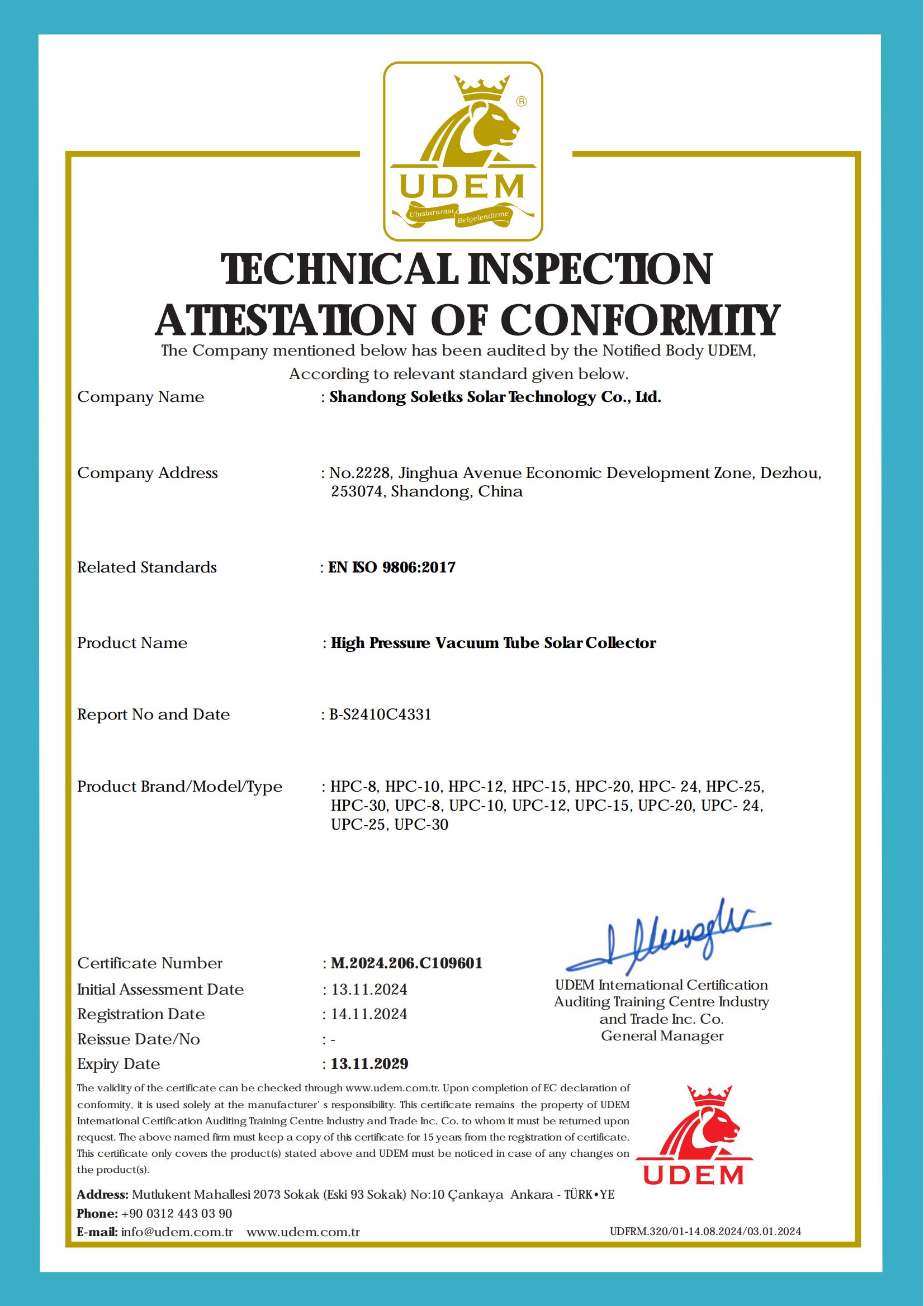
5. Request Solar Keymark + ISO 9806 + pressure + installation documents before procurement.
SOLETKS publishes a 热管式太阳能热水器 line for compact heater applications and an HPC Heat Pipe Solar Collector range for pressurized commercial projects.[1]
1. Cold-Climate Answer
Heat pipe solar water heaters work in cold European climates when the design protects the roof loop, pipework, heat exchanger, and storage from freezing. The evacuated tube reduces heat loss because the vacuum layer limits conduction + convection around the absorber. The sealed heat pipe transfers heat to the manifold, while the main system loop stays in the manifold and piping — and THAT loop is what needs freeze protection.
| Project condition | Heat pipe fit | Спускі рызыкі |
|---|---|---|
| Minimum outdoor temperature below 0 °C | ✅ Use closed-loop glycol, drainback, or engineered freeze protection.[2] | Direct water loop on exposed roof piping |
| Target hot water 45–60 °C | ✅ Strong cold-climate fit | Direct high-temperature expectation without backup |
| Roof access | ≥ 600 mm service path[2] | Tubes installed where replacement is unsafe |
| System pressure | Match collector + tank + valve + expansion rating | Mixed pressure classes without safety review |
| Winter solar resource | Use PVGIS data before sizing.[3] | Sizing by tube count only |
The design mistake: assuming vacuum tubes = freeze protection. They reduce heat loss at the collector, but exposed pipes, pumps, heat exchangers, sensors, and valves still freeze when water is left in cold zones.
2. European Cold-Climate Zones — A Real Mapping
European cold climates are not a single thing. Different latitudes need different design priorities:
| Zone | Examples | Design min temp | Heating degree-days | Key design priority |
|---|---|---|---|---|
| 地中海地区 | Lisbon, Madrid, Rome, Athens | 0 to +5 °C | 1,500–2,500 | Year-round HW + winter preheat |
| Atlantic temperate | London, Paris, Amsterdam, Hamburg | −5 to −10 °C | 2,500–3,500 | Glycol indirect mandatory |
| Central continental | Berlin, Munich, Warsaw, Prague | −10 to −15 °C | 3,000–4,000 | Deeper glycol concentration (40%) |
| Northern continental | Stockholm, Helsinki, Tallinn | −15 to −25 °C | 4,000–5,500 | 40–45% glycol + careful pressure design |
| Sub-arctic | Reykjavík, Tromsø, Northern Lapland | < −25 °C | > 5,500 | 45–50% glycol + altitude/wind specific |
| Alpine | Innsbruck, Bern, Andorra | −10 to −20 °C | 4,000–5,500 | Snow load + steep tilt + 40–45% glycol |
Палявое правіла: SOLETKS uses 35–40% propylene glycol for sites with design minimum around −10 °C (Beijing-grade winter), upgrading to 40–45% for northern continental sites and 45–50% for extreme cold (e.g., the Saga County plateau plant in Tibet uses ~50% propylene with high-altitude pressure derate).
For full glycol design, see Праектаванне сонечна-тэрмічнай сістэмы з цыркуляцыяй вадкасці.
3. Winter Solar Resource — European Cities
Winter solar resource determines how much heat pipe collectors can realistically deliver during the heating season. Approximate December irradiation (when hot water demand peaks but solar drops):
| City | Annual GHI (kWh/m²/yr) | Dec GHI (kWh/m²/day) | Winter solar fraction realistic |
|---|---|---|---|
| Lisbon | 1,800 | ~2.0 | 50–65% |
| Madrid | 1,850 | ~1.8 | 45–60% |
| Rome | 1,750 | ~1.7 | 45–60% |
| Vienna | 1,250 | ~0.8 | 30–45% |
| Munich | 1,200 | ~0.7 | 25–40% |
| Berlin | 1,100 | ~0.6 | 25–40% |
| Paris | 1,150 | ~0.6 | 25–40% |
| London | 1,050 | ~0.5 | 20–35% |
| Warsaw | 1,050 | ~0.5 | 20–35% |
| Amsterdam | 1,050 | ~0.4 | 20–35% |
| Stockholm | 1,000 | ~0.2 | 15–30% |
| Helsinki | 950 | ~0.1 | 15–25% |
| Reykjavík | 850 | ~0.05 | 10–20% |
Ключавое ўсведамленне: in northern Europe, the winter solar contribution is 不 designed to replace backup heat. The goal is measurable fuel + carbon reduction across the year, with strong summer + shoulder season output offsetting the lower winter contribution.
4. Heat Pipe vs Direct Flow Vacuum Tube
Both are evacuated tube collectors, but they handle the heat transfer differently:
| 特性 | Heat pipe | Direct flow vacuum tube |
|---|---|---|
| 传热 | Sealed heat pipe inside vacuum tube | Water/fluid flows directly through inner tube |
| Tube replacement | Individual tube replaceable (no system drain) | Often requires loop shutdown to replace |
| Failure mode | Single tube failure → small efficiency loss | Single tube failure → leak risk |
| Freeze risk | Heat pipe sealed, but system loop still freezes | Direct freeze risk if water in tubes |
| 成本 | Higher per tube | Lower per tube |
| Найлепш для | Commercial + frequent service | Residential + simpler systems |
| Maximum operating T | ~120 °C typical | ~95 °C typical |
The cold-climate advantage of heat pipes: individual tube replacement without system drain is a major operational benefit for commercial projects where downtime is expensive. Single tube failure does NOT disable the array.
For more on flat-plate alternatives, see Крытэрыі выбару трывалых плоскіх сонечных калектараў.
5. Sizing Calculation for Winter Hot Water
Start with daily heat demand + realistic winter solar contribution.
Заўвага да крыніцы: screening calculation for RFQ planning; final design needs local irradiation, collector test data, roof tilt, shading, pipe loss, storage temperature, antifreeze concentration, and backup-heater setpoint.[2]
Прыклад уваходу
| 参数 | 数值 |
|---|---|
| Daily hot water volume | 1000 л/сут |
| Cold water in winter | 8 °C |
| Target delivery temperature | 55 °C |
| Temperature rise | 47 °C |
| Water heat factor | 0.001163 kWh/L·K |
| Winter useful collector yield | 2.2 kWh/m²/day |
| Winter solar contribution target | 50% |
Формула
Daily heat demand    = volume × ΔT × 0.001163
Useful solar target  = daily heat × winter solar contribution
Lighting area needed = solar target ÷ winter useful yield
Замена
Daily heat demand    = 1,000 × 47 × 0.001163     = 54.7 kWh/day
Useful solar target  = 54.7 × 50%                = 27.4 kWh/day
Lighting area needed = 27.4 ÷ 2.2                = 12.5 m²
If using an HPC model with 3.00 m² lighting area:
Screening quantity   = 12.5 ÷ 3.00                = 4.2
RFQ starting count   = ~5 collectors
建议: for European winter projects, size the collector field to reduce backup energy — NOT to promise solar-only hot water. A stable system keeps a boiler, heat pump, or electric heater for final temperature and cloudy periods.
6. SOLETKS HPC Heat Pipe Product Range
| 型号 | Брутто-плошча | Lighting area | cURL Too many subrequests. | Max operating T | 峰值效率 |
|---|---|---|---|---|---|
| HPC182 | 1.82 m² | 1.20 m² | 0.6兆帕 | 120 °C | 0.724 |
| HPC242 | 2.42 m² | 1.60 m² | 0.6兆帕 | 120 °C | 0.724 |
| HPC302 | 3.02 m² | 2,00 м² | 0.6兆帕 | 120 °C | 0.724 |
| HPC362 | 3.62 m² | 2.40 m² | 0.6兆帕 | 120 °C | 0.724 |
| HPC442 | 4.42 m² | 3.00 m² | 0.6兆帕 | 120 °C | 0.724 |
Procurement insight: той 0.724 peak efficiency + 120 °C maximum operating temperature at 0.6 MPa pressure rating gives European buyers real selection inputs — 不 tube-count guessing.
7. Why Heat Pipes Help in Cold Weather (Mechanism)
In an evacuated tube:
- Solar radiation reaches an absorber insulated by vacuum
- Vacuum reduces convective heat loss → collector keeps useful heat even when outdoor air is cold
- Heat pipe adds a sealed transfer path: working medium evaporates → moves to condenser → releases heat to manifold → returns by gravity
This mechanism matters because collector efficiency falls as the collector becomes hotter than ambient air. In winter that temperature difference is large. Lower heat loss helps the collector deliver useful heat for the same sunlight.
Insulation matters too: poor insulation in roof piping cancels part of the benefit because heat leaves the system AFTER it has already been collected. Specify UV-resistant double-thickness pipe jacketing for European exposed-pipe installations.
8. Freeze Protection Design
Cold-climate heat pipe systems usually use one of three protection strategies:
| Strategy | Where it fits | Design rule |
|---|---|---|
| Closed-loop glycol | Most common European commercial freeze strategy | Test pH, concentration, pressure, freeze point every 12 months[2] |
| Зваротны сцёк | Sites with correct pipe slope + drain volume | Verify complete drainage after pump stop |
| Controller freeze protection | Mild freeze risk + reliable backup power | 不 sole protection in deep-freeze climates |
Why glycol dominates in cold Europe
- Glycol protects against freezing by lowering fluid freeze point
- Glycol degrades under heat, oxygen ingress, and stagnation
- Annual testing (pH, freeze point, color) catches degradation early
Why drainback is risky in Northern Europe
- Drainback requires perfect pipe slope on every horizontal run
- Snow + ice + cold roof piping = condensation
- Controller power loss + freezing weather = total failure
For deep European cold sites (Sweden, Finland, Baltics), closed-loop glycol is strongly preferred despite higher service cost.
9. Heat Pipe vs Flat Plate in Europe
Neither collector type wins every project. The right answer depends on target temperature, winter climate, budget, architecture, and maintenance capability.
| 标准 | Heat pipe evacuated tube | Flat plate collector |
|---|---|---|
| Cold and windy climate | Stronger when winter heat loss is limiting | Strong in moderate climates |
| Target water temperature | Better above 50 °C[2] | Strong for 35–55 °C loads[2] |
| Знешні выгляд даху | Масіў труб | Lower-profile panel |
| Tube-level service | Individual tube replaceable | Абслугоўванне на ўзроўні панэлі |
| Freeze strategy | Still requires protected loop | Also requires protected loop |
| Снегавая нагрузка | Трубы могуць затрымліваць снег паміж сабой. | Better snow shedding |
| Main sizing risk | Tube count hides aperture or lighting area | Gross area may hide useful output |
Heat pipe collectors suit cold climates because vacuum insulation lowers heat loss, while flat plate collectors suit many moderate-temperature projects because they are durable, simple, and visually clean.
In Europe, the comparison should use certified collector data and local irradiation rather than a generic "best collector" claim.
10. Snow Load and Tube Orientation
European projects must consider snow load and tube orientation:
| 区域 | Typical snow load (kg/m²) | Mounting recommendation |
|---|---|---|
| 地中海地区 | < 100 | Standard mounting |
| Atlantic temperate | 100–200 | Standard mounting |
| Central European | 200–400 | Reinforced mounting + steeper tilt |
| Northern continental | 400–700 | Reinforced + steep tilt + tube spacing for snow shed |
| Alpine | 800–2,500 | Specialized structural calculation REQUIRED |
Tube spacing rule for snow climates: increase row spacing by 20–30% over Mediterranean baseline to allow snow shedding between rows.
11. Lifecycle and Maintenance Matrix
European cold-climate projects should budget for inspection — NOT only product purchase.
| Актыў / задача | Interval | Плануй жыццё | Cold-climate failure mode |
|---|---|---|---|
| Glycol freeze point + pH | 12 месяцаў[2] | 3–5 years fluid | Freeze damage, corrosion, sludge |
| Pipe insulation + UV jacket | 12 месяцаў | 5–10 гадоў | Heat loss + cracked insulation |
| Expansion vessel pre-charge | 12 месяцаў | 5–8 гадоў | Pressure swings + relief discharge |
| Vacuum tube + heat pipe check | 12 месяцаў | 15–20 гадоў | Broken tubes or poor condenser contact |
| Pump + controller test | 6–12 месяцаў | 5–10 гадоў | No circulation or wrong differential |
| Backup heater sequence | 12 месяцаў | Спецыфічна для праекта | Cold showers during cloudy weeks |
Reference project: той Harz church hot water project (Germany, 2021, 22 t/day) uses engineering-grade collectors in series/parallel configuration with closed-loop glycol freeze protection. After 5 years of operation, the main maintenance lesson learned was the 2024 pH-drift incident from a 6-day summer stagnation — see the План эксплуатацыі і тэхнічнага абслугоўвання камерцыйнай сонечна-тэрмічнай сістэмы.
12. Standards and Documentation
European cold-climate procurement should ask for collector performance + pressure + quality + installation evidence.
| Стандарт / сертыфікат | Дзе прымяняецца | Правіла RFQ |
|---|---|---|
| ISO 9806:2017 | Метады выпрабавання сонечных цеплавых калектараў | Collector performance basis.[4] |
| 太阳能钥标 | Еўрапейская сертыфікацыя сонечна-тэрмічных сістэм | REQUIRED for most EU tenders + incentives.[5] |
| ISO 9001 | Кіраванне якасцю | Доказы працэсу пастаўшчыка.[6] |
| ASME BPVC | Tanks, boilers, pressure vessels | Pressure vessel rules.[7] |
| UL 508A | Пультаў кіравання | Панэль рынку UL.[8] |
| EU PVGIS | EU official solar resource | Use for site-specific irradiation data.[3] |
SOLETKS holds Solar Keymark, CE, TÜV, UL, IEC 61215, IEC 61730, ISO 9001, ISO 14001, and ISO 45001 — the EU-readiness package.
13. RFQ Inputs for SOLETKS
Запытаць інжынерную падтрымку праз Старонка для кантакту з SOLETKS when comparing compact heat pipe heaters, HPC collectors, storage, and freeze protection.
Site + climate
- Country, city, altitude
- Minimum outdoor temperature
- Heating degree-days (HDD)
- Snow load + wind exposure
- PVGIS irradiation data
Load
- Daily hot water demand (L/day or t/day)
- Cold water temperature + target delivery temperature
Building
- Roof area, tilt, orientation, shading, service access
- Existing boiler, heat pump, electric heater, or tank
System preferences
- Preferred freeze strategy: glycol / drainback / engineered
- Required HPC model size (HPC182 → HPC442)
- Working pressure required
Compliance
- ISO 9806, 太阳能钥标, pressure code, quality certificate
- Local installation rules (German MELG, French RE, etc.)
文件资料
- Photos, roof plan, plant-room space, expected commissioning date
14. Specification Checklist
| cURL Too many subrequests. | Патрабаванае значэнне |
|---|---|
| Minimum outdoor temperature | °C + design period |
| Heating degree-days | HDD figure |
| Hot-water load | L/day, t/day, or kWh/day |
| Collector model | HPC182 / 242 / 302 / 362 / 442 |
| Tube count + lighting area | (Not just tube count) |
| cURL Too many subrequests. | 0.6 MPa baseline |
| 防冻保护 | Glycol concentration / drainback volume / control sequence |
| Snow load reinforcement | Per regional spec |
| Сховішча | Liters + insulation + HX + backup coil |
| Safety | Expansion vessel + relief valve + mixing valve + air vent |
| 维护 | Glycol test + tube access + pump inspection + controller log |
常见问题
Are heat pipe solar water heaters good for European winters?
Heat pipe solar water heaters are a strong option for European winters when the system uses a freeze-safe loop, insulated piping, storage, and backup heating. The evacuated tube reduces heat loss in cold air, but roof piping and hydraulic components still need proper freeze protection.
Do heat pipe collectors remove the need for antifreeze?
No. Heat pipes help transfer heat inside the evacuated tubes, but the system loop, pipes, heat exchanger, and valves still require freeze protection. Cold-climate designs usually use glycol, drainback, or engineered protection based on minimum temperature, pipe route, and maintenance capability.
What is the difference between heat pipe and direct flow vacuum tubes?
Heat pipe uses a sealed inner tube; direct flow has water/fluid flowing through. Individual tube replacement is the key heat-pipe advantage — no need to drain the system. Heat pipe also supports higher max operating temperature (~120 °C vs ~95 °C for direct flow).
How many heat pipe collectors are needed for a 1,000 L/day system?
Worked example: 1,000 L/day from 8 → 55 °C = 54.7 kWh/day. At 50% winter solar target + 2.2 kWh/m²/day useful yield = 12.5 m² lighting area. Using SOLETKS HPC442 (3.00 m² lighting per unit) = ~5 collectors starting point.
What winter solar contribution is realistic in Europe?
| 区域 | Realistic winter solar fraction |
|---|---|
| 地中海地区 | 50–65% |
| Atlantic temperate | 25–40% |
| Central continental (Berlin) | 25–40% |
| Northern continental (Stockholm) | 15–30% |
| Sub-arctic | 10–20% |
Don't promise more than these in the proposal — backup heat is essential.
What glycol concentration for European cold climates?
| 气候 | Propylene glycol concentration |
|---|---|
| Atlantic temperate (−5 to −10 °C) | 35–40% |
| Central continental (−10 to −15 °C) | 40% |
| Northern continental (−15 to −25 °C) | 40–45% |
| Sub-arctic / Alpine (< −25 °C) | 45–50% |
For full glycol design, see Праектаванне сонечна-тэрмічнай сістэмы з цыркуляцыяй вадкасці.
Are heat pipe collectors better than flat plate in cold climates?
Heat pipes have an edge in very cold climates because vacuum insulation reduces heat loss when collector-to-ambient ΔT is large. In moderate European climates (Mediterranean, Atlantic temperate), flat-plate often wins on cost + simplicity. Compare on annual useful heat using Solar Keymark + ISO 9806 data — not on peak efficiency claims.
What information is needed for a European cold-climate quote?
City, HDD, PVGIS irradiation data, minimum outdoor temperature, daily HW volume, inlet temperature, target temperature, roof area, snow load, system pressure, freeze strategy, existing heater, certification requirements (Solar Keymark mandatory), photos, and roof plan.
Крыніцы
[1] Солеткс, 热管式太阳能热水器 and HPC Heat Pipe Solar Collector range (HPC182–HPC442).
[2] SOLETKS cold-climate screening note: freeze strategy, service width, winter yield, inspection interval, and lifecycle values are preliminary engineering rules; confirm final values against local code, collector datasheet, fluid supplier limits, and site conditions.
[3] European Commission Joint Research Centre, PVGIS solar radiation tool.
[4] ISO, ISO 9806:2017 Solar energy – Solar thermal collectors – Test methods.
[5] Солар Кімарк, Solar thermal certification scheme.
[6] ISO, ISO 9001:2015 Quality management systems.
[7] АСМЕ, Кадыфікацыя катлоў і ціскавых ёмістасцей.
[8] УЛ Салюшнс, Industrial Control Panels and Panel Shop Program – UL 508A.
Last reviewed: 2026-08-20 by SOLETKS Engineering Team. Next scheduled review: 2027-02-20. Project data referenced: Harz church (Germany, 2021, 22 t/day, engineering-grade series/parallel collectors), SOLETKS HPC heat pipe product range.
Патрэбна інжынерная праверка для канкрэтнага праекта?
Дашліце SOLETKS клімат рэгіёна, штодзённую нагрузку, абмежаванні даху або тэхнічнага падвала, аб'ём прадукцыі і патрабаванні да мэтавай дакументацыі, каб інжынерная каманда магла даць практычную камерцыйную рэкамендацыю.
Звязацца з SOLETKS