
طراحی کلکتور خورشیدی لوله حرارتی تجاری برای اروپای سرد
Commercial heat pipe solar collector design for cold Europe: glycol concentration, winter sizing, snow load, pump-loop protection, maintenance, and RFQ inputs.
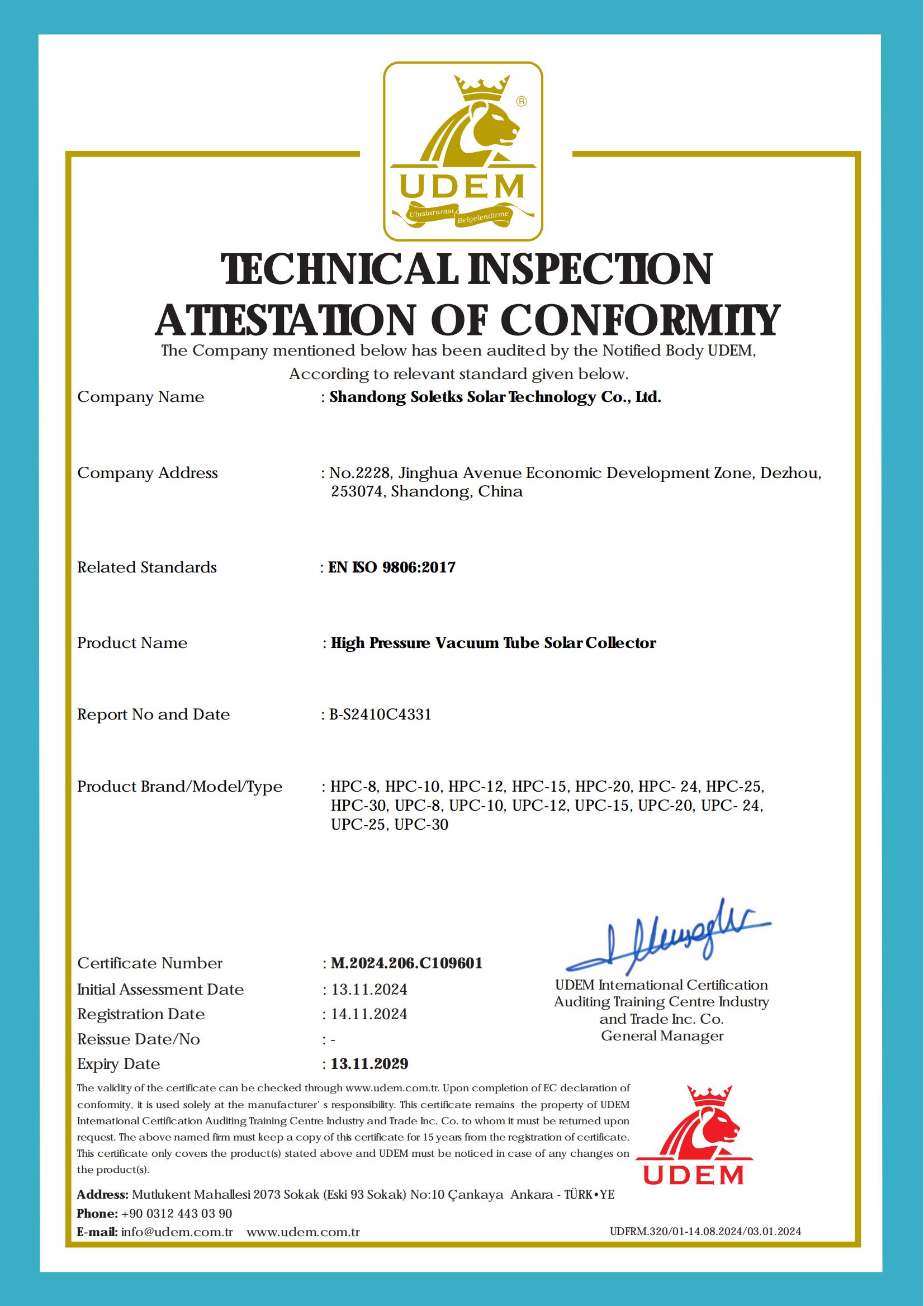
توسط تیم مهندسی SOLETKS — the evacuated tube and heat pipe application group at a Top-5 global flat-plate manufacturer with بیش از ۱۱۷ حق ثبت اختراع. We deploy heat pipe evacuated tube collectors across European cold climates, with reference projects including the Harz church plant in Germany (2021, 22 t/day, engineering-grade collectors in series/parallel configuration).
دامنه: This guide covers roof-mounted HPC collectors in indirect, pressurized commercial loops for hotels, schools, churches, and apartment buildings. For integrated-tank residential units, use our compact heat pipe solar water heater selection guide; the hydraulic, storage, and service decisions are different.
خلاصه — پاسخ سریع
A commercial heat pipe solar collector system for cold European climates must be designed around:
- Winter heat loss (the absorber runs farther above ambient when it's −10 °C outside)
- محافظت در برابر یخزدگی (loop hydraulics — NOT just collector design)
- Storage + backup heat (solar fraction in winter is 30–50%, not 80%)
- Roof loading (snow + wind in Northern Europe)
- Service access (replaceable tubes vs sealed designs)
The cold-climate advantage of heat pipe collectors:
- کاهش تلفات حرارتی همرفتی than flat plate (vacuum insulation reduces loss to ambient)
- Faster temperature rise in low-irradiation winter conditions
- Better performance at high ΔT (collector vs ambient)
- Heat pipes are individually replaceable — single tube failure doesn't disable the array
What heat pipes do NOT solve: roof piping, pump station, heat exchanger, sensors, and valves still need freeze protection (glycol, drainback, or engineered).
نکات کلیدی:
1. Heat pipe evacuated tubes fit cold climates when the system uses freeze-safe hydraulics.
2. Compare lighting area, NOT tube count.
3. Design backup heat for reliability — solar fraction in winter is realistic 30–50%.
4. Inspect glycol or drainback protection every 12 months.
5. Request Solar Keymark + ISO 9806 + pressure + installation documents before procurement.
SOLETKS publishes a آبگرمکن خورشیدی لولهگرمایی line for compact heater applications and an HPC Heat Pipe Solar Collector range for pressurized commercial projects.[1]
1. Cold-Climate Answer
Heat pipe solar water heaters work in cold European climates when the design protects the roof loop, pipework, heat exchanger, and storage from freezing. The evacuated tube reduces heat loss because the vacuum layer limits conduction + convection around the absorber. The sealed heat pipe transfers heat to the manifold, while the main system loop stays in the manifold and piping — and THAT loop is what needs freeze protection.
| Project condition | Heat pipe fit | محرک ریسک |
|---|---|---|
| Minimum outdoor temperature below 0 °C | ✅ Use closed-loop glycol, drainback, or engineered freeze protection.[2] | Direct water loop on exposed roof piping |
| Target hot water 45–60 °C | ✅ Strong cold-climate fit | Direct high-temperature expectation without backup |
| دسترسی به پشتبام | ≥ 600 mm service path[2] | Tubes installed where replacement is unsafe |
| فشار سیستم | Match collector + tank + valve + expansion rating | Mixed pressure classes without safety review |
| Winter solar resource | Use PVGIS data before sizing.[3] | Sizing by tube count only |
The design mistake: assuming vacuum tubes = freeze protection. They reduce heat loss at the collector, but exposed pipes, pumps, heat exchangers, sensors, and valves still freeze when water is left in cold zones.
2. European Cold-Climate Zones — A Real Mapping
European cold climates are not a single thing. Different latitudes need different design priorities:
| Zone | Examples | Design min temp | Heating degree-days | Key design priority |
|---|---|---|---|---|
| Mediterranean | Lisbon, Madrid, Rome, Athens | 0 to +5 °C | 1,500–2,500 | Year-round HW + winter preheat |
| Atlantic temperate | London, Paris, Amsterdam, Hamburg | −5 to −10 °C | 2,500–3,500 | Glycol indirect mandatory |
| Central continental | Berlin, Munich, Warsaw, Prague | −10 to −15 °C | 3,000–4,000 | Deeper glycol concentration (40%) |
| Northern continental | Stockholm, Helsinki, Tallinn | −۱۵ تا −۲۵ درجه سانتیگراد | 4,000–5,500 | 40–45% glycol + careful pressure design |
| Sub-arctic | Reykjavík, Tromsø, Northern Lapland | < −25 °C | > 5,500 | 45–50% glycol + altitude/wind specific |
| Alpine | Innsbruck, Bern, Andorra | −10 to −20 °C | 4,000–5,500 | Snow load + steep tilt + 40–45% glycol |
قاعده میدانی: SOLETKS uses 35–40% propylene glycol for sites with design minimum around −10 °C (Beijing-grade winter), upgrading to 40–45% for northern continental sites and 45–50% for extreme cold (e.g., the Saga County plateau plant in Tibet uses ~50% propylene with high-altitude pressure derate).
For full glycol design, see طراحی سیستم حرارتی خورشیدی با حلقه گلیکول.
3. Winter Solar Resource — European Cities
Winter solar resource determines how much heat pipe collectors can realistically deliver during the heating season. Approximate December irradiation (when hot water demand peaks but solar drops):
| شهر | Annual GHI (kWh/m²/yr) | Dec GHI (kWh/m²/day) | Winter solar fraction realistic |
|---|---|---|---|
| لیسبون | 1,800 | ~2.0 | 50–65% |
| مادرید | 1,850 | ~1.8 | 45–60% |
| Rome | 1,750 | ~1.7 | 45–60% |
| Vienna | 1,250 | ~0.8 | 30–45% |
| Munich | 1,200 | ~0.7 | 25–40% |
| Berlin | 1,100 | ~0.6 | 25–40% |
| Paris | 1,150 | ~0.6 | 25–40% |
| London | 1,050 | ~0.5 | 20–35% |
| Warsaw | 1,050 | ~0.5 | 20–35% |
| Amsterdam | 1,050 | ~0.4 | 20–35% |
| Stockholm | 1,000 | ~0.2 | 15–30% |
| Helsinki | 950 | ~0.1 | 15–25% |
| Reykjavík | 850 | ~0.05 | 10–20% |
Key insight: in northern Europe, the winter solar contribution is ممنوع designed to replace backup heat. The goal is measurable fuel + carbon reduction across the year, with strong summer + shoulder season output offsetting the lower winter contribution.
4. Heat Pipe vs Direct Flow Vacuum Tube
Both are evacuated tube collectors, but they handle the heat transfer differently:
| ویژگی | Heat pipe | Direct flow vacuum tube |
|---|---|---|
| انتقال حرارت | Sealed heat pipe inside vacuum tube | Water/fluid flows directly through inner tube |
| تعویض لوله | Individual tube replaceable (no system drain) | Often requires loop shutdown to replace |
| Failure mode | Single tube failure → small efficiency loss | Single tube failure → leak risk |
| Freeze risk | Heat pipe sealed, but system loop still freezes | Direct freeze risk if water in tubes |
| هزینه | Higher per tube | Lower per tube |
| Best for | Commercial + frequent service | Residential + simpler systems |
| Maximum operating T | ~120 °C typical | ~95 °C typical |
The cold-climate advantage of heat pipes: individual tube replacement without system drain is a major operational benefit for commercial projects where downtime is expensive. Single tube failure does NOT disable the array.
For more on flat-plate alternatives, see معیارهای انتخاب جمعکنندههای خورشیدی صفحه تخت بادوام.
5. Sizing Calculation for Winter Hot Water
Start with daily heat demand + realistic winter solar contribution.
یادداشت منبع: screening calculation for RFQ planning; final design needs local irradiation, collector test data, roof tilt, shading, pipe loss, storage temperature, antifreeze concentration, and backup-heater setpoint.[2]
نمونهٔ ورودی
| پارامتر | ارزش |
|---|---|
| Daily hot water volume | ۱۰۰۰ لیتر در روز |
| Cold water in winter | 8 °C |
| Target delivery temperature | ۵۵ درجه سانتیگراد |
| Temperature rise | 47 °C |
| ضریب گرمایی آب | 0.001163 kWh/L·K |
| Winter useful collector yield | 2.2 kWh/m²/day |
| Winter solar contribution target | 50% |
فرمول
Daily heat demand    = volume × ΔT × 0.001163
Useful solar target  = daily heat × winter solar contribution
Lighting area needed = solar target ÷ winter useful yield
جایگزینی
Daily heat demand    = 1,000 × 47 × 0.001163     = 54.7 kWh/day
Useful solar target  = 54.7 × 50%                = 27.4 kWh/day
Lighting area needed = 27.4 ÷ 2.2                = 12.5 m²
If using an HPC model with 3.00 m² lighting area:
Screening quantity   = 12.5 ÷ 3.00                = 4.2
RFQ starting count   = ~5 collectors
توصیه: for European winter projects, size the collector field to reduce backup energy — NOT to promise solar-only hot water. A stable system keeps a boiler, heat pump, or electric heater for final temperature and cloudy periods.
6. SOLETKS HPC Heat Pipe Product Range
| مدل | مساحت ناخالص | منطقه نورپردازی | cURL Too many subrequests. | Max operating T | بیشینه کارایی |
|---|---|---|---|---|---|
| اچپیسی۱۸۲ | 1.82 m² | 1.20 m² | ۰.۶ مگاپاسکال | ۱۲۰ درجه سانتیگراد | 0.724 |
| HPC242 | 2.42 m² | 1.60 m² | ۰.۶ مگاپاسکال | ۱۲۰ درجه سانتیگراد | 0.724 |
| HPC302 | 3.02 m² | ۲.۰۰ متر مربع | ۰.۶ مگاپاسکال | ۱۲۰ درجه سانتیگراد | 0.724 |
| HPC362 | 3.62 m² | 2.40 m² | ۰.۶ مگاپاسکال | ۱۲۰ درجه سانتیگراد | 0.724 |
| اچپیسی ۴۴۲ | 4.42 m² | 3.00 m² | ۰.۶ مگاپاسکال | ۱۲۰ درجه سانتیگراد | 0.724 |
بینش تدارکات: the 0.724 peak efficiency + 120 °C maximum operating temperature at 0.6 MPa pressure rating gives European buyers real selection inputs — ممنوع tube-count guessing.
7. Why Heat Pipes Help in Cold Weather (Mechanism)
In an evacuated tube:
- Solar radiation reaches an absorber insulated by vacuum
- Vacuum reduces convective heat loss → collector keeps useful heat even when outdoor air is cold
- Heat pipe adds a sealed transfer path: working medium evaporates → moves to condenser → releases heat to manifold → returns by gravity
This mechanism matters because collector efficiency falls as the collector becomes hotter than ambient air. In winter that temperature difference is large. Lower heat loss helps the collector deliver useful heat for the same sunlight.
Insulation matters too: poor insulation in roof piping cancels part of the benefit because heat leaves the system AFTER it has already been collected. Specify UV-resistant double-thickness pipe jacketing for European exposed-pipe installations.
8. Freeze Protection Design
Cold-climate heat pipe systems usually use one of three protection strategies:
| Strategy | Where it fits | Design rule |
|---|---|---|
| Closed-loop glycol | Most common European commercial freeze strategy | Test pH, concentration, pressure, freeze point every 12 months[2] |
| دریانک | Sites with correct pipe slope + drain volume | Verify complete drainage after pump stop |
| Controller freeze protection | Mild freeze risk + reliable backup power | ممنوع sole protection in deep-freeze climates |
Why glycol dominates in cold Europe
- گلیکول protects against freezing by lowering fluid freeze point
- Glycol degrades under heat, oxygen ingress, and stagnation
- Annual testing (pH, freeze point, color) catches degradation early
Why drainback is risky in Northern Europe
- Drainback requires perfect pipe slope on every horizontal run
- Snow + ice + cold roof piping = condensation
- Controller power loss + freezing weather = total failure
For deep European cold sites (Sweden, Finland, Baltics), closed-loop glycol is strongly preferred despite higher service cost.
9. Heat Pipe vs Flat Plate in Europe
Neither collector type wins every project. The right answer depends on target temperature, winter climate, budget, architecture, and maintenance capability.
| معیار | Heat pipe evacuated tube | Flat plate collector |
|---|---|---|
| Cold and windy climate | Stronger when winter heat loss is limiting | Strong in moderate climates |
| Target water temperature | Better above 50 °C[2] | Strong for 35–55 °C loads[2] |
| ظاهر سقف | Tube array | Lower-profile panel |
| Tube-level service | Individual tube replaceable | خدمات در سطح پنل |
| Freeze strategy | Still requires protected loop | Also requires protected loop |
| بار برفی | لولهها میتوانند برف را بین خود به دام بیندازند. | Better snow shedding |
| Main sizing risk | Tube count hides aperture or lighting area | Gross area may hide useful output |
Heat pipe collectors suit cold climates because vacuum insulation lowers heat loss, while flat plate collectors suit many moderate-temperature projects because they are durable, simple, and visually clean.
In Europe, the comparison should use certified collector data and local irradiation rather than a generic "best collector" claim.
10. Snow Load and Tube Orientation
European projects must consider snow load and tube orientation:
| cURL Too many subrequests. | Typical snow load (kg/m²) | Mounting recommendation |
|---|---|---|
| Mediterranean | < 100 | Standard mounting |
| Atlantic temperate | 100–200 | Standard mounting |
| Central European | 200–400 | Reinforced mounting + steeper tilt |
| Northern continental | 400–700 | Reinforced + steep tilt + tube spacing for snow shed |
| Alpine | 800–2,500 | Specialized structural calculation REQUIRED |
Tube spacing rule for snow climates: increase row spacing by 20–30% over Mediterranean baseline to allow snow shedding between rows.
11. Lifecycle and Maintenance Matrix
European cold-climate projects should budget for inspection — NOT only product purchase.
| Asset / task | Interval | Planning life | Cold-climate failure mode |
|---|---|---|---|
| Glycol freeze point + pH | ۱۲ ماه[2] | 3–5 years fluid | Freeze damage, corrosion, sludge |
| Pipe insulation + UV jacket | ۱۲ ماه | ۵–۱۰ سال | Heat loss + cracked insulation |
| پیشبارگذاری مخزن انبساط | ۱۲ ماه | ۵–۸ سال | تغییرات فشار + تخلیه اطمینان |
| Vacuum tube + heat pipe check | ۱۲ ماه | ۱۵–۲۰ سال | Broken tubes or poor condenser contact |
| Pump + controller test | ۶–۱۲ ماه | ۵–۱۰ سال | No circulation or wrong differential |
| Backup heater sequence | ۱۲ ماه | ویژه پروژه | Cold showers during cloudy weeks |
Reference project: the Harz church hot water project (Germany, 2021, 22 t/day) uses engineering-grade collectors in series/parallel configuration with closed-loop glycol freeze protection. After 5 years of operation, the main maintenance lesson learned was the 2024 pH-drift incident from a 6-day summer stagnation — see the طرح بهرهبرداری و نگهداری حرارتی خورشیدی تجاری.
12. Standards and Documentation
European cold-climate procurement should ask for collector performance + pressure + quality + installation evidence.
| استاندارد / گواهینامه | موارد کاربرد | قانون RFQ |
|---|---|---|
| ایزو ۹۸۰۶:۲۰۱۷ | روشهای آزمون کلکتورهای حرارتی خورشیدی | Collector performance basis.[4] |
| کلیدخورشیدی کاورمک | گواهینامه حرارتی خورشیدی اروپایی | REQUIRED for most EU tenders + incentives.[5] |
| ایزو ۹۰۰۱ | مدیریت کیفیت | شواهد فرآیند تأمینکننده.[6] |
| ASME BPVC | Tanks, boilers, pressure vessels | Pressure vessel rules.[7] |
| UL 508A | پنلهای کنترل | UL-market panel.[8] |
| EU PVGIS | EU official solar resource | Use for site-specific irradiation data.[3] |
SOLETKS برگزار میکند سولار کیمارک، CE، TÜV، UL، IEC 61215، IEC 61730، ISO 9001، ISO 14001 و ISO 45001 — the EU-readiness package.
13. RFQ Inputs for SOLETKS
از طریق درخواست پشتیبانی مهندسی کنید صفحه تماس SOLETKS when comparing compact heat pipe heaters, HPC collectors, storage, and freeze protection.
Site + climate
- Country, city, altitude
- Minimum outdoor temperature
- روز-درجهٔ گرمایشی (HDD)
- Snow load + wind exposure
- PVGIS irradiation data
بارگذاری
- Daily hot water demand (L/day or t/day)
- Cold water temperature + target delivery temperature
Building
- Roof area, tilt, orientation, shading, service access
- Existing boiler, heat pump, electric heater, or tank
ترجیحات سیستم
- Preferred freeze strategy: glycol / drainback / engineered
- Required HPC model size (HPC182 → HPC442)
- Working pressure required
انطباق
- ISO 9806, کلیدخورشیدی کاورمک, pressure code, quality certificate
- Local installation rules (German MELG, French RE, etc.)
مستندات
- Photos, roof plan, plant-room space, expected commissioning date
14. Specification Checklist
| مورد | مقدار مورد نیاز |
|---|---|
| Minimum outdoor temperature | °C + design period |
| Heating degree-days | HDD figure |
| Hot-water load | L/day, t/day, or kWh/day |
| مدل کلکسیونر | HPC182 / 242 / 302 / 362 / 442 |
| Tube count + lighting area | (Not just tube count) |
| cURL Too many subrequests. | 0.6 MPa baseline |
| محافظت در برابر یخزدگی | Glycol concentration / drainback volume / control sequence |
| Snow load reinforcement | Per regional spec |
| انبار | Liters + insulation + HX + backup coil |
| ایمنی | Expansion vessel + relief valve + mixing valve + air vent |
| Maintenance | Glycol test + tube access + pump inspection + controller log |
FAQ
Are heat pipe solar water heaters good for European winters?
Heat pipe solar water heaters are a strong option for European winters when the system uses a freeze-safe loop, insulated piping, storage, and backup heating. The evacuated tube reduces heat loss in cold air, but roof piping and hydraulic components still need proper freeze protection.
Do heat pipe collectors remove the need for antifreeze?
No. Heat pipes help transfer heat inside the evacuated tubes, but the system loop, pipes, heat exchanger, and valves still require freeze protection. Cold-climate designs usually use glycol, drainback, or engineered protection based on minimum temperature, pipe route, and maintenance capability.
What is the difference between heat pipe and direct flow vacuum tubes?
Heat pipe uses a sealed inner tube; direct flow has water/fluid flowing through. Individual tube replacement is the key heat-pipe advantage — no need to drain the system. Heat pipe also supports higher max operating temperature (~120 °C vs ~95 °C for direct flow).
How many heat pipe collectors are needed for a 1,000 L/day system?
Worked example: 1,000 L/day from 8 → 55 °C = 54.7 kWh/day. At 50% winter solar target + 2.2 kWh/m²/day useful yield = 12.5 m² lighting area. Using SOLETKS HPC442 (3.00 m² lighting per unit) = ~5 collectors starting point.
What winter solar contribution is realistic in Europe?
| cURL Too many subrequests. | Realistic winter solar fraction |
|---|---|
| Mediterranean | 50–65% |
| Atlantic temperate | 25–40% |
| Central continental (Berlin) | 25–40% |
| Northern continental (Stockholm) | 15–30% |
| Sub-arctic | 10–20% |
Don't promise more than these in the proposal — backup heat is essential.
What glycol concentration for European cold climates?
| اقلیم | غلظت پروپیلن گلیکول |
|---|---|
| Atlantic temperate (−5 to −10 °C) | 35–40% |
| Central continental (−10 to −15 °C) | 40% |
| Northern continental (−15 to −25 °C) | 40–45% |
| Sub-arctic / Alpine (< −25 °C) | 45–50% |
For full glycol design, see طراحی سیستم حرارتی خورشیدی با حلقه گلیکول.
Are heat pipe collectors better than flat plate in cold climates?
Heat pipes have an edge in very cold climates because vacuum insulation reduces heat loss when collector-to-ambient ΔT is large. In moderate European climates (Mediterranean, Atlantic temperate), flat-plate often wins on cost + simplicity. Compare on annual useful heat using Solar Keymark + ISO 9806 data — not on peak efficiency claims.
What information is needed for a European cold-climate quote?
City, HDD, PVGIS irradiation data, minimum outdoor temperature, daily HW volume, inlet temperature, target temperature, roof area, snow load, system pressure, freeze strategy, existing heater, certification requirements (Solar Keymark mandatory), photos, and roof plan.
منابع
[1] سولِتکس, آبگرمکن خورشیدی لولهگرمایی and HPC Heat Pipe Solar Collector range (HPC182–HPC442).
[2] SOLETKS cold-climate screening note: freeze strategy, service width, winter yield, inspection interval, and lifecycle values are preliminary engineering rules; confirm final values against local code, collector datasheet, fluid supplier limits, and site conditions.
[3] European Commission Joint Research Centre, PVGIS solar radiation tool.
[4] آیزو, ISO 9806:2017 انرژی خورشیدی – جمعکنندههای حرارتی خورشیدی – روشهای آزمون.
[5] سولار کیمارک, طرح صدور گواهینامه حرارتی خورشیدی.
[6] آیزو, استاندارد ایزو ۹۰۰۱:۲۰۱۵ سیستمهای مدیریت کیفیت.
[7] آسامای, کد دیگ بخار و مخزن تحت فشار.
[8] یوال سولوشنز, برنامه تابلوهای کنترل صنعتی و تابلوسازی – UL 508A.
آخرین بازبینی: ۲۰۲۶-۰۸-۲۰ توسط تیم مهندسی SOLETKS. بازبینی بعدی برنامهریزیشده: ۲۰۲۷-۰۲-۲۰. Project data referenced: Harz church (Germany, 2021, 22 t/day, engineering-grade series/parallel collectors), SOLETKS HPC heat pipe product range.
آیا به بازبینی مهندسی ویژه پروژه نیاز دارید؟
شرایط اقلیمی سایت، بار روزانه، محدودیتهای سقف یا اتاق تأسیسات، دامنه محصول و نیازمندیهای مستندسازی هدف را برای SOLETKS ارسال کنید تا تیم مهندسی بتواند یک توصیه تجاری عملی ارائه دهد.
تماس با SOLETKS