
1. Why Serious Buyers Start with Certified Report Data
The most common early mistake is to shortlist on quotation, photos, or one η0 headline. That is weak for collectors aimed at export distribution, OEM, or commercial DHW. Professional buyers need: recognised certification / report path, verifiable key parameters, line breadth (not one hero SKU), and fit to pressure and operating regime — then benchmark against known market levels.
Report-based comparison is a disciplined first filter. It does non replace factory audits, OEM talks, or commercial due diligence. For Chinese flat plate suppliers, the market should not be read only as “low-cost alternative” — some are already on report-backed performance that justifies technical evaluation. The Soletks STK-FPC annex lists tre standard models — 2.00, 2.50, 3.00 m² gross — which is more useful to OEM buyers than an isolated one-off.
2. What This Comparison Covers — and What It Does Not
Scope: flat plate liquid solar collectors only — not evacuated tubes, PVT, or air heaters — so the comparison stays technically coherent and useful for flat plate collector sourcing decisions.
We focus on parameters traceable to reports / annexes: η0,b, a1, a2, pressure, gross / aperture area, annual yield where published, and certificate / report reference, plus visible line depth.
Report data is non a full buy decision: it does non score lead time stability, OEM response, packaging, spare parts, warranty field behaviour, batch consistency, oppure terms. It is a screening tool: find technically credible options first, then verify execution separately.
3. Methodology: How This Comparison Was Built
3.1 Product scope
Only flat plate liquid heat collectors — avoids mixing technologies with different system behaviour.
3.2 Size-class logic
Compare within ~2.0, ~2.5, ~3.0 m² bands. A 2.0 and 3.0 m² unit are non interchangeable: layout, transport, mounting, and project match all change.
3.3 Core metrics
Primary set: η0,b, a1, a2, max working pressure, gross and aperture area, annuale yield where available, report / certificate ID. For Soletks, gross areas are 2.00 / 2.50 / 3.00 m² with aperture 1.88 / 2.37 / 2.86 m² respectively in the annex.
3.4 Interpretation
Massimo η0 is not auto-win; lower a1 is not always superior in every boundary condition. Read conditionally: η0 = starting point; losses grow in importance as ΔT to ambient rises; pressure = system fit; line depth = OEM flexibility.
3.5 Soletks annex reading note
In the Soletks annex, thermal performance parameters are explicitly given from model STK-FPC-2.00. Therefore η0,b = 0.774, a1 = 1.64, a2 = 0.077 are the annex thermal basis — not casually presented as separately re-tested for 2.50 and 3.00 without explanation.
4. The Four Numbers Buyers Should Read First
4.1 η0,b — start, not the whole story
η0,b = efficiency near zero temperature difference — a clear optical starting point. A strong η0 can still underperform in service if losses rise fast with ΔT. Annex: η0,b = 0.774 — do non stop there.
4.2 a1 — often more relevant in real DHW / preheat
Field conditions are not permanent ideal onset. Lower a1 usually means better loss control in practice. Annex: a1 = 1.64 W/(m²·K) — a reason to discuss operating conditions, not only peak optical copy.
4.3 Working pressure — quiet commercial filter
Pressure often underrated until late. Annex: max op. 1000 kPa, with stagnation 200 °C e max op. T 150 °C — for many commercial screens, that is an early pass/fail, not a footnote.
4.4 Line depth — one hero model ≠ OEM platform
STK-FPC lists 2.00 / 2.50 / 3.00 m² with dimensions 2000×1000×80, 2000×1250×80, 2000×1500×80 mm — that coverage matters more to channels than a single flattered datasheet line.
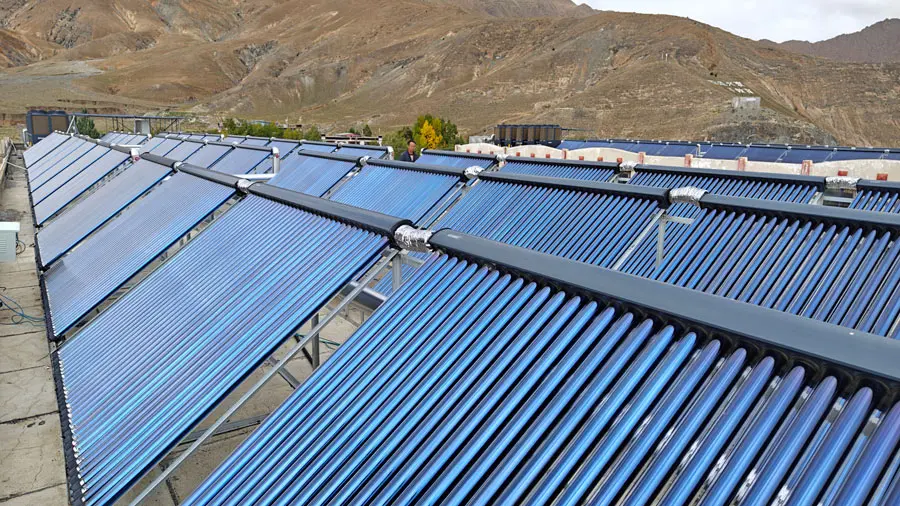
Size class, pressure class, and annual-yield class must match the project, not a generic leaderboard. Photo: Unsplash (license)
5. Chinese Flat Plate Collectors Compared by Size Class
The tables below use a reviewed working sample set of Chinese suppliers for illustration — labels Peer A–I are anonymised. Re-verify every figure against the attuale certificate and annex on Solar Keymark / notified-body systems before contract use.
5.1 The ~2.0 m² class
Soletks STK-FPC-2.00: 2000×1000×80 mm, aperture 1.88 m². Annex per-collector power (Gb=850, Gd=150, u=1.3 m/s): 1524 W @ 0 K, 1476 @ 10, 1287 @ 30, 975 @ 50, 540 @ 70, 251 @ 81 K.
| Rank | Brand / sample | Modello | Gross | η0,b | a1 | Note |
|---|---|---|---|---|---|---|
| 1 | Soletks | STK-FPC-2.00 | 2.00 m² | 0.774 | 1.64 | Keymark annex thermal basis |
| 1 | Peer A | 2.0 m² sample | 2.00 m² | 0.774 | 1.64 | Same top optical level in Chinese set |
| 3 | Peer B | 2.0 m² sample | 2.00 m² | 0.758 | 2.06 | Competitive η0, weaker a1 |
| 4 | Peer C | 2.0 m² sample | 2.00 m² | 0.754 | 4.52 | High a1 |
| 5 | Peer D | 2.0 m² sample | 2.00 m² | 0.745 | 3.65 | — |
| 6 | Peer E | 2.0 m² sample | 2.00 m² | 0.741 | 1.86 | Relatively low heat loss in band |
| 7 | Peer F | 2.0 m² sample | 2.00 m² | 0.732 | 3.77 | Quasi-dynamic in working set |
| 8 | Peer G | 2.0 m² sample | 2.00 m² | 0.731 | 2.83 | — |
| 9 | Peer H | 2.0 m² sample | 2.00 m² | 0.717 | 3.55 | — |
| 10 | Peer I | 2.0 m² sample | 2.00 m² | 0.700 | 3.42 | — |
In this 2.0 m² set, STK-FPC-2.00 is top tier on η0,b and among the strongest on a1 — the pairing matters more than η0 alone for real operating discussion.
5.2 The ~2.5 m² class
STK-FPC-2.50: 2000×1250×80 mm, aperture 2.37 m². Power: 1905 / 1844 / 1609 / 1219 / 675 / 314 W from 0→81 K (same Gb, Gd, u as above).
| Rank | Brand / sample | Modello | Gross | η0,b | Note |
|---|---|---|---|---|---|
| 1 | Peer A | 2.5 m² sample | 2.50 m² | 0.784 | Top visible η0 in reviewed set |
| 2 | Soletks | STK-FPC-2.50 | 2.50 m² | ~0.79 | Estimated; not a separate full annex η set in source — confirm with current annex / factory |
| 3 | Peer B | 2.5 m² sample | 2.50 m² | 0.782 | Strong optical |
| 4 | Peer C | 2.5 m² sample | 2.50 m² | 0.754 | — |
| 5 | Peer D | 2.5 m² sample | 2.50 m² | 0.731 | — |
Il 2.5 m² band needs careful reading: documentation depth varies. Position STK-FPC-2.50 as a strong mid/upper option from series logic, size coverage, and yield tables — state ~η0 as estimated unless a separate annex block is cited.
5.3 The ~3.0 m² class & larger-format context
This band matters when buyers also evaluate larger-format collectors for commercial DHW, engineered arrays, or fewer connections per kW. STK-FPC-3.00: 2000×1500×80 mm, aperture 2.86 m². Power: 2285 / 2213 / 1930 / 1463 / 810 / 376 W (0→81 K).
| Rank | Brand / sample | Modello | Gross | η0,b | a1 | Note |
|---|---|---|---|---|---|---|
| 1 | Soletks | STK-FPC-3.00 | 3.00 m² | 0.812 | 1.83 | Per internal working comparison / report set |
| 2 | Peer A | 3.0 m² sample | 3.00 m² | 0.784 | 3.06 | Next visible tier in set |
| 3 | Peer B | 3.0 m² sample | 3.00 m² | — | — | In reviewed sample; verify annex |
| 4 | Peer C | 3.0 m² sample | 3.00 m² | — | — | In reviewed sample; verify annex |
In this band, the current working comparison shows STK-FPC-3.00 with a high η0 e un stronger a1 than the next visible row — a useful shortlist signal for large-collector projects if numbers are re-confirmed on the live certificate.
6. Pressure Comparison: A Quiet but Critical Filter
In closed loops, multi-storey buildings, or demanding hydraulics, max operating pressure can be an early eliminator.
| Brand / benchmark | Max op. pressure | vs Soletks (1000 kPa) |
|---|---|---|
| Soletks (annex) | 1000 kPa | Baseline |
| Mainstream European level | 1000 kPa | Same tier |
| Selected alternatives | 800 kPa | Below |
| Selected alternatives | 600 kPa | Clearly below |
7. What European Benchmarks Tell Us
Benchmarks contextualise Chinese data — without them, a China-only table becomes a closed loop. Typical takeaways: (1) some Chinese report data is strong enough to shortlist on performance + fit, not only price; (2) European incumbents still hold channel trust, install base, and references that a datasheet never shows; (3) the practical question is often which Chinese factory is document-ready, series-consistent, and credible enough to enter the shortlist?
8. Why Annual Yield Thinking Matters More Than a Single Lab Number
You buy seasonal output, not one lab point. The Soletks annex adds gross annual thermal yield by reference location. Example — STK-FPC-2.00 at 25 °C mean fluid T: 2443 kWh/collector in Athens, 1416 in Stockholm, 1536 in Würzburg. At 50 °C: 1741 / 840 / 913 kWh respectively.
STK-FPC-3.00 at 25 °C: 3665 kWh in Athens vs 2125 Stockholm, 2304 Würzburg. Per m² gross at 25 °C: e.g. 1222 kWh/m², 69% Athens; 957 / 59% Davos; 708 / 61% Stockholm; 768 / 62% Würzburg — a practical bridge to climate-based expectations.
9. Buyer Rules: How to Shortlist a Chinese Flat Plate Supplier
- Rule 1 — Do not shortlist on η0 alone.
- Rule 2 — Compare solo within the same size class.
- Rule 3 — Check pressure early (e.g. 1000 kPa in Soletks annex = relevant prima final engineering).
- Rule 4 — Prefer usable line depth, not one hero model.
- Rule 5 — Separate technical screening from execution (lead time, batch QC, documentation).
If you still need to understand how flat plate and evacuated tube technologies compare, decide technology first — then apply the rules above to flat plate solo.
10. Soletks in Context: Strengths and What to Verify
View Soletks through the same market logic as any candidate: η0,b 0.774 with a1 1.64 supports operating-condition discussion beyond headline η; 1000 kPa; tre standard gross sizes; location-based annual yield, not only peak claims. That is meaningful for OEMs needing a coherent range.
Still verify directly: export lead time, OEM workflow, packaging, document response speed, after-sales, e batch-to-batch spec control. A good report does not guarantee a good ship — it justifies a deeper conversation. For a broader European selection and RFQ frame, use our selection guide for European projects (types, working principle, and project fit).
11. Conclusion: From Certified Data to a Real Shortlist
Reliable buying starts with report data, read in the right size class, then translated to sourcing: verify report logic → compare like for like → read η0 with a1 / a2 → check pressure early → assess line depth → only then OEM and commercial validation. That does not make a viral “#1” headline — it makes a defensible shortlist. The next step is the technical package and a conversation with marketing removed.
Next step: data pack & engineering
STK-FPC-2.00, 2.50, 3.00 — Keymark path, model matrix, and location yields (Athens, Davos, Stockholm, Würzburg, …).
Technical package
OEM, distribution, or project: request report references, model tables, and project matching notes for STK-FPC.
Request technical package →Engineering compare
Send market, pressure class, size band, and yield expectations — we return a STK-FPC–based comparison and quote frame.
Compare your shortlist →OEM / distribution
2.00 / 2.50 / 3.00 line overview: annex data, custom options, export packaging.
OEM / distribution inquiry →E-mail: export@soletksolar.com · service.soletksolar.com/contatti
Frequently Asked Questions
What is a Solar Keymark annex and why does it matter?
Il annex to the certificate holds tested η0, a1, a2, pressure, yields, etc., per model — more useful than a brochure because it ties to standard conditions and verifiable references. Ask for the annex or equivalent in evaluation.
Why compare within the same size class?
Different gross area means different layout, logistics, and project match. Mixing 2.0 and 3.0 m² in one “best” table distorts the result.
Is η0 the most important number?
It is a start. Real systems spend much time away from zero ΔT — a1 (and a2) then dominate useful output. A slightly lower η0 with much lower a1 can win in service.
How important is pressure when sourcing from China?
Often underrated until late. Closed loops and tall buildings may exclude 600–800 kPa products regardless of a pretty η0. Check early.
Can report data alone pick the best supplier?
No — it builds a technical shortlist. Execution (lead time, OEM, packaging, after-sales, batch QC) must be verified separately.