
A verdadeira questão das vendas
No papel, tanto o termossifão como os sistemas de circulação forçada utilizam a energia solar gratuita para produzir água quente. No entanto, no terreno, resolvem problemas muito diferentes. Um é simples, compacto e atrativo para trabalhos residenciais simples. A outra é mais flexível, mais fácil de escalar e mais adequada a edifícios onde a disposição, o controlo e a fiabilidade são mais importantes do que o custo inicial mais baixo.
O Departamento de Energia dos EUA continua a enquadrar o aquecimento solar de água na mesma distinção entre ativo e passivo, e fabricantes como a SOLETKS reflectem esta divisão nas suas linhas de produtos - desde unidades integradas compactas a configurações de sistemas divididos concebidos para projectos comerciais.
A verdadeira questão de vendas não é "Qual é o melhor?". É "Qual delas é mais fácil de vender, instalar, apoiar e defender para este tipo de edifício, este clima e este comprador?"
Num relance: Termossifão vs Circulação Forçada
Antes de nos aprofundarmos, eis uma comparação rápida para o ajudar a orientar-se.
| Fator | Termossifão | Circulação forçada |
|---|---|---|
| Método de circulação | Passivo (convecção natural) | Ativo (bomba + controlador) |
| Instalação típica | Unidade integrada no telhado (depósito + coletor juntos) | Disposição dividida (coletor no telhado, depósito no interior ou na sala da fábrica) |
| Posição do tanque | No telhado, por cima ou ao lado do coletor | Interior, sob o teto, sala de plantas ou varanda |
| Carga do telhado | Elevado - depósito de água cheio no telhado | Baixo - apenas colectores no telhado |
| Adequação ao congelamento | Limitado - tanque exposto vulnerável | Forte - circuito indireto com glicol |
| Melhores tipos de edifícios | Moradias, casas unifamiliares, residenciais ligeiras | Hotéis, hospitais, escolas, fábricas, edifícios de vários andares |
| Complexidade do serviço | Baixa - menos componentes | Mais elevado - recompensa a manutenção profissional |
| Custo inicial típico | Mais baixo | Higher |
| Tipo de comprador recomendado | Mercados residenciais sensíveis aos preços e de serviços reduzidos | Orientada para os projectos, sensível às alterações climáticas e orientada para a engenharia |
Este quadro dá-lhe a divisão geral. As secções seguintes explicam por que razão cada fator é importante e onde se situam as soluções de compromisso.
O que é um aquecedor solar de água por termossifão?
Um sistema de termossifão é um aquecedor solar passivo de água. Faz circular a água naturalmente porque a água quente sobe e a água fria desce. Na maioria dos modelos de termossifão, o coletor fica por baixo do depósito de armazenamento e todo o conjunto é instalado como uma unidade compacta no telhado. Os sistemas passivos são geralmente menos dispendiosos, mas são normalmente menos eficientes do que os sistemas activos. Ao mesmo tempo, podem ser mais fiáveis porque utilizam menos peças móveis.
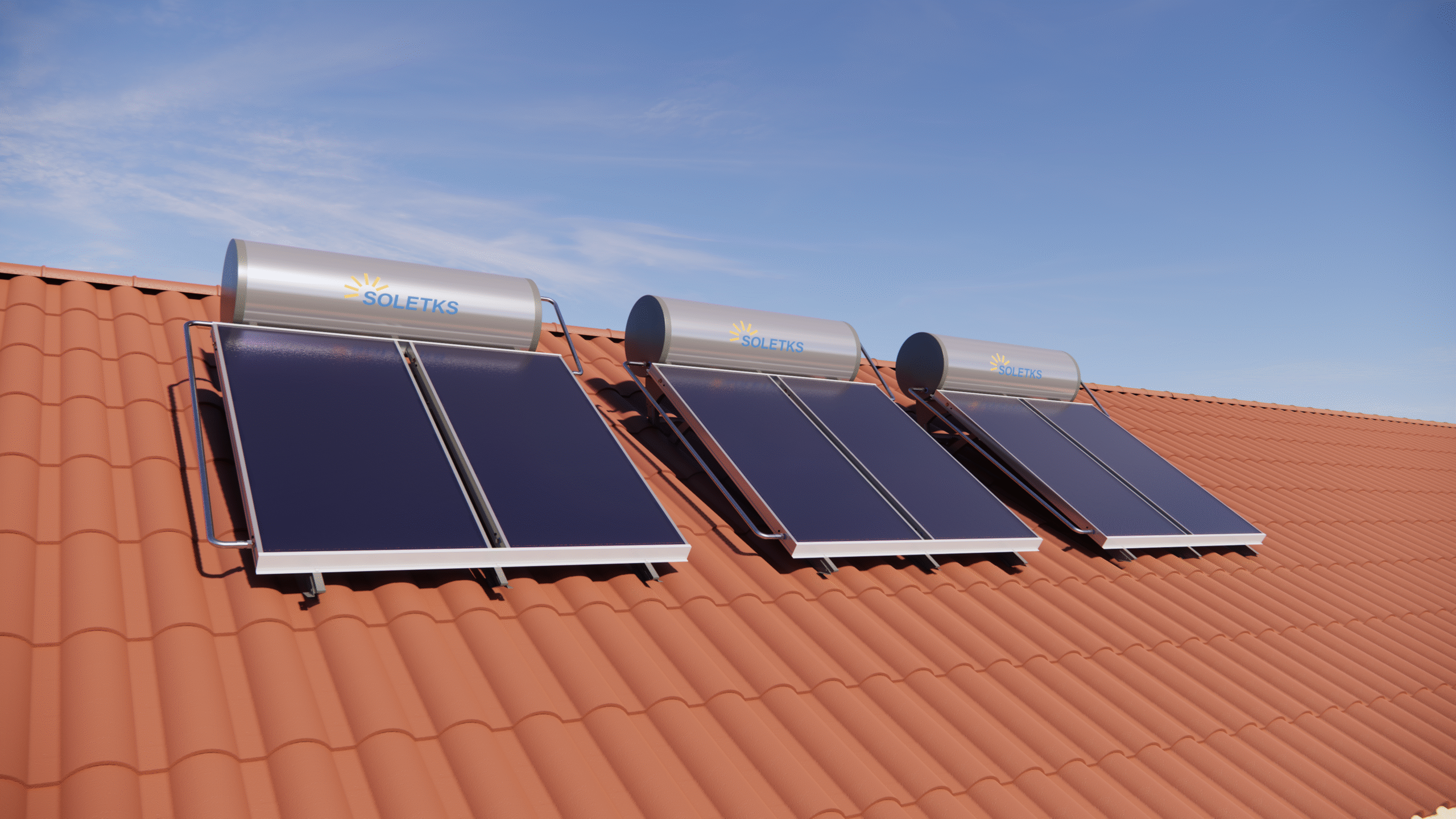
Aquecedor solar de água integrado SOLETKS: uma unidade compacta de telhado em que o coletor e o depósito de armazenamento são instalados em conjunto - o formato clássico de termossifão
Nota terminológica
O termossifão descreve um método de circulação - como a água se move através do sistema sem uma bomba. Não define automaticamente o formato do produto. Algumas unidades rooftop integradas utilizam circulação por termossifão, enquanto outras podem utilizar modelos pressurizados com caraterísticas de funcionamento diferentes. Ao avaliar os produtos, verifique se a unidade funciona com circulação natural alimentada por gravidade ou se utiliza um circuito pressurizado, porque essa distinção afecta o comportamento do sistema, a tolerância ao congelamento e a compatibilidade com o edifício.
Como funciona a circulação por termossifão
Do ponto de vista das vendas, o termossifão é mais fácil de posicionar como um solução compacta e de baixa complexidade para casas e projectos residenciais ligeiros. Funciona especialmente bem quando os compradores pretendem um sistema simples, os recursos de serviço são limitados e o telhado pode transportar o depósito em segurança.
O que é um aquecedor de água solar de circulação forçada?
Um sistema de circulação forçada é um aquecedor solar de água ativo. Utiliza uma bomba e um controlador para mover a água ou o fluido de transferência de calor entre os colectores e o depósito de armazenamento. Nos sistemas diretos, as bombas fazem circular a água da casa - e estes funcionam melhor onde o congelamento é raro. Nos sistemas indirectos, a bomba faz circular um fluido de transferência de calor não congelante através de um permutador de calor, razão pela qual são comuns em climas mais frios.
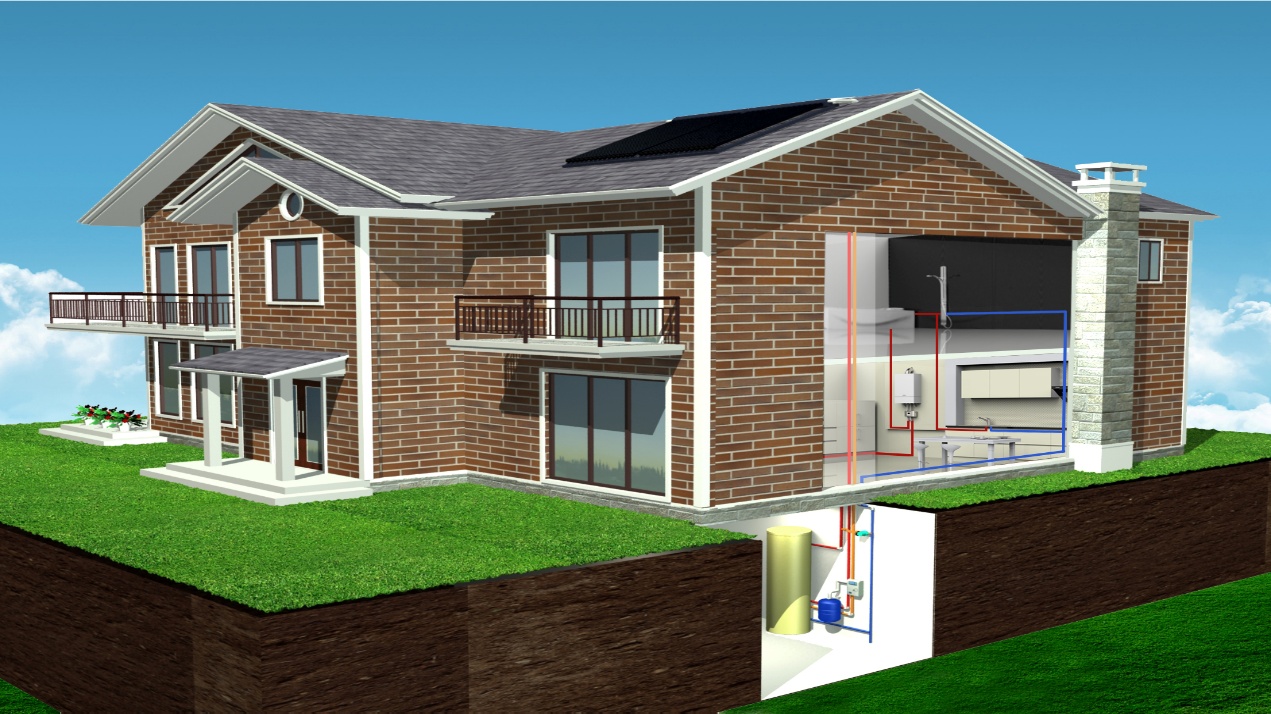
Em termos comerciais, a circulação forçada significa normalmente uma esquema de instalação splitO sistema SOLETKS é composto por: colectores no telhado, tanque de armazenamento no interior ou numa sala de instalações e um circuito controlado entre eles. O SOLETKS aquecedor solar de água split de placa plana está posicionado em torno desta arquitetura - instalação flexível, menor carga no telhado, perda de calor reduzida e maior proteção contra o congelamento.
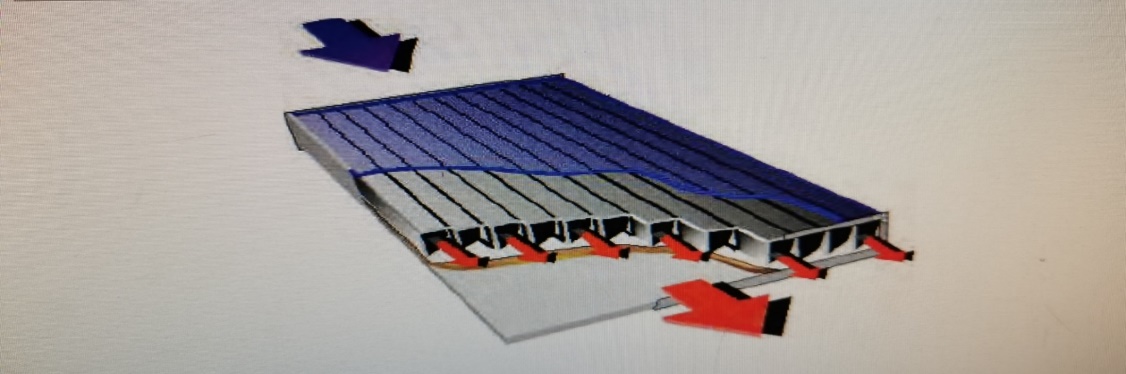
Como funciona a circulação forçada
Quando o termossifão é o produto mais fácil de vender
O termossifão é geralmente a venda mais fácil quando o projeto é pequenos, residenciais e sensíveis ao preço.
Para uma vivenda, casa unifamiliar ou aplicação de água quente sanitária ligeira, a simplicidade de um pacote compacto no telhado é uma vantagem real. Não existe uma estação de bombagem separada para explicar, menos controlos para colocar em funcionamento e menos dependências eléctricas. Esta simplicidade é muitas vezes mais importante do que a obtenção do melhor desempenho térmico. O Departamento de Energia dos EUA também refere que os sistemas passivos são normalmente menos dispendiosos e podem durar mais tempo porque evitam bombas e controladores.
Aquecedores solares de água integrados em telhados residenciais: vários ângulos de montagem (0°, 25°, 45°) adaptam-se a moradias, telhados planos e superfícies inclinadas
Menor primeiro custo
Sem estação de bombagem, sem controlador, sem depósito de expansão. O conjunto compacto mantém a lista de materiais simples e o custo final mais baixo - uma vantagem direta nos mercados residenciais sensíveis ao preço.
Menos chamadas de retorno
Menos componentes significa menos pontos de falha. Em mercados onde o serviço pós-venda é reduzido e o suporte de peças sobresselentes é limitado, esta simplicidade reduz o risco de garantia.
Instalação rápida
Os módulos principais pré-montados simplificam o trabalho no local. Uma equipa, um dia, um telhado - sem canalização interior ou cablagem do controlador para complicar o trabalho.
Mas a venda só é fácil se o edifício se adaptar efetivamente ao produto.
Where Thermosiphon Starts to Become Hard to Defend
The biggest issue is not theory. It is the building.
A rooftop thermosiphon unit puts the tank on the roof. That immediately raises questions about structural load, appearance, maintenance access, wind exposure, and heat loss. Real product data shows why this matters: one thermosiphon range lists a full tank weight of 239 kg for a 200 L model e 360 kg for a 300 L model — before adding collector weight, supports, pipework, and project-specific wind or seismic requirements.
Roof Structure Is Often the Deciding Factor
If a building's roof cannot safely support a full water tank plus the collector assembly, the thermosiphon option is off the table regardless of its other advantages. This is especially common with lightweight steel or older flat-roof commercial buildings. Experienced distributors always ask for roof type and load capacity before quoting a rooftop integrated unit.
Published design literature on integrated and compact systems also flags the same pain points: exposed outdoor tanks increase heat loss, building integration is harder, aesthetics can suffer, and the format is less suitable for broader building applications. In frozen regions, compact systems need anti-freezing measures such as draining the pipeline or electric heat tracing.
That means thermosiphon becomes much harder to defend when the project involves:
- Multi-storey buildings with complex layouts
- Long pipe runs between roof and point of use
- Strict facade or aesthetic control requirements
- Difficult roof access for maintenance
- Cold climates with regular freezing temperatures
When Forced Circulation Becomes the Better Business Decision
Forced circulation is rarely the simplest product, but it is often the better project answer.
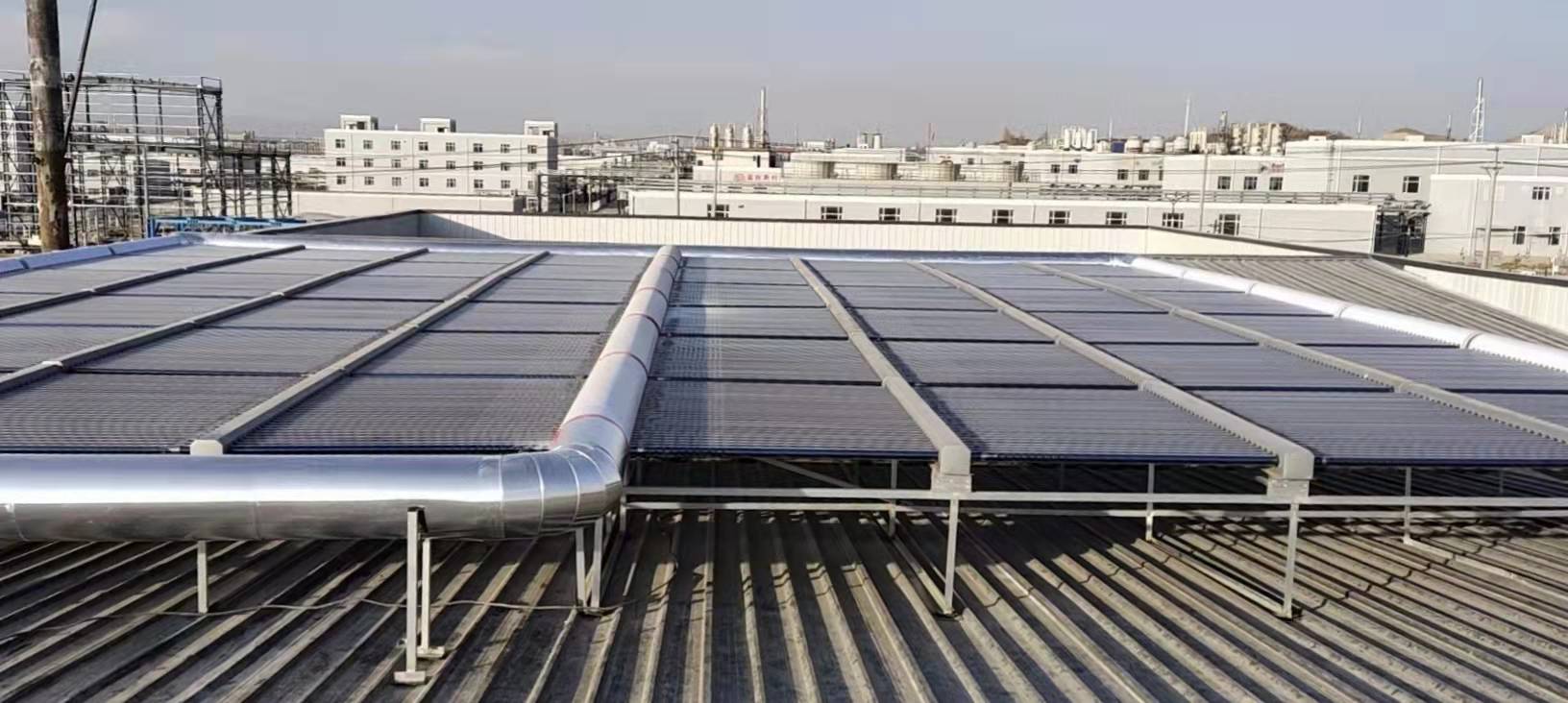
The split layout separates the collector from the storage tank, which makes installation far more flexible. The collector can stay on the roof while the tank is placed indoors, under the roof, on a balcony, or in a plant room. Research on split solar water heater integration specifically highlights that this format is better suited to villas, multi-storey buildings, high-rise buildings, offices, factories, hotels, hospitals, and schools — because the collector arrangement is more flexible and the system integrates better with the building.
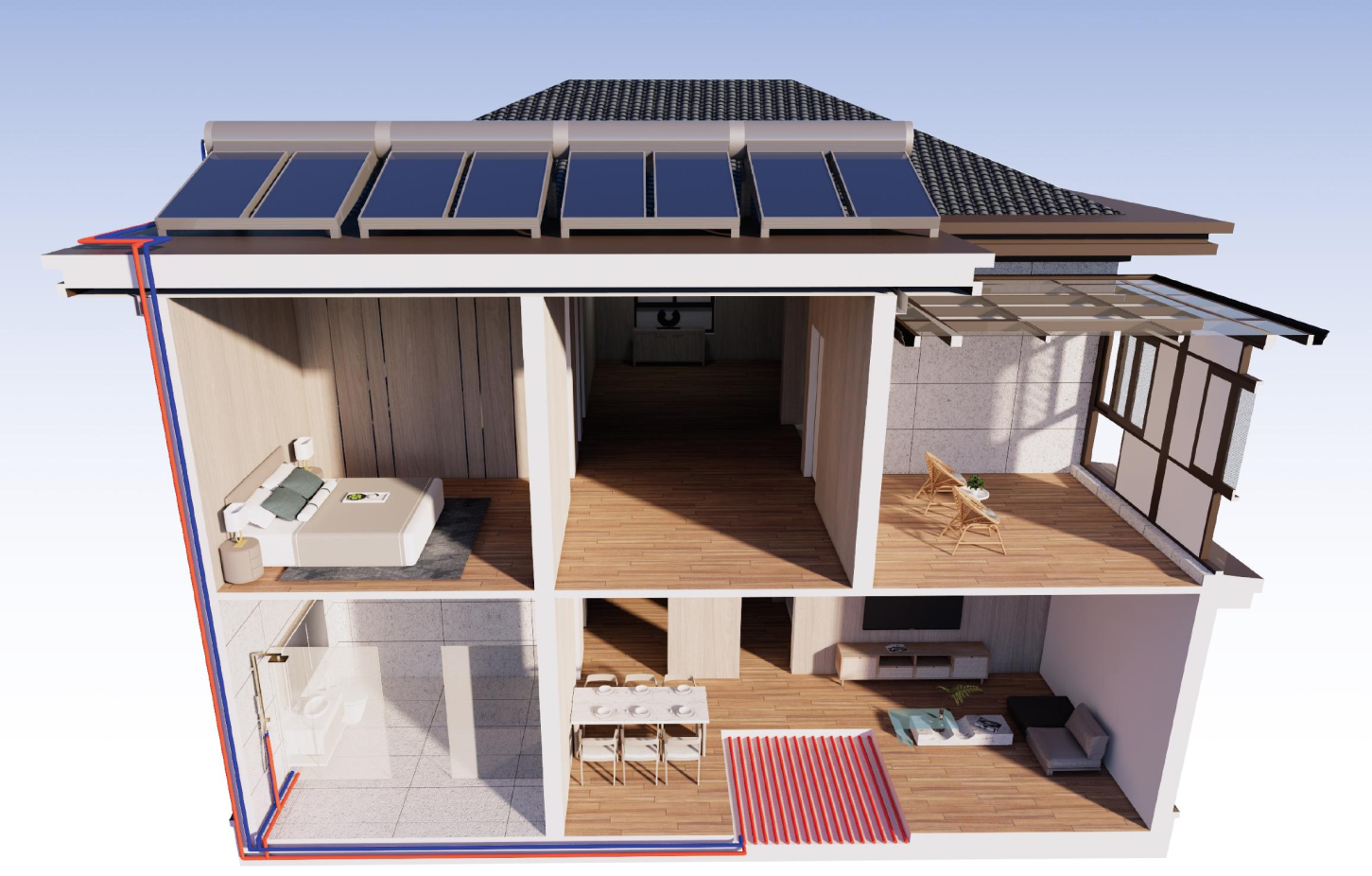
Commercial forced circulation system: flat plate collectors on the hotel roof, storage tanks in the plant room below — split architecture designed for scale
This is also where the sales story becomes stronger for B2B buyers. A hotel, hospital, school, or factory does not buy solar hot water because the system looks simple. It buys because the system fits the load profile, can be controlled, can be maintained, and can scale. That is exactly why the sistemas comerciais de água quente solar section on the SOLETKS site — and the accompanying commercial sizing guide for hotels and hospitals — are more commercially relevant for project buyers than a generic residential product page.
For commercial-scale projects, the collector choice also matters. Standard residential-sized flat plate collectors may work for small split systems, but hotels, hospitals, and factories with higher thermal loads often require engineering-grade large-format collectors designed for centralized hot water systems, where higher output per unit area, reduced installation complexity, and lower cost per watt become critical.

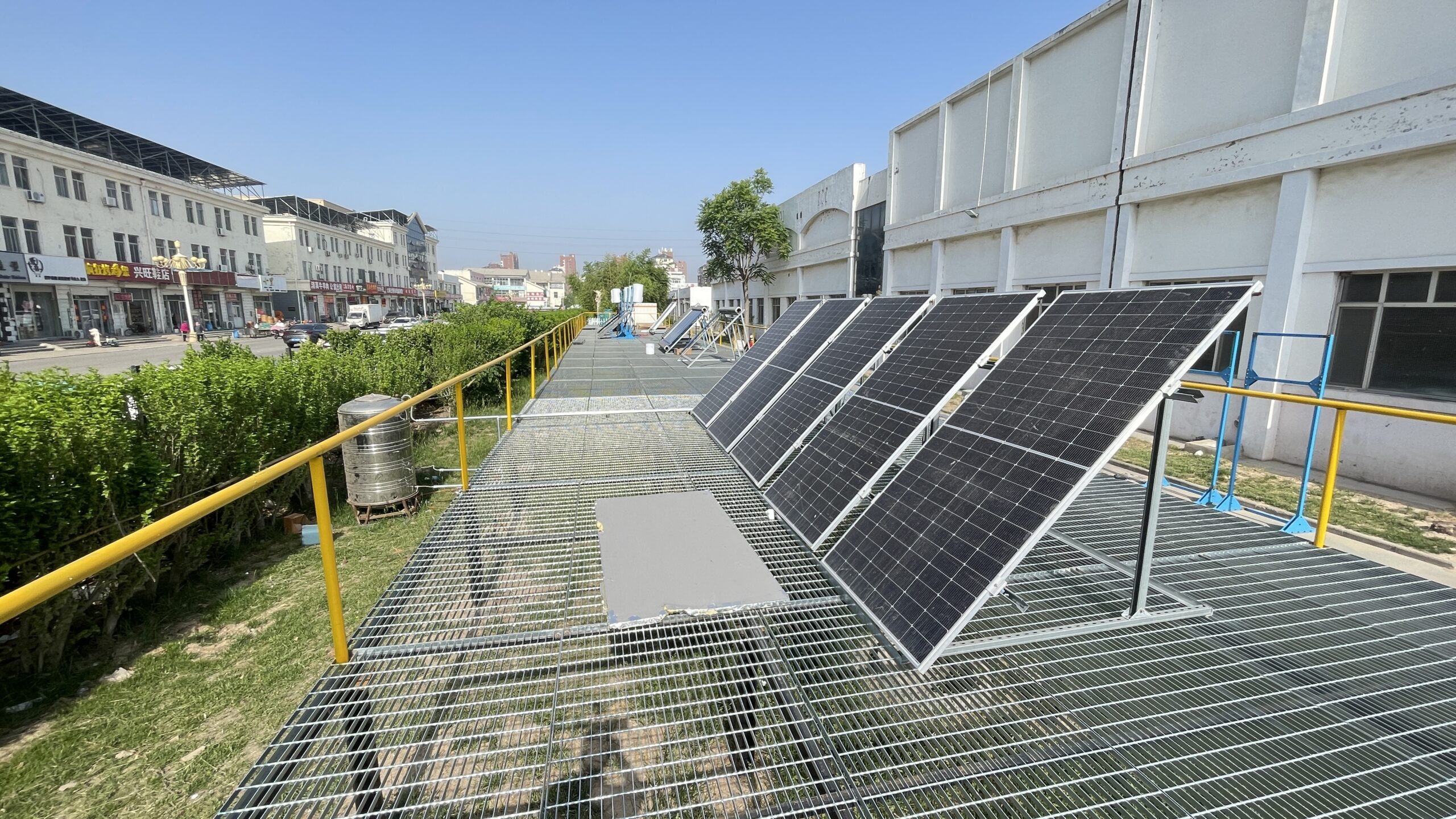
What Buyers Actually Feel: Performance, Stability, and Real Hot Water Delivery
In everyday selling, buyers do not ask about thermodynamic categories. They ask whether they will still have hot water during peak demand, whether temperature will stay stable, and whether the system still makes sense in winter.
A controlled side-by-side study published in Energies compared an identical forced-circulation system and thermosyphon system. Over a four-day nonstop trial:
| Métrica de desempenho | Termossifão | Circulação forçada |
|---|---|---|
| Solar fraction | 0.48 | 0.62 |
| Thermal efficiency | 53.3% | 68.2% |
| Additional heat delivered | — | +5.4 kWh over thermosiphon |
| Pump electricity consumed | 0 kWh | 0.07 kWh |
Context Matters
The authors note that the test was conducted in late spring, so results may differ by season. That does not mean every pumped system automatically wins every project. It does mean forced circulation is easier to justify when the buyer values controlled performance, higher storage flexibility, and better response under heavier or more continuous demand.
Freeze Protection and Climate Risk
Climate is one of the clearest dividing lines.
The U.S. Department of Energy states that direct circulation systems work well where freezing is rare, while indirect circulation systems use a non-freezing heat-transfer fluid and are popular in climates prone to freezing. DOE's heat-transfer-fluid guidance also notes that non-toxic propylene glycol is typically used for freeze protection, and that antifreeze fluids degrade over time and normally need replacement every three to five years.
| Clima | Thermosiphon Suitability | Forced Circulation Suitability | Sales Logic |
|---|---|---|---|
| Tropical / warm | Excelente | Excelente | Thermosiphon wins on simplicity + cost |
| Mild temperate | Bom | Excelente | Either — depends on building |
| Variable / seasonal freeze | Limitado | Excelente | Forced circulation easier to defend |
| Cold / regular freeze | Unsuitable without major mitigation | Good (glycol loop) | Forced circulation required |
Channel Strategy Point: For distributors operating across multiple climate zones, a forced circulation product range with indirect-loop capability covers a wider geography than a thermosiphon-only portfolio. That is a channel strategy point, not just a technical one.
Maintenance Reality: Simple System vs Professional System
Termossifão is usually easier to understand and easier to keep running in low-service markets. That is its strongest channel advantage.
Forced circulation, on the other hand, is the professional system. It rewards better installation, better controls, and better maintenance. That is why it fits stronger service channels and more demanding projects. The SOLETKS commercial maintenance guide positions commercial solar hot water systems as long-life assets that depend on consistent care — and that is a much better fit for hotels, hospitals, and other critical-load buildings than a purely "cheap and simple" message.
| Dimension | Termossifão | Circulação forçada |
|---|---|---|
| Ease of understanding | High — simple concept, few parts | Moderate — requires technical knowledge |
| Maintenance burden | Low — occasional inspection | Planned — pump, controller, glycol checks |
| Channel fit | Low-service, retail-oriented | Professional, project-oriented |
| Revenue model | Transactional — sell and move on | Relationship — sell, install, maintain |
| System lifespan (well-maintained) | 15–20 years | 20–25 anos |
For distributors, this is not just a technical distinction. It is a business model distinction. Thermosiphon is easier to move. Forced circulation is easier to build into an engineering-led project pipeline.
A Practical Decision Checklist
Instead of relying on general impressions, use these criteria to guide the recommendation for each project.
Choose Thermosiphon When
- The building is a house, villa, or light residential structure
- The roof is structurally suitable for a full rooftop tank (check weight capacity)
- The climate is warm or only mildly seasonal
- The buyer is prioritizing low first cost and easy installation
- After-sales service capability in the market is limited
- The hot water load is simple and domestic-scale
Choose Forced Circulation When
- The building is a hotel, hospital, school, factory, dormitory, or multi-storey structure
- Long pipe runs or complex layout constraints are involved
- The roof cannot support a full water tank, or aesthetics are tightly controlled
- Freeze protection is important for the project climate
- The buyer expects monitoring, scalability, and stable peak-hour supply
- The project involves centralized hot water with engineered backup integration
If the answer to most of the criteria in the first column is "yes," thermosiphon is likely the faster sale. If the second column dominates, forced circulation is usually the safer long-term recommendation.
Before You Request a Quote: What We Need from You
Correct system selection depends on real project inputs — not assumptions. This is consistent with how commercial solar hot water sizing is handled for serious project inquiries.
Before we recommend thermosiphon or forced circulation, send us:
Tipo de Edifício
Residential, hotel, hospital, school, factory, or other — this determines system architecture.
Demanda diária de água quente
In liters or gallons, or the number of rooms/beds/users if exact volume is unknown.
Climate & Winter Minimum
So we can evaluate freeze risk and solar fraction for your location.
Roof Photos or Layout
To assess structural suitability, orientation, available area, and shading conditions.
Backup Heat Source
Electric, gas, diesel, heat pump, or other — so integration can be planned from the start.
Installation Constraints
Tank location preferences, pipe run distances, facade requirements, and access conditions.
With these inputs, we can tell you which system architecture fits the project, recommend collector area and storage sizing, and provide a quotation-ready configuration.
Why SOLETKS for This Decision
When evaluating a manufacturer for either product path, experienced buyers look for a few things: whether the supplier can actually engineer both system types, whether the products carry recognized certifications, whether commercial-scale project experience exists, and whether the factory provides real technical support — not just catalog PDFs.

SOLETKS manufacturing facility in Shandong, China — production lines spanning both compact integrated units and split forced-circulation system components
Certifications
Solar Keymark, CE, ISO 9001, ISO 14001, ISO 45001. Products tested and certified to international standards — not just Chinese domestic standards.
Global Project Experience
Hotel hot water systems, institutional heating projects, and large-scale solar thermal installations across multiple climate zones — from the Middle East to Northern Europe.
Real Engineering Support
System sizing, collector layout, hydraulic design, and integration planning. Whether the project calls for a simple residential thermosiphon package or a multi-collector system for a 100-room hotel.
117+ Patentes
Top 5 global ranking in flat-plate collector manufacturing. Innovation-driven, not just cost-driven — with proprietary selective coatings and FEM-optimized flow channels.
Final Answer: Which One Should You Sell?
The Bottom Line
If your channel is residential, price-sensitive, and service-light, thermosiphon is often the faster and easier product to sell.
If your channel is project-driven, climate-sensitive, and expects more engineering discipline, forced circulation is usually the safer long-term product to sell.
The Principle That Matters
Do not sell by collector type alone. Sell by building type, roof condition, service capability, and operating risk.
That is the difference between moving a product and closing the right project.
Ready to Match the Right System to Your Next Project?
Send your building type, estimated daily hot water demand, roof layout, winter minimum temperature, and backup heating preference. We will recommend whether thermosiphon or forced circulation is the better fit — and provide a quotation-ready system configuration.
Para compradores de projectos
- ✓ System architecture recommendation
- ✓ Collector area & tank sizing
- ✓ Hydraulic design support
- ✓ Quotation-ready configuration
- ✓ ROI & payback analysis
For Distributors & Partners
- ✓ Portfolio planning for your climate zones
- ✓ Technical training & documentation
- ✓ Product line evaluation
- ✓ Channel strategy consultation
- ✓ OEM/ODM capability
Engineering support available for hotels, hospitals, factories, and large-scale residential projects
Frequently Asked Questions
Is thermosiphon cheaper than forced circulation?
Usually yes on first cost, because thermosiphon avoids pumps and controllers and uses a more compact layout. But lower upfront cost does not automatically mean better project value — if the roof load, heat loss, or building layout makes the system a poor fit, the total installed cost and lifetime performance can shift the equation.
Is forced circulation more efficient?
It often can be, especially where controlled flow, better tank placement, and stronger system management matter. In one side-by-side study, forced circulation outperformed thermosyphon over a four-day nonstop test with higher solar fraction (0.62 vs 0.48) and thermal efficiency (68.2% vs 53.3%), though seasonal results can vary.
Which system is better for hotels and hospitals?
Forced circulation is usually the better choice because these buildings have higher and more continuous demand, more complex layouts, and greater need for controllability and maintainability. Split-system design and commercial sizing methodology both point in that direction.
Which system is better for villas and houses?
Thermosiphon is often the simpler fit for straightforward domestic projects in warm climates, especially when low first cost and easy installation matter most. However, in cold regions or where roof load is a concern, a split forced-circulation system may still be preferable even for residential applications.
Does forced circulation need glycol?
Not always. Direct active systems circulate water and work well where freezing is rare. But in colder climates, indirect active systems commonly use a non-freezing heat-transfer fluid — typically non-toxic propylene glycol — for freeze protection. Glycol-based fluids degrade over time and normally need replacement every three to five years.
Can an integrated rooftop system be pressurized?
Yes — some integrated solar water heaters operate under pressure and use pressurized tanks, which means they are not traditional gravity-fed thermosiphon systems even though they share a similar rooftop installation format. When evaluating integrated units, always confirm whether the system uses natural thermosiphon circulation or a pressurized configuration, because this affects performance, freeze behavior, and system compatibility.
Is roof structure a deciding factor when choosing between thermosiphon and forced circulation?
Often, yes. Thermosiphon places a full water tank on the roof, and a loaded 300 L unit can exceed 360 kg before adding supports and pipework. If the roof structure cannot handle that weight safely — which is common with lightweight steel roofs or older flat-roof buildings — forced circulation with an indoor tank becomes the practical choice by default.
What information should a buyer send before asking for a quotation?
At minimum: building type, daily hot water demand (liters or gallons), roof layout or photos, installation constraints, winter minimum temperature, and preferred backup heat source. Those inputs allow a manufacturer to recommend the right system architecture and provide a quotation-ready configuration.