
Commercial Solar Thermal Commissioning Tests and Handover Checklist
Verify a commercial solar thermal system after installation with pressure, flow, temperature, sensor, control, safety and handover record checks.
Rozsah pôsobnosti: this page begins after physical installation. It verifies measured pressure, flow, temperature rise, sensor mapping, pump and backup-heat logic, safety devices, Day-1 to Day-90 follow-up and the final handover record. Use the existing installation checklist for roof load, mounting, pipe routing and equipment assembly, and the O&M plan for routine service after handover.
Podľa Inžiniersky tím SOLETKS — the commercial solar thermal application group at a Top-5 global flat-plate manufacturer with Viac ako 117 patentov. We have commissioned commercial solar thermal plants from 22 t/day European parishes (Harz church, Germany, 2021) through 50 t/day urban hotels (APEC Summit, Beijing, 2014 — operating 12+ years, ~150,000 kWh/year backup avoided) to 107,000 m² centralized heating (Saga County, Tibet, 2019) — prvá centralizovaná solárna vykurovacia stanica vo vysokej nadmorskej výške na svete.
TL;DR — Stručná odpoveď
A kontrolný zoznam pre uvedenie komerčných solárnych tepelných systémov do prevádzky should prove that the installed system safely moves heat from collector field → storage → users.
Commissioning is NOT a photo report after installation. It is a measured handover record for:
1. Pressure (cold + operating)
2. Flow (meter OR temperature-rise calculation)
3. Temperatures (collector supply/return + tank top/middle/bottom + delivery)
4. Sensors (labels matching controller)
5. Controls (pump start/stop, high-limit, backup priority)
6. Backup heater (sequence + setpoint)
7. Safety (relief valve + expansion + mixing valve + disconnect)
8. Documentation (drawings + photos + manuals + first-year service plan)
Hlavné body:
1. Do not hand over without pressure test records, flow / ΔT evidence, sensor labels, pump logs, relief-valve settings, backup-heater sequence, photo records, and the first 1-month + 6-month + 12-month service plan.
2. Commissioning is the start of maintenance — not an end-of-installation event.
3. The commissioning baseline is the reference for every future maintenance comparison.
Use SOLETKS’ Komerčný / priemyselný solárny systém na ohrev vody page for engineered commercial hot-water applications. For ongoing maintenance procedures, see the Commercial Solar Thermal O&M Plan.[1]
1. Commissioning vs Acceptance Test — Different Things
Many EPC projects confuse commissioning with acceptance test — they are NOT the same:
| Activity | When | Who | Purpose |
|---|---|---|---|
| Inštalácia | Construction phase | Installer | Physical assembly + plumbing + wiring |
| Pre-commissioning | After installation, before fluid fill | Installer + engineer | Pressure test, leak check, electrical verification |
| Commissioning | After fluid fill + first operation | Engineer + commissioning team | Verify system runs, all subsystems work, controls operate |
| Acceptance test | After successful commissioning | Owner / EPC / consultant | Formal performance verification against contract |
| Handover | After acceptance | All parties | Transfer to owner / facility team |
| Warranty period | After handover | Supplier + installer | Defect rectification + early-life service |
Common confusion: “the panels are on the roof and the boiler runs — commissioning done!” → NO. Without measured pressure, flow, temperature, sensor verification, control test, and documentation, no commissioning has occurred.
2. Commissioning Answer
Commissioning should answer one question:
Does the installed solar thermal plant match the design basis under safe operating conditions?
The checklist must cover: collector field, pump station, heat exchanger, storage tank, controller, backup heater, valves, insulation, freeze protection, potable-water boundary, and user delivery temperature.
| Handover record | Minimum value | Prečo je to dôležité |
|---|---|---|
| Pressure test | Cold + operating pressure recorded | Proves loop integrity before normal use |
| Temperature test | Collector supply, collector return, tank top, tank bottom | Shows heat moves through right path |
| Flow evidence | Flow meter, pump curve, OR ΔT method | Prevents hidden low-flow faults |
| Sensor map | At least 4 labeled sensors[2] | Prevents wrong control decisions |
| Backup sequence | Solar priority + backup enable point | Keeps hot water reliable without wasting solar |
| As-built file | Drawings + photos + settings + manuals | Creates baseline for service |
Why commissioning matters: a system can look finished while air remains in the loop, sensors are reversed, pipe insulation is incomplete, or the backup heater is heating the tank before solar has a chance to work. All of these failures look “fine” until the first real winter or first 30-day energy report.
3. Complete Commissioning Schedule — Day-7 to Day-90
A proper commissioning campaign spans 3 months, not 3 hours:
Day −7 to Day −1 — Pre-commissioning
| Activity | Owner |
|---|---|
| Final installer punch-list complete | Installer |
| All pipes pressure-tested (cold) | Installer |
| All electrical wiring verified | Installer |
| Drawings + commissioning forms ready | Engineer |
| Commissioning team scheduled | EPC / supplier |
Day 0 — First operation
| Čas | Activity |
|---|---|
| 08:00 | Fill solar loop (water or glycol per design) |
| 09:00 | Vent air at high points |
| 10:00 | Pressurize to cold-fill setpoint, leak check |
| 11:00 | Start circulation pump in manual mode |
| 12:00 | Verify flow + collector supply/return ΔT |
| 14:00 | Test high-limit, low-flow, freeze protection logic |
| 15:00 | Switch to automatic mode |
| 16:00 | Test backup heater sequence |
| 17:00 | Initial commissioning sign-off |
Day 1–7 — Stable operation watch
| Activity | Frekvencia |
|---|---|
| Cold + hot pressure log | Denné |
| Pump runtime + cycling check | Denné |
| Backup heater runtime log | Denné |
| Tank temperature 4-point log | Denné |
| Visible inspection of insulation, valves, sensors | Day 3 + Day 7 |
| Air vent verification | Day 1 + Day 3 |
Day 30 — First service check
| Activity | Purpose |
|---|---|
| Strainer inspection + clean | Catch installation debris |
| Pressure log review | Identify drift early |
| Sensor calibration check | Verify against reference |
| Backup heater runtime trend review | Confirm solar priority logic |
| Insulation completeness | Final UV jacket installation |
Day 90 — First seasonal review
| Activity | Purpose |
|---|---|
| Glycol test (if applicable) | First seasonal degradation check |
| Expansion vessel pre-charge | Catch first drift |
| Sensor calibration | Compare against drift |
| Full system performance summary | Compare to commissioning baseline |
| Owner training refresh | Reinforce operational understanding |
Field rule from APEC Summit hotel (Beijing, 2014): the first 90 days after commissioning are when 70% of installation defects surface. Skipping the Day-30 and Day-90 follow-ups is the single largest cause of poor first-year solar fraction.
4. Flow and Temperature-Rise Calculation
The commissioning team should convert measured flow + temperature rise into a heat-transfer check.
Poznámka k zdroju: screening calculation uses water-loop approximation; final acceptance should follow supplied design, fluid mixture, meter accuracy, and local commissioning requirements.[2]
Príklad vstupných údajov
| Parameter | Value |
|---|---|
| Solar loop flow | 4 m³/h |
| Collector supply temperature | 64 °C |
| Collector return temperature | 52 °C |
| Temperature rise (ΔT) | 12 °C |
| Water heat factor | 1.163 kWh/m³·K |
| Design useful heat target | 50 kW |
Vzorec
Measured thermal transfer = flow × ΔT × 1.163
Deviation from target     = measured transfer − design target
Náhrada
Measured thermal transfer = 4 × 12 × 1.163       = 55.8 kW
Deviation from target     = 55.8 − 50            = +5.8 kW above target ✅
Odporúčanie: accept the flow check ONLY when sensor locations, pump speed, fluid type, and weather condition are recorded. If measured ΔT is below 5 °C or above 20 °C, check flow rate, air removal, sensor placement, and valve positions before handover.
5. Post-Installation Checklist
The checklist should be completed after installation but before owner handover:
| Commissioning item | Record required | Acceptance rule |
|---|---|---|
| Pole zberača | Row count, tilt, orientation, clamps, shading photo | Match as-built drawing |
| Prechody cez strechu | Sealing photo + waterproofing note | No unsealed pipe or cable path |
| Solar loop pressure | Fill pressure + operating pressure | Stable during test period |
| Pump station | Pump model, voltage, flow direction, speed | Pump starts only under correct differential |
| Air removal | Air vent, separator, purge record | No air noise or unstable pressure |
| Výmenník tepla | Approach temperature + isolation valves | Service access available |
| Tank sensors | Top, middle, bottom positions labeled | Sensor labels match controller |
| Backup heater | Enable setpoint + priority sequence | Solar preheat used before backup |
| Glycol fluid (if applicable) | Type, concentration, freeze point, pH | Within supplier range |
| Safety devices | Relief valve, expansion vessel, mixing valve | All accessible + labeled |
Mechanism reminders:
- Wrong sensor location → bad control because controller acts on wrong temperature
- Air in the loop → reduces heat transfer because liquid doesn’t contact hottest surfaces
- Weak insulation → useful heat leaves system before reaching tank
6. TOP 5 Commissioning Failures (Avoid These)
These are the 5 most common commissioning failures we have seen across SOLETKS projects:
Failure #1 — Reversed temperature sensors
Symptom: controller never starts pump even on sunny days. Cause: collector sensor and tank sensor wires swapped during installation. Detection: check sensor labels physically + verify rise on sunny morning. Prevencia: label both ends of sensor cable + verify at first operation.
Failure #2 — Air trapped in collector loop
Symptom: flow meter reads design value but tank doesn’t heat; pump cycles. Cause: insufficient air venting after fluid fill. Detection: unstable pressure + pump noise + slow tank rise. Prevencia: vent at every high point, hold pressure 30+ minutes, re-vent after pump start.
Failure #3 — Backup heater “shadowing” solar
Symptom: solar fraction year-1 is 40–60% of design. Cause: backup heater enable is set too aggressive, heating tank before solar hours. Detection: backup runtime log shows pre-solar-hours operation. Prevencia: delay backup enable; let solar fill upper tank first.
Failure #4 — Expansion vessel pre-charge mismatch
Symptom: relief valve discharges on hot days; loop loses fluid. Cause: factory pre-charge not adjusted to project static height. Detection: pre-charge measurement at next service vs design spec. Prevencia: measure + reset pre-charge predtým fluid fill; verify after 1 hot day.
Failure #5 — Incomplete UV jacket on horizontal pipe
Symptom: night heat loss higher than expected; pipe insulation visibly cracked at 12-month inspection. Cause: UV exposure on roof piping degrades cheap insulation jacket in 1–3 years. Detection: visual inspection at Day-30 + Day-90 check. Prevencia: specify double-thickness UV-resistant jacketing on horizontal runs.
Field observation (APEC Summit Beijing): the year-4 UV insulation degradation pattern (horizontal pipes wearing 3–4 years before vertical) confirmed this Failure #5 pattern. The Day-30 commissioning visual inspection catches this BEFORE it becomes year-4 expensive.
7. Control Logic Test
Controls should be tested in manual AND automatic modes. The commissioning record should show what happens when:
- Solar is available
- Solar is not available
- Tank is hot
- Backup heat is required
| Control test | Required action | Record |
|---|---|---|
| Differential pump start | Pump starts when collector hotter than tank by setpoint | Setpoint + response photo |
| Pump stop | Pump stops when differential falls below stop value | Setpoint + response photo |
| High-limit protection | Pump or heat dump follows high-temp logic | Maximum tank temperature |
| Ochrana proti zamrznutiu | Controller mode + fluid method identified | Freeze design temperature |
| Backup enable | Boiler / heat pump / electric starts at defined setpoint | Backup enable temperature |
| Alarm test | Sensor fault or pump fault visible | Alarm screenshot or controller log |
Backup sequence rule: the backup sequence should preserve solar value. If backup holds the whole tank at final temperature all day → collector efficiency drops because the solar loop sees a hotter inlet. Better sequence: let solar preheat first; use backup for final lift or low-sun periods.
8. Safety and Documentation
Safety commissioning should separate pressure, scald, electrical, and access risks:
| Safety item | Minimum record | Failure risk |
|---|---|---|
| Relief valve | Rating + discharge route | Overpressure or unsafe discharge |
| Expansion vessel | Volume, pre-charge, isolation | Pressure swings + relief discharge |
| Zmiešavací ventil | Setpoint + location | Scald risk at outlets |
| Electrical disconnect | Label + access photo | Unsafe service work |
| Roof access | Walk path + anchor plan | Unsafe inspection |
| Potable-water boundary | HX or tank material note | Hygiene or compliance issue |
| Hygiene policy (hospitals/hotels) | Storage ≥ 60 °C, return ≥ 55 °C | Legionella risk |
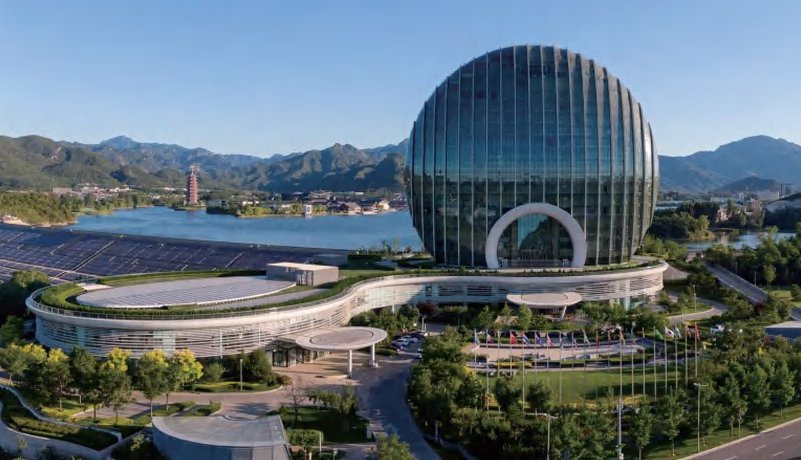
’SOLETKS“ APEC Summit hotel is published as a 50 t/day commercial hot-water reference with 150,000 kWh annual energy saving a 74 tonnes CO₂ reduction. A project at that scale needs commissioning records tied to load, sensors, backup heat, and service baseline — NOT only delivery photos.[3]
9. SOLETKS Multi-Project Commissioning Reference
| Projekt | Rok | Stupnica | Commissioning highlights |
|---|---|---|---|
| APEC Summit hotel (Beijing) | 2014 | 50 t/day | 35% PG indirect glycol, brazed plate HX, year-2 control re-tuning recovered solar fraction from ~28% → ~42% |
| Saga County (Tibet) | 2019 | 107 000 m² | Multi-zone distributed pumping, 50% PG with altitude derate, 1.8 bar cold-fill |
| Harz church (Germany) | 2021 | 22 t/day | 40% PG, gasketed plate HX (upgraded from brazed after 18-month hard-water test) |
| Florida resort villas (USA) | 2022 | 200 L/villa | Pressurized SUS316L tanks, coastal corrosion-resistant mounting |
| Tianjin school TPV Pro+ | 2024 | 3 000 m² | Hybrid heat + electricity, PVT + heat pump coupled |
Each commissioning campaign tailored to climate, scale, and application — same SOLETKS 6-step quality workflow throughout.
10. First-Year Lifecycle and TCO Matrix
Commissioning records lower lifecycle cost because the maintenance team can compare the future system against a measured baseline.
| Asset / record | First check | Ongoing interval | Vplyv celkových prevádzkových nákladov (TCO) |
|---|---|---|---|
| Pressure + expansion record | 1 month[2] | 12 mesiacov[2] | Finds pressure drift before relief loss |
| Pipe insulation photo check | 1 month[2] | 6 mesiacov[2] | Reduces roof heat loss + water ingress |
| Pump noise, flow, seal check | 3 months[2] | 12 mesiacov[2] | Prevents low-flow energy loss |
| Heat-transfer fluid sample | 6 mesiacov | 12 mesiacov | Controls freeze + corrosion |
| Sensor comparison | 3 months | 6 mesiacov | Prevents false pump starts |
| Backup heater runtime log | 30-day trend | 6 months review | Shows whether backup steals solar value |
Keep the commissioning file with owner + installer + service provider. Include: pressure test results, sensor map, controller settings, pump data, relief valve settings, expansion vessel pre-charge, backup sequence, photos, as-built drawings, and the first-year service schedule.
11. Normy a dokumentácia
| Norma / certifikát | V akých prípadoch sa uplatňuje | Commissioning rule |
|---|---|---|
| ISO 9806:2017 | Solar collector test basis | Collector performance evidence.[4] |
| Solar Keymark | Európska certifikácia solárnych tepelných systémov | EU tender requirement.[5] |
| UL 508A | Priemyselné ovládacie panely | UL-market scope.[6] |
| ASME BPVC | Pressure vessels + boilers | Tank/pressure rules.[7] |
| NSF/ANSI 61 | Kontakt s pitnou vodou | Drinking-water approval.[8] |
| ISO 9001 | Supplier quality | Factory-process evidence.[9] |
12. Údaje pre žiadosť o cenovú ponuku pre SOLETKS
Send your project data through the Kontaktná stránka SOLETKS and ask for commissioning documents with the quotation.
Projekt
- Building type, project city, operating season
- Daily hot-water demand + target temperature
System scope
- Collector type, quantity, tilt, orientation, roof plan
- Storage tank volume, heat exchanger, pump station details
- Existing backup heater + control interface
Commissioning requirements
- Required pressure test method, fluid type, freeze design temperature
- Standards required (ISO 9806, Solar Keymark, ASME, NSF/ANSI 61)
Documents needed
- Hydraulic schematic, wiring diagram, as-built drawing, controller settings
- Commissioning form template + maintenance plan
13. Commissioning Checklist (Field-Use Compact Version)
| Položka | Povinný záznam |
|---|---|
| Tlak | Fill pressure + operating pressure + relief valve setting |
| Prúd | Flow meter value OR ΔT calculation |
| Temperature | Collector supply/return + tank top/middle/bottom + delivery |
| Sensors | Label, location, controller channel |
| Controls | Pump start/stop, high-limit, freeze mode, backup enable |
| Bezpečnosť | Expansion vessel, relief discharge, mixing valve, disconnect |
| Glycol | Type, concentration, freeze point, pH (if closed-loop) |
| Izolácia | Photos of all roof piping, plant-room piping, tank |
| Dokumentácia | Photos, as-built drawings, manuals, warranties, service dates |
| First-year plan | Day 30 + Day 90 + Month 6 + Month 12 service dates |
FAQ
What is commercial solar thermal commissioning?
Commercial solar thermal commissioning is the measured handover process after installation. It verifies pressure, flow, temperature, sensors, controls, safety devices, backup heat, insulation, and documentation. The goal is to prove the installed system matches the design basis AND establishes a baseline for future maintenance.
What is the difference between commissioning and acceptance test?
Commissioning verifies the system runs correctly (all subsystems work, controls operate, safety functions). Acceptance test is the formal performance verification against the contract — typically after commissioning is complete. Handover is the final transfer to the owner. Don’t confuse the three.
How long should commissioning take?
A proper commissioning campaign spans 3 months: Day 0 first operation → Day 1–7 stable watch → Day 30 first service → Day 90 first seasonal review. Skipping Day-30 and Day-90 follow-ups is the #1 cause of poor first-year solar fraction. Most installation defects surface in the first 90 days.
What records should be kept after commissioning?
Keep: pressure test results, flow readings or ΔT calculation, sensor map, pump settings, controller setpoints, relief valve rating, expansion vessel pre-charge, backup-heater sequence, photos, manuals, warranties, and as-built drawings. These support first 1-month + 6-month + 12-month service checks.
Why does backup heater sequence matter?
Backup sequence matters because a boiler, heat pump, or electric heater can reduce solar yield if it heats the storage tank too early. The system should use solar preheat first, then backup heat for final temperature or low-sun periods. This protects reliability without hiding poor solar performance. At APEC Summit hotel, control-logic tuning alone recovered solar fraction from ~28% → ~42% in one quarter.
What are the most common commissioning failures?
TOP 5: (1) Reversed temperature sensors, (2) Air trapped in collector loop, (3) Backup heater “shadowing” solar (most common), (4) Expansion vessel pre-charge mismatch, (5) Incomplete UV jacket on horizontal pipe. All five are catchable in the Day-7 + Day-30 + Day-90 checks.
What flow rate or ΔT is acceptable at commissioning?
For a typical commercial solar thermal loop, measured collector ΔT should be 8–15 °C at design solar conditions. Below 5 °C → flow too high (check pump speed, verify glycol viscosity). Above 20 °C → flow too low (check air, strainer, valve positions). Always record measured flow + ΔT together with sensor locations + weather conditions.
What data is needed for a commissioning document quote?
Building type, city, daily hot-water demand, target temperature, collector type, storage volume, pump station details, backup heater, freeze design temperature, pressure test method, required standards, and drawing scope. These inputs define the commissioning form, sensor list, and handover record.
Zdroje
[1] SOLETKS, Komerčný / priemyselný solárny systém na ohrev vody a Zabezpečenie Kvality.
[2] SOLETKS commissioning screening note: flow, temperature-rise, sensor count, service intervals, and acceptance thresholds are preliminary commissioning rules; final values should follow project design, component manuals, fluid supplier limits, and local code.
[3] SOLETKS APEC Summit hotel hot-water reference: 50 t/day, ~150,000 kWh annual energy saving, ~74 tonnes CO₂ reduction.
[4] ISO, ISO 9806:2017 Solárna energia – Solárne tepelné kolektory – Skúšobné metódy.
[5] Solar Keymark, Systém certifikácie solárnych tepelných zariadení.
[6] UL Solutions, Industrial Control Panels – UL 508A.
[7] ASME, Predpisy pre kotly a tlakové nádoby.
[8] NSF, Standards for water treatment systems including NSF/ANSI 61 context.
[9] ISO, ISO 9001:2015 Systémy riadenia kvality.
Last reviewed: 2026-08-27 by SOLETKS Engineering Team. Next scheduled review: 2027-08-27. Project data referenced: APEC Summit hotel (Beijing, 2014, 50 t/day, 12+ years operation), Harz church (Germany, 2021, 22 t/day), Saga County (Tibet, 2019, 107,000 m²), Florida resort villas (USA, 2022), Tianjin school TPV Pro+ (2024).
Potrebujete technické posúdenie konkrétneho projektu?
Zašlite spoločnosti SOLETKS údaje o klimatických podmienkach v danom objekte, dennú záťaž, obmedzenia týkajúce sa strechy alebo technických miestností, rozsah dodávky a požadované požiadavky na dokumentáciu, aby vám technický tím mohol poskytnúť praktické komerčné odporúčanie.
Kontakt SOLETKS